
Home Federal Bancorp: Lending Mix, Regional Dynamics, and the Levers for Community Bank Value Creation
A focused Louisiana bank with a diversified loan book, Home Federal Bancorp’s future hinges on its ability to manage interest rate risk, navigate local competition, and leverage its community roots amid leadership transition.
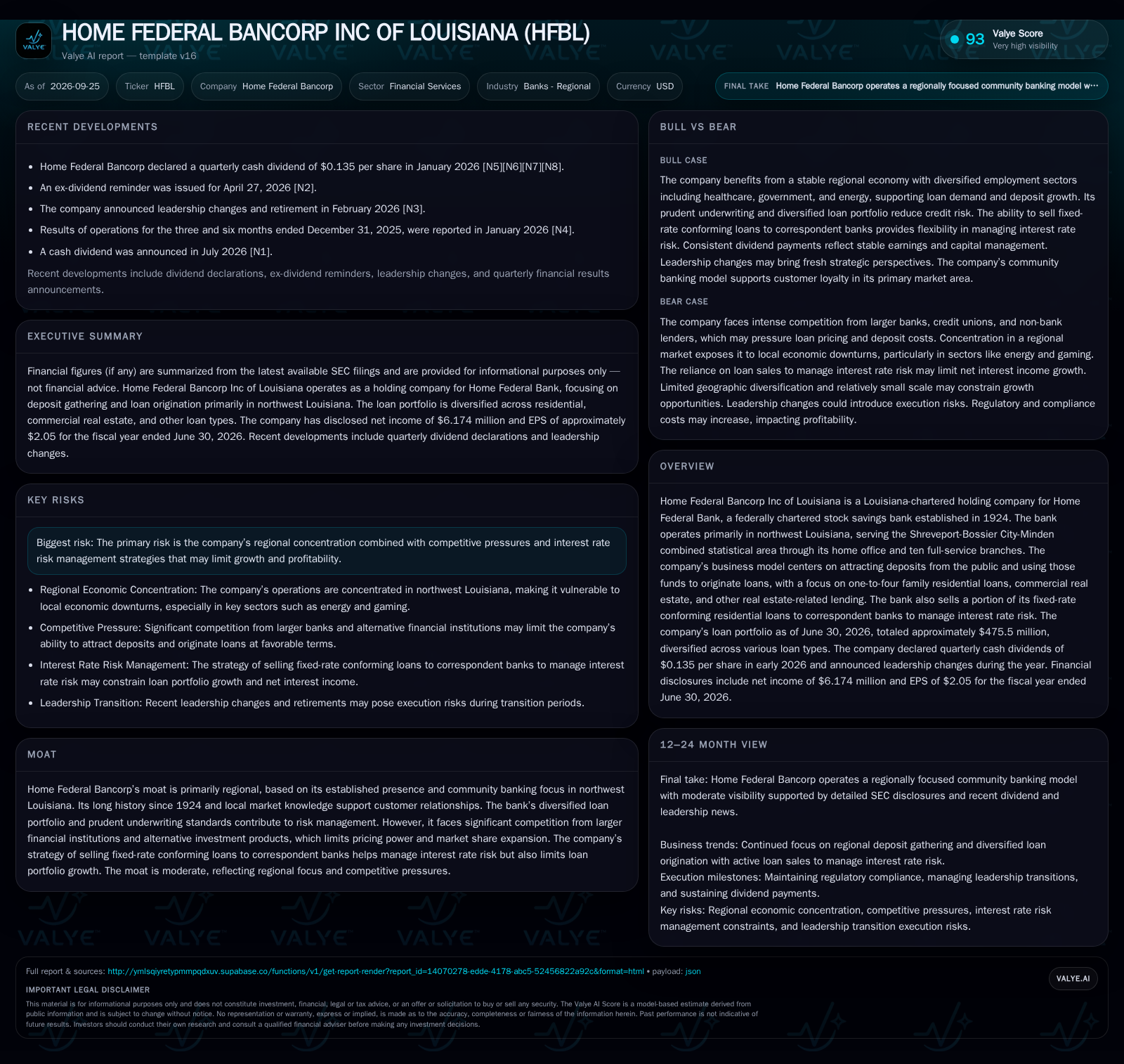
Home Federal Bancorp Inc of Louisiana operates as a regional community bank with a $475.5 million net loan portfolio, heavily weighted toward real estate lending. Recent financials show solid profitability and consistent dividends, but the company faces challenges from regional economic concentration, intense competition, and the need to actively manage interest rate risk via loan sales. Leadership changes in 2026 introduce execution questions as the bank’s performance will depend on its ability to sustain core lending economics and adapt to shifting market dynamics [S1] [N1] [N3].
Home Federal Bancorp Inc of Louisiana exemplifies the strengths and constraints of a traditional community banking model in a dynamic regional market. With a substantial portion of its balance sheet dedicated to real estate lending and a disciplined approach to interest rate risk via loan sales, the bank has maintained profitability and steady dividends. However, its fortunes remain closely tied to northwest Louisiana’s economic health, and 2026’s leadership changes bring fresh uncertainty. The interplay between asset mix, risk management, and local competition will define whether Home Federal can sustain its current trajectory or faces margin and growth headwinds.
Material Developments: Loan Portfolio, Profitability, and Management Changes
As of June 30, 2026, Home Federal Bancorp reported a net loan portfolio of $475.5 million, representing nearly 74% of total assets. The composition of this portfolio is weighted toward one-to-four family residential (34.18%) and commercial real estate loans (29.34%), with the remainder in multi-family, land, construction, and non-real estate loans [S1]. This concentration underscores the bank’s exposure to local real estate cycles.
The company delivered net income of $6.174 million and basic earnings per share of $2.05 for the fiscal year, supporting the continuation of quarterly cash dividends at $0.135 per share through 2026 [S1] [N1] [N5] [N6] [N7] [N8].
A notable operational development was the announcement of leadership changes and retirement in early 2026, introducing potential execution risk as new management steers the institution through competitive and regulatory challenges [N3].
The bank continues to actively sell fixed-rate conforming residential mortgages to correspondent banks, a strategic lever for managing interest rate risk but one that also limits retained portfolio growth [S1].
Community Banking Model: Economics, Leverage, and Interest Rate Management
Home Federal’s core economic engine is the spread between the interest earned on originated loans and the cost of deposits. The bank’s reliance on deposit funding provides a relatively low-cost, stable funding base characteristic of community banks. However, this also means that deposit pricing is highly sensitive to local competition and broader rate environments.
A significant proportion of assets are deployed in real estate-secured lending, which can provide steady income during periods of local economic strength but exposes the bank to asset quality risk if property markets weaken. The sale of $30 million in residential mortgages during fiscal 2026 illustrates a strategy to offload interest rate risk, helping mitigate duration mismatches in a rising rate environment [S1].
Operating leverage in this model is limited by the need for conservative underwriting and regulatory capital requirements. The bank’s ability to scale is constrained by its geographic focus and local deposit base, making cost control and asset quality management central to maintaining profitability. Fee income from loan sales and other banking services may supplement, but not replace, net interest income as the main profit driver.
Capital needs are generally moderate; the company’s dividend payments and steady profitability suggest a balance between returning capital to shareholders and retaining sufficient capital for growth and regulatory compliance [S1] [N1] [N5] [N6] [N7] [N8].
Regional Advantage vs. Scale-Driven Competition
Home Federal’s competitive positioning is anchored in local market knowledge, longstanding relationships, and community banking reputation in northwest Louisiana. These factors can support customer loyalty and deposit retention, especially among retail and small business clients.
However, the bank faces intense competition from national and large regional banks, credit unions, and non-bank lenders, all of which can offer more diversified products, digital convenience, and often better pricing due to scale. The ability of larger competitors to invest in technology and marketing poses a persistent threat to customer acquisition and retention.
Alternative financial products and fintech entrants may further erode traditional banking margins, particularly if customer preferences shift toward digital-first solutions or if rate competition intensifies for both loans and deposits.
While Home Federal’s regional brand and underwriting discipline may limit credit losses compared to some peers, its moderate scale and limited geographic footprint cap its pricing power and market share expansion potential.
How Prudent Risk Management and Local Ties Could Drive Outperformance
The bullish scenario is built on the bank’s ability to sustain prudent underwriting, maintain asset quality, and leverage its community presence to capture a stable share of deposits and loan demand—even as larger competitors intensify their efforts. If the northwest Louisiana economy remains resilient, particularly in key sectors like healthcare, energy, and government, credit costs could stay low and loan demand steady.
Effective execution of the loan sales strategy—offloading fixed-rate mortgages in a timely manner—could insulate the bank from margin compression in volatile rate environments. This would allow Home Federal to optimize its interest rate spread without sacrificing volume.
If new leadership capitalizes on operational efficiencies, digital customer engagement (even at a modest scale), or targeted commercial lending opportunities, the bank could see incremental growth in both fee and net interest income.
Likely Trajectory: Margin Stability Amid Competitive and Economic Crosswinds
The most plausible outcome is that Home Federal maintains steady performance but with limited growth.
Loan growth will likely track local economic expansion, with periodic sales of conforming mortgages to manage risk. Net interest margin may be pressured if deposit costs rise faster than loan yields, especially if larger competitors aggressively pursue market share or if digital-only entrants gain traction.
Leadership transition could slow strategic initiatives in the near term but is unlikely to disrupt core operations unless there is a significant shift in risk appetite or cost structure.
Evidence of this base scenario would include stable earnings, consistent dividend declarations, and modest loan and deposit growth in line with local economic conditions.
Where Concentration and Competition Could Squeeze Returns
A negative scenario would unfold if the regional economy weakens, particularly in sectors like energy or gaming that have outsized local influence. A resulting spike in loan delinquencies, especially in the real estate portfolio, could drive up credit costs and erode net income.
If larger banks or fintech lenders further escalate competition for deposits, Home Federal may be forced to raise rates on deposits or accept lower yields on new loans, squeezing the net interest margin. A failure to effectively execute loan sales could leave the bank overexposed to interest rate risk.
Leadership missteps during the transition—such as delayed responses to market changes, operational errors, or a loss of key customer relationships—could exacerbate these pressures.
Confirmation of this downside would include rising non-performing assets (if disclosed), shrinking net interest margin, reduced profitability, or a cut in the dividend.
Milestones That Will Define the Value Trajectory for Home Federal Bancorp
Trends in the net interest margin: Sustained margin compression or expansion will be a key indicator of competitive and rate environment dynamics.
Loan portfolio asset quality: Disclosure of non-performing loan ratios or charge-offs, if provided, would offer insight into credit risk management effectiveness.
Deposit growth and mix: The rate and cost of deposit inflows versus outflows, especially against larger or digital-first competitors, will signal competitive positioning.
Volume and terms of loan sales: The frequency and profitability of mortgage sales to correspondent banks will show how effectively interest rate risk is being managed.
Leadership retention and new strategic initiatives: Updates on the integration of new management and any shifts in business strategy would help gauge execution risk.
Regional economic health: Local employment, real estate values, and sectoral performance in northwest Louisiana will remain external indicators of loan demand and credit quality.
Cost control and efficiency: Changes in the expense base or efficiency ratio, if disclosed, would reveal the bank’s ability to manage operating leverage.
Disclaimer: This is research-only, informational analysis and not investment advice. It may include AI-generated interpretation and general industry context. Always verify important details using primary sources.

Comments