
CID Holdco: Advanced Asset Tracking Ambitions Confront Financial and Market Structure Hurdles
CID Holdco has built a differentiated asset tracking SaaS platform utilizing RFID and AI-driven edge cameras.
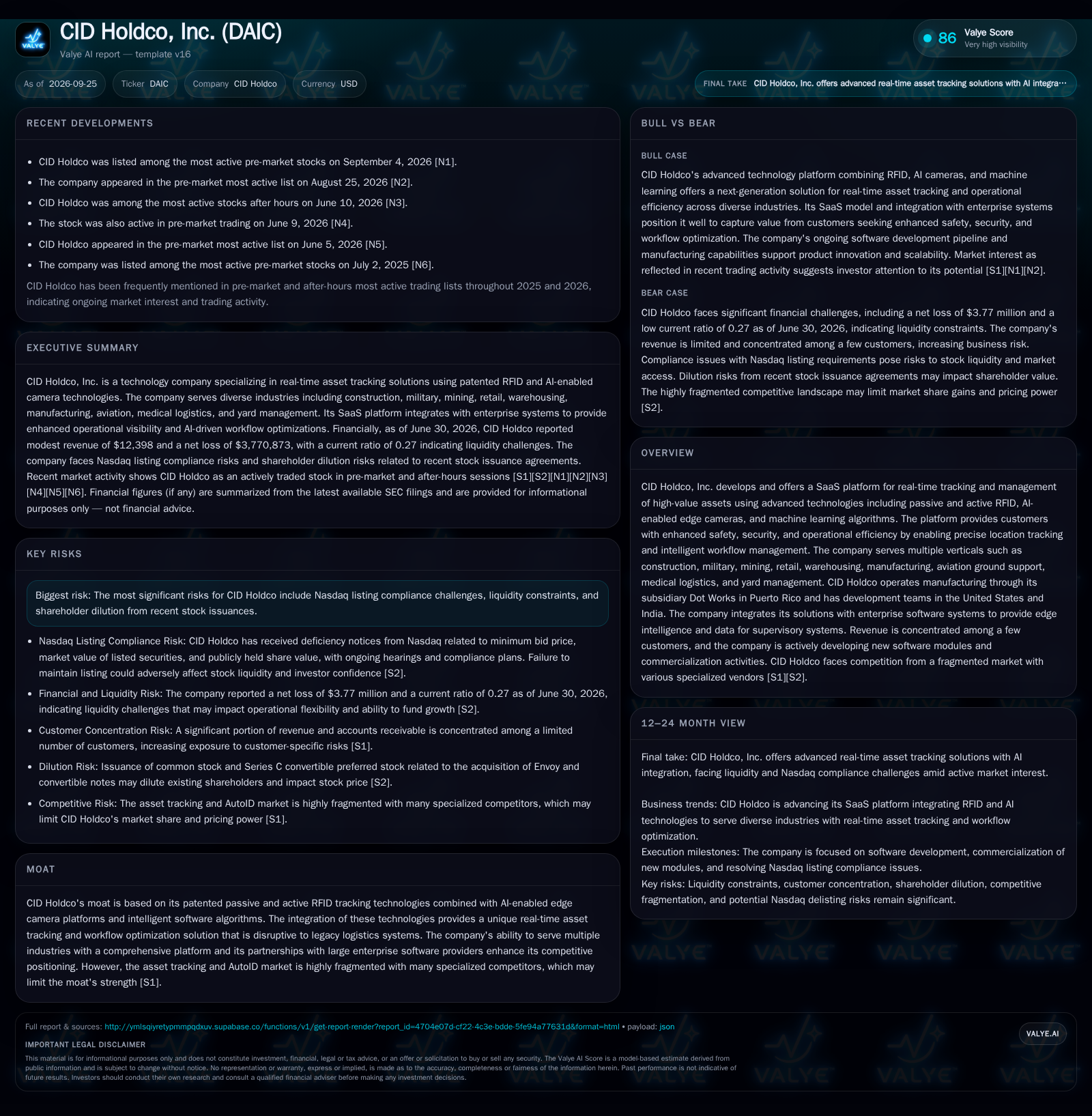
CID Holdco has built a differentiated asset tracking SaaS platform utilizing RFID and AI-driven edge cameras. Despite technical breadth and multi-vertical reach, the company’s commercial scale remains limited, with modest revenue, a net loss of $3.8 million, and a current ratio of just 0.27 as of June 2026. Revenue concentration, imminent dilution from pending acquisitions, and Nasdaq compliance issues create a complex risk profile. The core question is whether CID Holdco can translate its technology into broader commercial traction before financial constraints or market structure erode its positioning. [S1] [S2]
CID Holdco, Inc. stands at the confluence of advanced asset tracking technology and intense financial and market headwinds. Its SaaS platform—melding patented RFID, edge AI cameras, and enterprise software integration—targets operational pain points across construction, military, logistics, and more. The company faces a fragmented competitive landscape, Nasdaq compliance uncertainty, and heavy customer concentration, all of which pressure its ability to scale and sustain innovation. The investment case hinges on CID Holdco’s capacity to convert technical edge into durable, diversified revenue before financial or market forces undermine its prospects. [S1] [S2]
Recent Financials, Customer Concentration, and Compliance Threats Reshape the Outlook
As of June 30, 2026, CID Holdco reported just $12,398 in revenue and a net loss of $3,770,873, with basic and diluted EPS of -$2.68. The company’s current assets totaled $3.58 million against current liabilities of $13.05 million, resulting in a current ratio of 0.27 and a cash ratio of zero. These figures indicate severe liquidity constraints and a limited margin for operational missteps. [S2]
Revenue is concentrated among a small number of customers, with one customer accounting for a significant portion of total revenue. This concentration creates sensitivity to contract renegotiation, churn, or execution risk with a single counterparty. [S1]
CID Holdco has received Nasdaq deficiency notices for minimum bid price, market value of listed securities, and publicly held share value, threatening its public listing unless compliance is restored. [S2]
A pending acquisition of Envoy, structured via common and Series C convertible preferred stock issuance, introduces the prospect of shareholder dilution if completed. [S2]
How the Platform Could Scale: SaaS, Hardware, and Integration-Driven Economics
CID Holdco’s business model is built around a SaaS platform that leverages patented passive and active RFID, low-power AI edge cameras, and proprietary software to deliver real-time asset tracking and workflow intelligence. Theoretically, this model should support high gross margins on software subscriptions, especially if recurring revenue can be built across multiple verticals.
The commercial stack likely blends hardware sales (RFID tags, edge devices), SaaS subscriptions, and integration services. Hardware may be a necessary enabler rather than a margin driver, with software subscriptions and data analytics as the potential source of operating leverage. However, the limited reported revenue suggests either early-stage deployment, long sales cycles, or pricing pressures.
The company’s cost structure is dominated by human resources and infrastructure for ongoing software development and commercialization. This creates high fixed costs, which could yield significant operating leverage if customer adoption accelerates, but also exposes CID Holdco to steep losses if revenue fails to scale. [S1]
Capital needs are non-trivial: ongoing R&D, manufacturing (via Dot Works in Puerto Rico), and customer support all require investment. [S2]
Fragmented Market Structure and the Challenge of Building Defensible Differentiation
CID Holdco operates in a highly fragmented asset tracking and AutoID market, with competition from both hardware-centric vendors and software-focused platforms targeting specific verticals. Common competitors include barcode/RFID solution providers, IoT device makers, and SaaS workflow vendors.
The company’s moat is premised on the integration of patented RFID, AI-enabled edge cameras, and enterprise software APIs. If this integration delivers superior real-time precision, automation, and actionable analytics, it could create switching frictions for customers and a degree of pricing power—especially in regulated or mission-critical environments.
However, the lack of visible commercial scale and the ease with which large enterprise customers can trial alternative solutions or dual-source technologies may limit CID Holdco’s ability to build network effects or lock-in. The diversity of served industries (from construction to medical logistics) is a double-edged sword: it expands TAM but dilutes go-to-market focus and can slow adoption.
Customer concentration further erodes bargaining leverage and magnifies the risk from any customer defection or contract downsizing. Without clear evidence of multi-year contracts, high renewal rates, or ecosystem effects, defensibility remains more potential than proven. [S1]
From Technical Edge to Commercial Traction: What Would Signal a Turnaround
The bullish scenario requires CID Holdco to convert its technical stack into broader commercial adoption across multiple industries. Success would likely be driven by landing additional large enterprise customers, expanding use cases within existing accounts, and demonstrating that the platform delivers measurable ROI (e.g., loss reduction, safety improvements, workflow automation).
Proof points would include a sharp uptick in subscription revenue, customer diversification (with no single customer accounting for a dominant share of sales), and evidence of multi-year or recurring contracts. Operating leverage would become visible if gross margin expands and net losses begin to narrow despite ongoing R&D investment.
Restoration of Nasdaq compliance and the completion of the Envoy acquisition on accretive terms (with minimal disruptive dilution) could further bolster confidence. Market signals would include increased SaaS ARR, new vertical wins, and positive customer references. Falsification could occur if revenue remains stagnant, customer churn rises, or if technical differentiation is not reflected in commercial wins.
Incremental Progress Amid Headwinds: Most Likely Outcomes Absent a Step-Change
The most plausible scenario is one of incremental progress, with CID Holdco continuing to invest in software development and vertical-specific modules while seeking to stabilize liquidity through cost control or small-scale financing. Revenue may grow modestly but remain concentrated, with high dependency on a handful of customers.
Nasdaq listing status remains at risk, and the company could either retain its listing via technical compliance or transition to an over-the-counter market. The Envoy acquisition may close but is unlikely to immediately transform the revenue base.
Commercial momentum is constrained by limited go-to-market resources, long enterprise sales cycles, and competitive pricing pressure. Gross margin may improve modestly if SaaS adoption grows, but ongoing net losses are likely unless a major customer ramps up or a breakthrough vertical win is achieved.
Confirmation would come from steady but slow revenue growth, stable customer retention, and gradual improvement in operating metrics. Falsification would be evident in further revenue declines, loss of key customers, or failure to address liquidity concerns.
Liquidity Shock, Customer Loss, and Listing Failure: Bearish Chain of Events
The adverse scenario centers on the compounding effects of liquidity exhaustion, loss of key customers, and inability to restore Nasdaq compliance. With a current ratio of just 0.27 and zero cash ratio, any delay in receivables or unexpected expense could trigger a cash crunch. [S2]
If the primary revenue-contributing customer reduces business or defects, the company’s already modest sales could collapse, precipitating further layoffs, R&D cuts, or asset sales. Shareholder dilution from the Envoy acquisition or emergency financing may further depress the stock, especially if delisting occurs.
Competitively, larger or better-funded rivals may undercut pricing or out-innovate CID Holdco, eroding any remaining technical edge. The company could be forced into a distressed sale, restructuring, or even bankruptcy if alternative capital is unavailable.
This scenario would be confirmed by falling revenue, loss of the largest customer, Nasdaq delisting, additional headcount reductions, or going-concern warnings in future filings.
Milestones That Will Determine Whether CID Holdco’s Platform Can Survive and Scale
Quarterly revenue growth and diversification: A useful metric would be revenue by customer cohort and vertical, to assess whether commercial adoption is broadening or still concentrated. [S1] [S2]
Gross margin evolution: If disclosed, gross margin trends would clarify whether SaaS and software are scaling relative to hardware and services.
Nasdaq compliance status: Updates on bid price, market value, and share distribution will directly affect stock liquidity and potential investor base. [S2]
Customer churn or renewal rates: Disclosure of renewal rates or lost business would test assumptions about stickiness and switching costs.
Progress on the Envoy acquisition: Transaction closing, integration progress, and impact on dilution or the revenue base will be critical to monitor. [S2]
New SaaS module launches and customer adoption: Announcements of new product capabilities and initial customer uptake would indicate innovation velocity.
Headcount trends by function: Changes in R&D, sales, or customer success staffing could reveal shifts in strategic focus or cost containment.
Disclaimer: This is research-only, informational analysis and not investment advice. It may include AI-generated interpretation and general industry context. Always verify important details using primary sources.

Comments