
Critical Metals Corp.: Supply Chain Integration, Strategic Partnerships, and the Capital Challenge in Rare Earths
Critical Metals Corp. is pursuing a bold rare earth supply chain strategy, combining its Greenland Tanbreez asset with a major Saudi processing JV and the pending acquisition of European Lithium. While resource and partnership developments point to significant long-term potential, current financial metrics highlight the urgency of execution and capital management in a sector defined by geopolitical complexity and capital intensity.
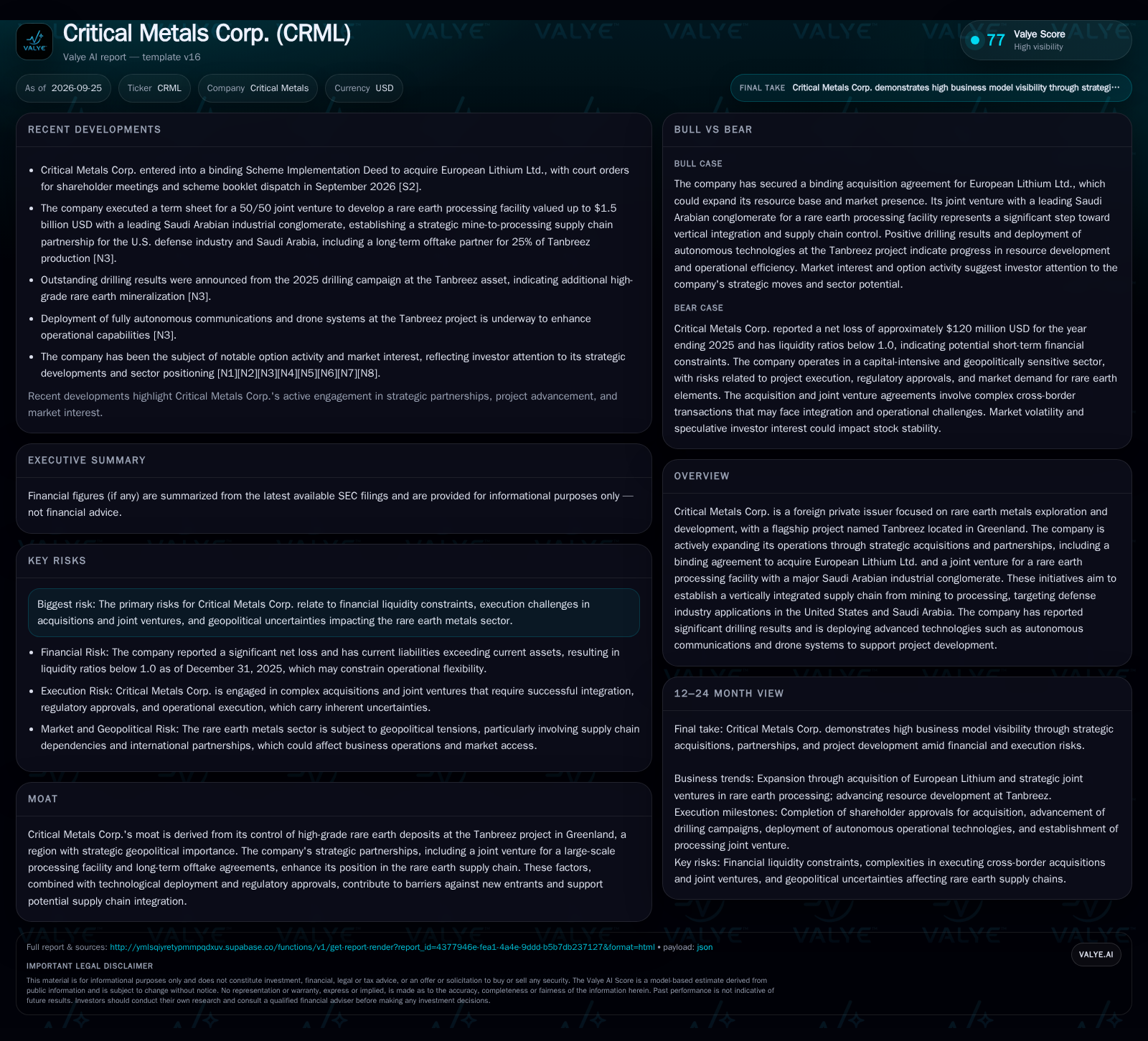
Critical Metals Corp. is executing a high-ambition strategy in rare earths: acquiring European Lithium, forming a $1.5B Saudi JV for processing, and advancing its Greenland Tanbreez project. The ultimate success will hinge on project execution, partner alignment, and navigating sector volatility. [S1] [S2] [N3]
Critical Metals Corp. stands at a crossroads familiar to ambitious resource developers: it has amassed high-potential assets and secured headline-grabbing partnerships, most notably its Greenland Tanbreez project, a processing JV with a Saudi conglomerate, and the pending acquisition of European Lithium. These moves aim to position the company as a vertically integrated rare earths supplier for the U.S. defense sector and the Kingdom of Saudi Arabia. Yet, its current financials reveal a company in urgent need of capital and flawless execution. The next phase will test the company's ability to turn strategic intent into operational cash flow, while navigating the capital intensity and geopolitical headwinds endemic to the rare earths industry.
Strategic Partnerships and Financial Strain Define the Current Moment
Critical Metals Corp. is in the midst of transformative transactions: it has entered a binding agreement to acquire European Lithium Ltd., which, if completed, will expand its resource base and European market access. Simultaneously, the company has executed a term sheet for a 50/50 joint venture with a major Saudi Arabian industrial conglomerate to develop a rare earth processing facility valued up to $1.5 billion USD. This JV includes a long-term offtake agreement covering 25% of Tanbreez production, creating a direct link to both the U.S. defense supply chain and Saudi industrial demand. [S2] [N3]
Operational progress is evident, with recent drilling campaigns at Tanbreez yielding high-grade results and the deployment of autonomous communications and drone systems aimed at boosting efficiency. However, the company ended 2025 with cash and equivalents of $80.9 million USD versus current liabilities of $108.4 million USD, and a net loss of $120.4 million USD for the year. The company reported cash and liquidity metrics for the period; these figures do not by themselves establish operating runway, investment capacity, financial flexibility, or financing capacity. [S1]
How the Rare Earths Model Could Generate Value—And Where the Leverage Lies
The rare earths business model is capital intensive and hinges on the successful transition from exploration to development, then to processing and commercialization. For Critical Metals, revenue as of 2024 was negligible ($360,000 USD), reflecting a pre-production stage where expenditures far outpace sales. [S1] The economics will shift dramatically if the company can bring Tanbreez into production and realize processing margins through its Saudi JV.
Key revenue drivers will include the volume and grade of rare earth concentrate produced, processing yields, and the pricing environment for rare earth elements—commodities subject to severe price swings and geopolitical supply/demand shocks. The long-term offtake for 25% of Tanbreez output provides a baseline of demand and some revenue visibility, but the majority of future economics will depend on efficient ramp-up, operational cost control, and the ability to secure additional offtake or spot-market sales.
Operating leverage could be significant given the fixed cost of mine development and processing infrastructure, but only if throughput ramps as planned. Conversely, delays or production shortfalls could exacerbate cash burn, particularly with the company’s current liabilities already exceeding liquid assets. The capital needs for mine development, processing plant construction, and technology deployment are substantial, underscoring the importance of external financing, JV partner funding contributions, and access to credit or equity markets.
Can Critical Metals Build a Defensible Position in a Geopolitically Charged Sector?
Critical Metals aims to carve out a strategic niche by combining high-grade Greenlandic resources, European expansion via the European Lithium acquisition, and a processing partnership with a major Saudi conglomerate. This configuration is designed to reduce dependence on Chinese supply chains, a growing priority for both the U.S. and Saudi defense and industrial policy.
In the rare earths sector, competitive advantage often stems from resource quality (grade and scale), security of tenure, proximity to end-markets, and the ability to process concentrates into high-purity products. The Tanbreez asset, if fully developed, could offer scale and grade advantages, while the Saudi JV could unlock access to downstream processing expertise and capital. The long-term offtake agreement also provides a rare degree of demand certainty.
However, the company faces competition from established rare earth producers, integrated mining/processing groups, and new entrants backed by state or strategic capital. The success of Critical Metals’ strategy will depend on timely project execution, sustained partner alignment, and the ability to navigate shifting regulatory and geopolitical priorities. Substitution risk for rare earths is low in many defense and high-tech applications, but supply chain realignment can be slow and costly, making execution risk paramount.
If Integration and Execution Align, Critical Metals Could Become a Rare Earths Linchpin
The favorable scenario requires several links in the chain to hold: the European Lithium acquisition closes smoothly, resource development at Tanbreez continues to deliver high-grade results, and the Saudi JV transitions from term sheet to fully funded, operational facility. With these elements in place, Critical Metals could emerge as a preferred supplier for defense-related rare earth demand in both the U.S. and Saudi Arabia, benefiting from price premiums and long-term contracts.
Operational leverage would kick in as production scales, margins improve with processing integration, and autonomous technologies reduce unit costs. The company would be able to access further capital at favorable terms, reinvest in exploration, and potentially expand its processing footprint to serve broader industrial and energy-transition markets.
Confirmation of this upside would come from: (1) successful closing and integration of the European Lithium transaction; (2) full JV agreement execution and initial capital drawdown for the Saudi processing facility; (3) sustained high-grade drilling and resource upgrades at Tanbreez; (4) new offtake agreements or contract expansions; and (5) positive operating cash flow or a clear path to break-even.
Progress Amid Persistent Funding and Execution Risks
The most plausible medium-term scenario is one of incremental progress punctuated by funding and execution challenges. Critical Metals may advance the European Lithium acquisition and make headway on Tanbreez development, but construction of the Saudi JV facility could face delays due to permitting, partner alignment, or capital raising. The company may need to raise additional equity or debt, potentially diluting existing shareholders or increasing financial risk.
Resource quality and operational technology could continue to improve efficiency, but with current liabilities exceeding liquid assets, any hiccup in project timelines or cost overruns could stress the company’s balance sheet. The rare earths market is likely to remain volatile, with pricing and offtake terms subject to swings in global demand, policy changes, and competitive project ramp-ups elsewhere.
Evidence for the base scenario would include: (1) steady but incomplete progress on acquisitions and JV milestones; (2) periodic capital raises to shore up liquidity; (3) incremental resource upgrades; and (4) continued net losses as the company transitions toward production.
Cash Crunch or Project Delays Could Derail the Supply Chain Ambition
In a negative scenario, Critical Metals is unable to close the European Lithium acquisition or finalize the Saudi JV on favorable terms. Delays in permitting, funding, or construction at Tanbreez or the Saudi facility could lead to extended cash burn, forcing the company into distressed financing or asset sales.
Sector-wide shocks—such as a collapse in rare earth prices, adverse regulatory changes, or geopolitical events disrupting Greenlandic or Saudi operations—could further erode the company’s ability to execute its strategy. In this scenario, Critical Metals risks becoming a stranded asset holder or an acquisition target for better-capitalized competitors.
Developments That Will Determine Whether Critical Metals Delivers on Its Rare Earths Vision
Completion and integration of the European Lithium Ltd. acquisition, including court and shareholder approvals and any disclosed closing adjustments.
Finalization, funding, and construction milestones for the 50/50 Saudi processing joint venture, including partner capital commitments and regulatory approvals.
Updates on offtake agreements beyond the initial 25% of Tanbreez production—expansion or diversification of customer base would help test demand resilience.
Drilling campaign results at Tanbreez, including resource upgrades, grade continuity, and independent verification of reserves.
Deployment and operational impact of autonomous communications and drone systems at Tanbreez—metrics on efficiency gains or cost reductions, if disclosed.
Progress toward first production and revenue recognition from Tanbreez or the Saudi JV facility—timing and scale of initial cash flows would be particularly informative.
Sector and geopolitical developments in rare earths that could affect supply chain access, export controls, or partner alignment in Greenland, Saudi Arabia, or target end markets.
Disclaimer: This is research-only, informational analysis and not investment advice. It may include AI-generated interpretation and general industry context. Always verify important details using primary sources.

Comments