
SR Bancorp: Regional Scale, Loan Mix, and the Frictions of Community Banking Growth
SR Bancorp’s post-merger branch footprint, balanced loan book, and capital return moves define its New Jersey strategy—but persistent margin pressures, regional concentration, and competition from large banks and fintechs test the durability of its model.
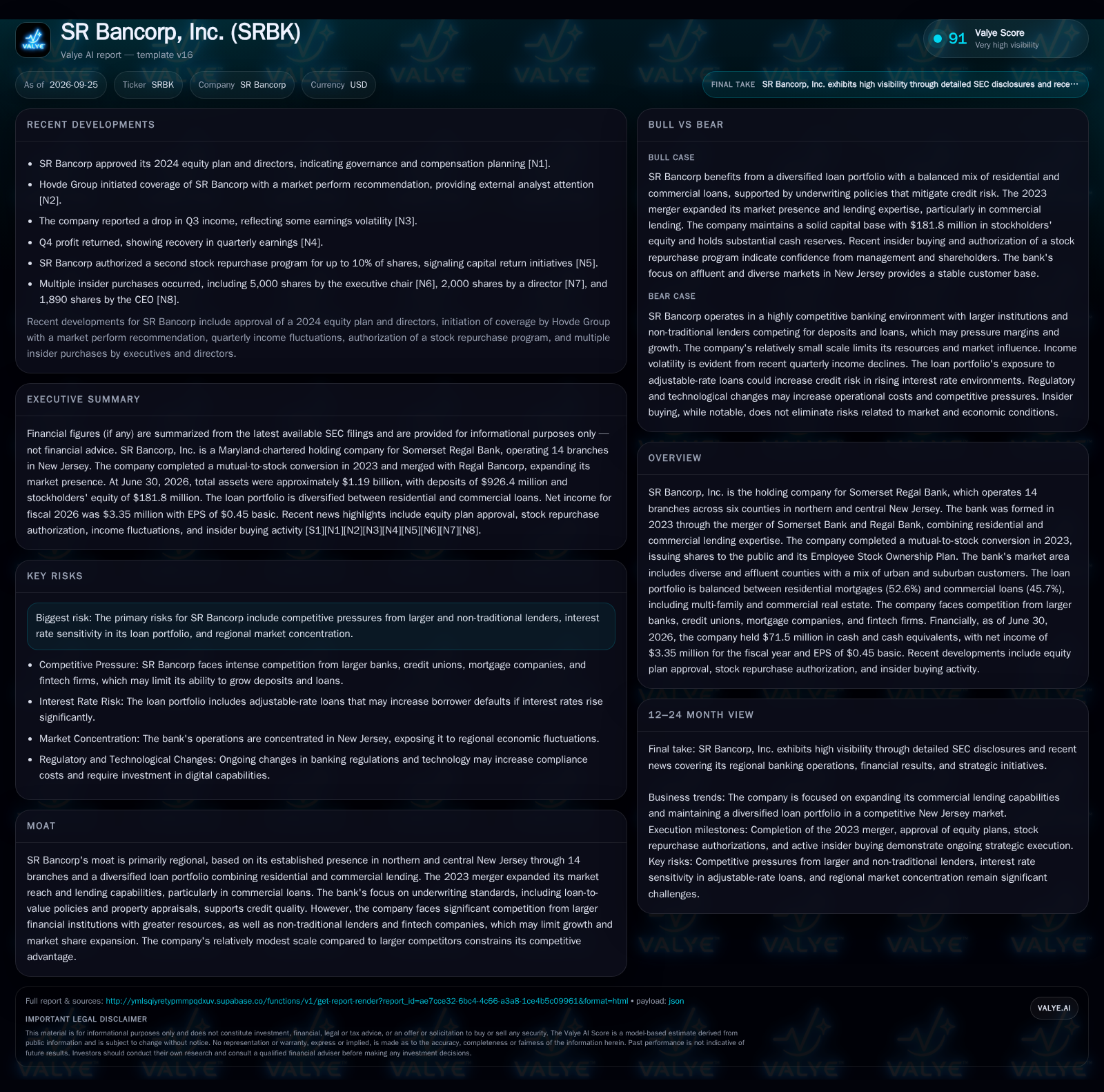
SR Bancorp, Inc. operates 14 branches in northern and central New Jersey following its 2023 merger, maintaining a loan portfolio split between residential mortgages and commercial credits. As of June 30, 2026, it reported $1.19 billion in assets and $3.35 million in annual net income. Recent insider buying and a new stock repurchase authorization highlight management’s capital allocation priorities. However, the bank’s modest scale, regional concentration, and exposure to competitive and interest-rate risks present ongoing challenges to sustainable earnings growth [S1] [N4] [N5] [N6] [N7] [N8].
SR Bancorp, Inc., the product of a 2023 merger between Somerset Bank and Regal Bank, is a $1.19 billion-asset community bank with 14 branches across diverse and affluent counties in northern and central New Jersey. With a loan book nearly evenly split between residential mortgages and commercial credits, the bank’s strategy hinges on leveraging local knowledge while adapting to intense competition from larger institutions and fintech disruptors. Recent capital return initiatives—including a new stock repurchase program and notable insider buying—underscore management’s confidence, but margin compression, regional concentration, and the frictions of scaling a sub-$2 billion community bank remain central to the investment debate.
Branch Scale, Loan Mix, and Recent Capital Return Moves
SR Bancorp’s present operating reality is shaped by three key facts. First, its total assets reached $1.19 billion at June 30, 2026, with a loan portfolio of $904.5 million split 52.6% into residential mortgages and 45.7% into commercial lending, reflecting a post-merger balance between traditional community banking and commercial expansion [S1]. Second, the company operates 14 branches across six New Jersey counties, anchoring its business in a regionally diverse but geographically concentrated market [S1]. Third, management and the board have signaled capital allocation priorities by authorizing a second stock repurchase program for up to 10% of shares and executing multiple insider purchases, including by the executive chair, CEO, and a director [N5] [N6] [N7] [N8]. These actions highlight both organizational confidence and a focus on shareholder returns, even as the bank’s net income for FY2026, at $3.35 million, reflects modest profitability amid recent income volatility [S1] [N3] [N4].
How Community Banks Like SR Bancorp Generate Earnings—and Where Pressure Mounts
SR Bancorp’s core economic engine is the spread between the interest it earns on loans (primarily residential mortgages and commercial credits) and the interest it pays on deposits—a classic net interest margin (NIM) model. With 52.6% of the loan book in residential mortgages and 45.7% in commercial credits (multi-family, commercial real estate, and C&I), the bank balances lower-yield, lower-risk housing loans against higher-yield, more cyclical commercial lending [S1]. The branch network is a fixed-cost base, and deposit gathering in affluent New Jersey communities may give SR Bancorp access to relatively stable, if expensive, funding.
Operating leverage in this model is modest: incremental loan growth can improve efficiency ratios, but technology investments, regulatory compliance, and the need to match rates from larger competitors keep costs elevated. Adjustable-rate commercial loans indexed to the five-year Treasury note provide some protection against rising rates but also expose borrowers—and thus the bank—to payment shocks in a volatile rate environment. Capital needs are moderate post-conversion, but the relatively small scale limits SR Bancorp’s ability to absorb credit losses or invest aggressively in digital transformation. Stock buybacks and insider purchases return capital to shareholders but could constrain balance-sheet flexibility if earnings remain volatile.
Competitive Frictions: Regional Strengths Versus Scale Disadvantages
SR Bancorp’s competitive position is grounded in local market knowledge, relationship banking, and a diversified loan book. The 2023 merger expanded its capabilities in commercial lending and gave it meaningful presence in a set of New Jersey counties with robust economic diversity—ranging from pharmaceutical and life sciences to logistics and financial services [S1]. These markets offer affluent customers and business borrowers, but are also heavily contested by larger regional and national banks, credit unions, and increasingly, digital-first fintech lenders.
Larger competitors can outspend SR Bancorp on technology, marketing, and product breadth, putting pressure on deposit rates and underwriting spreads. Fintechs and mortgage companies compete for both deposits and lending customers, often with lower overhead and faster digital onboarding. While SR Bancorp’s underwriting discipline (including PMI and appraisals for high-LTV loans) helps mitigate credit risk, its modest size constrains its bargaining power and limits its ability to offer differentiated products or absorb economic shocks. The regional moat is real, but not impregnable—especially if local economic conditions sour or customer expectations shift toward digital convenience.
Unlocking Value Through Commercial Lending Expansion and Franchise Deepening
A favorable scenario for SR Bancorp would see it leveraging its post-merger scale to deepen commercial relationships in its core counties, capturing share from less nimble competitors while maintaining credit quality. Success could hinge on the bank’s ability to cross-sell treasury, cash management, and digital services to local businesses, supporting higher fee income and more sticky deposits. If SR Bancorp can judiciously grow its commercial loan book—particularly in multi-family and commercial real estate—while avoiding credit pitfalls, net interest income could rise faster than expenses, driving operating leverage.
Confirmation of this scenario would come from sustained growth in commercial loan balances, rising non-interest income (if disclosed), improving efficiency ratios, and continued insider and board confidence reflected in further share repurchases or purchases. Evidence of stable or growing net income alongside modest credit losses would further validate the thesis.
Steady-State Banking in a Crowded, Competitive New Jersey Market
The most plausible outcome is that SR Bancorp maintains a modest growth trajectory, balancing incremental loan growth against ongoing competitive and margin pressures. Residential mortgage lending remains steady, while commercial credits grow in line with local economic development. Net interest margins may remain compressed as deposit costs rise and loan yields are pressured by competition from larger banks and fintechs. The bank continues capital return initiatives such as buybacks, but earnings volatility persists due to the cyclical nature of commercial lending and the region’s economic sensitivity.
This scenario would be confirmed by stable, albeit modest, annual net income, gradual growth in the loan book, and continued but not dramatic changes in the deposit base. Efficiency ratios remain relatively flat, and credit costs stay within historical norms. Falsification would come from sharp swings in net income, a spike in non-performing loans, or a material contraction in deposits or lending volumes.
Margin Compression and Regional Shocks Threaten Earnings and Franchise Value
A negative scenario would see SR Bancorp squeezed by rising funding costs as larger banks and digital challengers bid up deposit rates, while loan growth stalls amid heightened competition and a local economic downturn. The adjustable-rate component of the commercial loan book could lead to higher delinquencies if borrowers struggle with increased payments in a rising rate environment. If credit losses rise and NIM compresses further, profitability could erode, forcing the bank to slow buybacks and limit growth initiatives.
Evidence of this downside would include a marked decline in net interest margin, a spike in non-performing or restructured loans, declining deposits, or a halt in capital return programs. A regional recession or adverse event impacting the New Jersey market would also threaten the bank’s loan performance and customer retention.
Benchmarks That Will Define SR Bancorp’s Competitive and Financial Trajectory
Net interest margin (NIM) trends over the next several quarters, as an indicator of pricing power and funding cost management.
Growth and credit quality in the commercial loan portfolio, especially multi-family and commercial real estate exposures.
Deposit base stability and cost, particularly relative to peer community banks and larger regional competitors.
Efficiency ratio movement, as a barometer of operating leverage and expense control.
Non-performing loan (NPL) and charge-off rates—if disclosed—to assess emerging credit risk in a potentially tougher environment.
Pace and magnitude of stock repurchases, and any changes to capital return policy.
Insider buying or selling activity, as a potential window into management’s confidence in forward earnings.
Any disclosed progress or investment in digital banking capabilities, which could influence retention and customer acquisition.
Disclaimer: This is research-only, informational analysis and not investment advice. It may include AI-generated interpretation and general industry context. Always verify important details using primary sources.

Comments