
Propanc Biopharma: Preclinical Promise, Clinical Hurdles, and the Capital Challenge in Novel Cancer Therapy
Propanc Biopharma’s pancreatic proenzyme therapy has demonstrated striking preclinical efficacy and secured FDA Orphan Drug Designation, but the company faces a pivotal test as it prepares for its first-in-human trial—contingent on new funding. The next 18 months will clarify whether its differentiation-based approach can translate into a viable therapeutic and sustainable business.
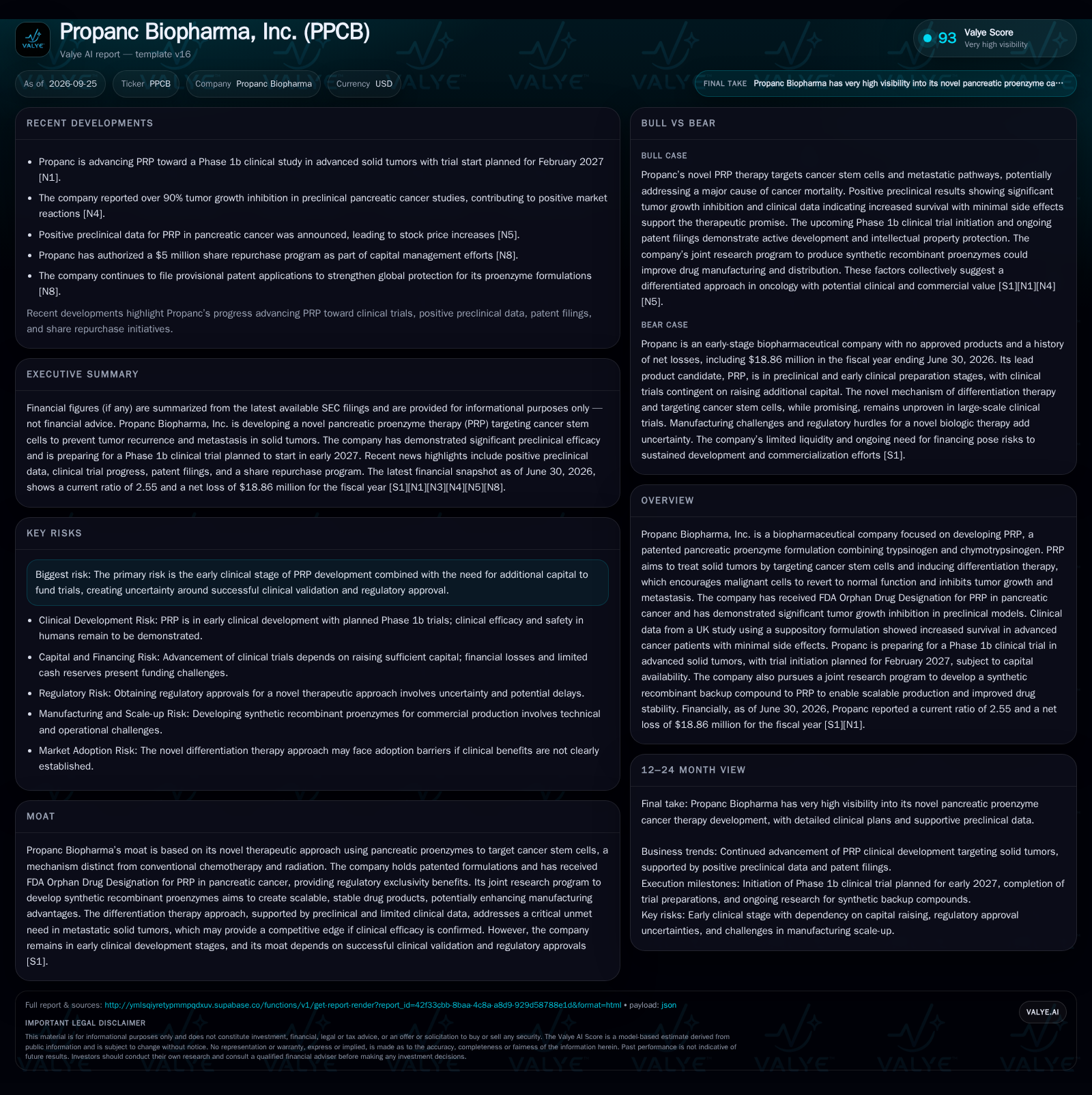
Propanc Biopharma’s lead asset, PRP, targets cancer stem cells in solid tumors and has shown >90% tumor inhibition in preclinical pancreatic cancer studies. With FDA Orphan Drug Designation and a Phase 1b trial planned for 2027 pending capital, Propanc stands at a clinical inflection point.
Propanc Biopharma is advancing a novel oncology approach with its PRP therapy, targeting the root of tumor recurrence by focusing on cancer stem cells. The company’s preclinical data is compelling—demonstrating over 90% tumor inhibition in pancreatic models—and it has secured regulatory recognition via FDA Orphan Drug Designation. The coming year will prove critical in determining whether Propanc’s differentiated science can translate into clinical and commercial progress [S1] [N1] [N4] [N5].
Propanc’s Clinical Readiness and Financial Snapshot: A Company at the Cusp
Propanc Biopharma’s lead candidate, PRP, is a patented intravenous therapy combining trypsinogen and chymotrypsinogen to inhibit tumor growth and metastasis by targeting cancer stem cells. Preclinical models showed over 90% tumor inhibition in pancreatic cancer and significant tumor weight reduction in ovarian cancer, supporting its differentiation-based mechanism [S1] [N4]. The company has secured FDA Orphan Drug Designation for pancreatic cancer, which could confer development incentives and market exclusivity if approved [S1]. Preparations for a Phase 1b trial in advanced solid tumors are underway, targeting a February 2027 start, but remain contingent on capital raising [S1] [N1]. The company reported a current ratio of 2.55 for the period. [S1]
Therapy Economics: High-Risk Model with Binary Outcomes
Propanc’s economic model is typical of early-stage biotechs: capital-intensive R&D, no commercial revenue, and negative operating leverage until late-stage clinical milestones are reached. Costs are dominated by research, clinical trial preparation, and regulatory activities, with minimal recurring revenue until (and unless) a drug is approved. The company reported cash and liquidity metrics for the period; these figures do not by themselves establish operating runway, investment capacity, financial flexibility, or financing capacity. [S1]
If PRP demonstrates safety and efficacy in humans and advances through later-stage trials, the economics could shift dramatically. FDA Orphan Drug Designation may enable premium pricing and up to seven years of U.S. market exclusivity post-approval, with potential for additional incentives such as tax credits and expedited review. However, pricing power and volume will ultimately depend on clinical differentiation, evidence of survival benefit, and payer acceptance. Manufacturing scale-up, especially for a biologic, introduces further capital requirements and margin risk—an area Propanc is addressing through its POP1 synthetic recombinant backup program, which could improve scalability and cost structure if successful [S1].
The capital-intensive nature of early-stage biotech ventures like Propanc necessitates a finely tuned balance between funding inflows and milestone achievements. Given the absence of commercial revenue, the company’s valuation and ability to raise capital are heavily dependent on demonstrating incremental clinical progress. Each developmental phase carries inherent binary risks—either validating the therapeutic hypothesis or necessitating strategic reassessment. The timing and structure of financing rounds will critically influence dilution risk and operational continuity. Moreover, the pathway to commercialization involves complex downstream economics including manufacturing scale-up, supply chain logistics, and payer negotiations, all of which require substantial upfront investment and carry execution risk that could materially affect long-term profitability.
Novel Mechanism in a Crowded Oncology Landscape: Where PRP Could Stand Out
Propanc’s focus on cancer stem cells and differentiation therapy sets it apart from conventional cytotoxic and targeted agents, which often fail to prevent recurrence and metastasis. This mechanism may appeal to oncologists and patients if robust clinical data emerge, especially in indications like pancreatic cancer where outcomes remain poor and therapeutic options are limited.
However, the oncology field is intensely competitive, with major pharmaceutical and biotech companies pursuing a range of approaches including immunotherapies, antibody-drug conjugates, and next-generation targeted therapies. Any clinical benefit from PRP will need to be both statistically and clinically meaningful to displace entrenched standards of care or to be adopted as an adjunct. The company’s preclinical results are promising, but translation to human efficacy remains unproven. The POP1 program, if it achieves improved stability and scalable manufacturing, could become a differentiator by lowering COGS and supporting global distribution—though these advantages are only potential at this stage [S1].
The differentiation of PRP’s mechanism—targeting cancer stem cells to prevent recurrence and metastasis—addresses a significant unmet need but also introduces challenges in clinical validation. Cancer stem cell biology is complex and heterogeneous across tumor types, which may impact the generalizability of efficacy signals observed in preclinical models. Additionally, the competitive oncology landscape is marked by rapid innovation cycles and evolving standards of care, which could shift during Propanc’s clinical development timeline. Strategic positioning will thus require not only demonstrating clinical benefit but also anticipating competitive responses, potential combination regimens, and evolving regulatory expectations. The success of the POP1 synthetic backup program could further influence competitive dynamics by enabling cost-effective manufacturing and broader market access.
From First-in-Human Success to Strategic Optionality: What Could Unlock Value
A favorable scenario would see Propanc successfully raising capital, initiating its Phase 1b trial in early 2027, and demonstrating safety and preliminary evidence of anti-tumor activity in humans. Positive data could catalyze further funding, attract strategic partners, and position the company for expedited development under Orphan Drug incentives. If the POP1 synthetic program delivers a scalable, stable recombinant version of PRP, Propanc could address manufacturing challenges that often limit biologics’ commercial reach.
Evidence supporting this scenario would include: (1) timely financing and trial initiation; (2) clear safety/tolerability profile in Phase 1b; (3) early signals of efficacy (tumor response or survival extension); and (4) progress on synthetic backup development. Confirmation of commercial interest via licensing, partnerships, or non-dilutive funding would further strengthen the case for value creation.
Clinical Uncertainty and Financial Pressure: The Most Likely Near-Term Outcome
The most plausible scenario is that Propanc secures sufficient capital to initiate its Phase 1b trial on a delayed timeline, with trial execution extending over the planned 24 months. Early data may clarify safety but yield only limited efficacy signals, typical of first-in-human oncology studies. The company will likely continue to incur substantial operating losses, requiring further rounds of funding before reaching any registrational endpoint.
This scenario is confirmed if Propanc announces new financing, keeps trial preparations on track, and progresses through the clinical protocol without major setbacks. Conversely, inability to raise funds or repeated delays in trial start would indicate a worsening outlook. Absent clear clinical efficacy signals or partnership interest, the company’s negotiating leverage and valuation would likely remain depressed.
Adverse Outcomes: Funding Delays or Clinical Setbacks Could Derail Progress
The principal risk is that Propanc fails to secure adequate funding, resulting in indefinite delays to clinical trial initiation or forced cutbacks in development programs. Even if the Phase 1b trial begins, unforeseen safety concerns or lack of efficacy could halt clinical progress and erode stakeholder confidence. Manufacturing hurdles with the POP1 recombinant backup could further constrain options, especially if scalability or stability issues emerge.
This scenario would be confirmed by: (1) persistent funding gaps or unsuccessful capital raises; (2) missed or repeatedly delayed clinical milestones; (3) negative or ambiguous Phase 1b outcomes; and (4) operational setbacks in the synthetic program. In such a case, Propanc could face a protracted search for strategic alternatives or risk winding down operations.
Milestones and Metrics That Will Determine Propanc’s Trajectory
Successful completion of a capital raise to fund the planned Phase 1b trial—timing and structure of any announced financing will be critical [S1] [N1].
Initiation of the Phase 1b clinical trial in advanced solid tumors as planned for February 2027, or any delays/adjustments to this timeline [S1] [N1].
Early Phase 1b clinical data: safety/tolerability profile and initial efficacy signals (tumor response rates, progression-free survival), if disclosed.
Progress updates on the POP1 synthetic recombinant backup program, including preclinical milestones or manufacturing scale-up developments [S1].
Operational cash burn rate and changes in liquidity position—frequency and terms of additional capital raises, if disclosed [S1].
Announcements of strategic partnerships, licensing deals, or non-dilutive funding that could validate the platform or reduce dilution risk.
Regulatory interactions beyond Orphan Drug Designation, such as fast track or breakthrough therapy applications, if pursued.
Disclaimer: This is research-only, informational analysis and not investment advice. It may include AI-generated interpretation and general industry context. Always verify important details using primary sources.

Comments