
GenFlat Holdings: Collapsible Container Economics, Adoption Hurdles, and the Path to Revenue Conversion
GenFlat Holdings targets the global shipping industry’s costly problem of repositioning empty containers with its patented collapsible design. Early pilot programs and a sizable sales pipeline point to initial traction, but minimal revenue and steep losses underscore the challenge of converting customer interest into durable business. The company’s success will hinge on adoption rates, operational scaling, and proving its technology’s value in a risk-averse, cost-driven market.
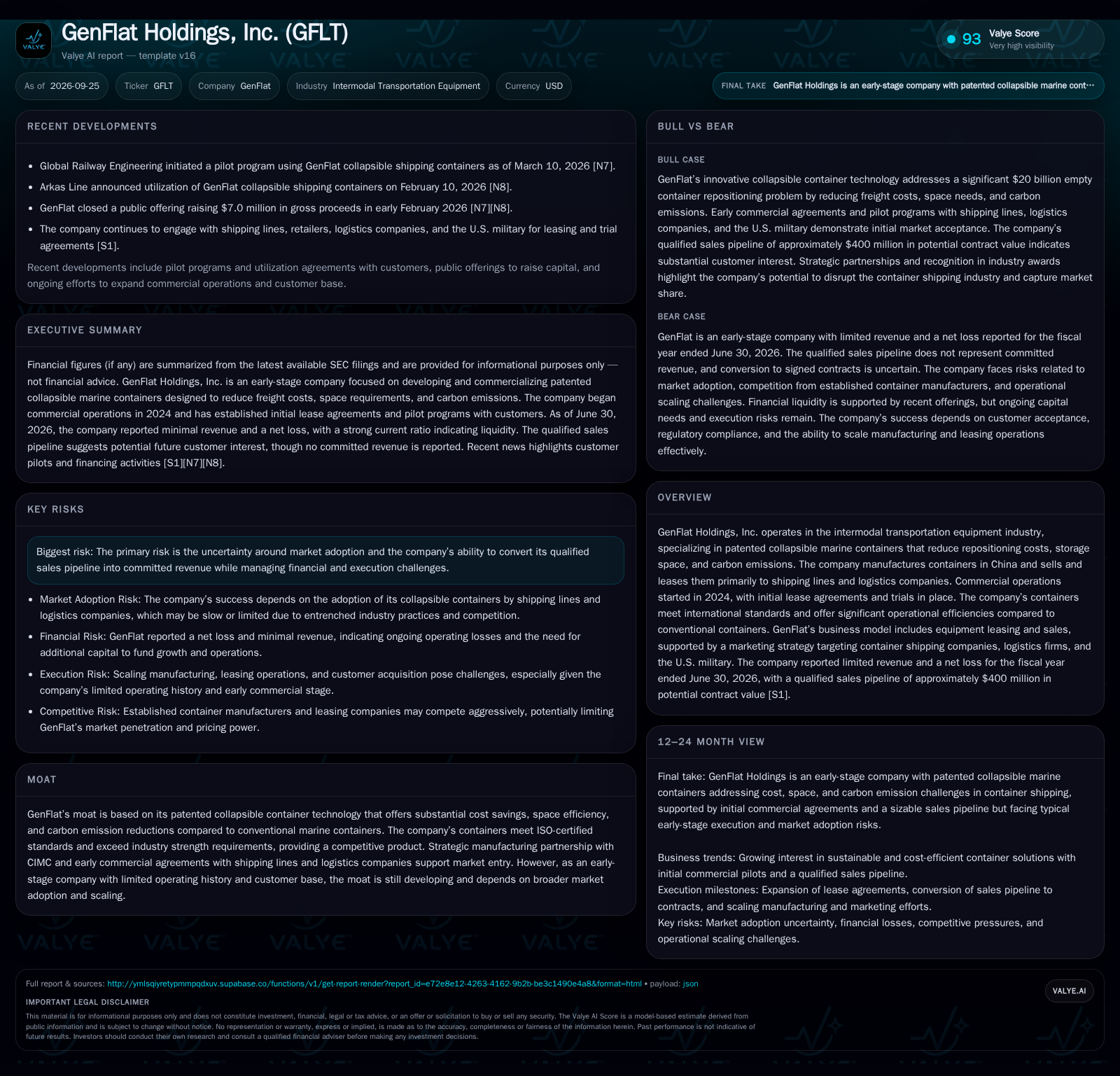
GenFlat Holdings is commercializing patented collapsible marine containers designed to cut freight and handling costs. The company has begun early pilot programs and leasing agreements, with a $400 million qualified sales pipeline as of June 2026, but reported only $6,120 in revenue and a net loss exceeding $3.2 million for the year. The core question is whether GenFlat can convert pipeline interest into signed contracts and recurring business amid industry inertia and capital needs. [S1]
GenFlat Holdings, Inc. is seeking to upend the $20 billion global challenge of repositioning empty shipping containers with its ISO-certified, collapsible container technology. The company’s value proposition—dramatic reductions in freight, handling, and storage costs—has attracted initial pilots with shipping lines and logistics players, as well as a sizable pipeline of potential deals. Yet, with just $6,120 in revenue and a net loss of $3.3 million in its latest fiscal year, GenFlat’s commercial journey is only beginning. The next phase will test the technology’s operational validity and the company’s ability to convert interest into durable contracts in a conservative, margin-driven industry. [S1]
Early Commercial Activity, Large Pipeline, and Steep Losses Define GenFlat’s Starting Point
GenFlat Holdings began commercial operations in May 2024, and by June 30, 2026, had secured one rental agreement, two equipment lease agreements, and three trial agreements with a total of seven customers—spanning shipping lines, retailers, logistics companies, and the U.S. military. [S1] Despite these initial steps, the company reported revenue of just $6,120 and a net loss of $3,275,122 for the fiscal year ended June 2026. [S1] As of June 30, 2026, GenFlat’s qualified sales pipeline stood at approximately $400 million in potential contract value, but this figure represents non-binding opportunities rather than committed revenue. [S1] Recent pilots with Global Railway Engineering and Arkas Line signal growing customer engagement, but the company’s financials reflect the gap between interest and monetization. [N7] [N8]
Collapsible Container Economics: Potential Value Creation and Cost Barriers
GenFlat’s core economic proposition is to reduce the costs associated with repositioning empty containers—a major pain point for global shipping lines, often amounting to billions in annual expense. The company’s containers can be collapsed and stacked four-to-one, theoretically saving up to 75% on freight costs, terminal handling, and storage space. [S1] If these operational savings are realized at scale, GenFlat could position its containers at a premium price point versus traditional boxes, supported by the promise of lower total cost of ownership.
The company’s business model spans equipment leasing (including acquisition, leasing, re-leasing, and sale of intermodal equipment) and direct sales, giving it flexibility to capture both recurring and transactional revenue streams. [S1] Leasing could provide stable, predictable cash flows if adoption grows, while sales offer upfront monetization and faster asset turnover. However, GenFlat’s manufacturing is outsourced to CIMC in China, which may keep capital expenditures low but also means the company is exposed to supply chain and cost fluctuations.
Operating leverage is likely high: incremental revenue from scaling container deployments would flow through a relatively fixed cost base, once manufacturing and logistics are dialed in. However, the company’s minimal reported revenue and substantial net loss indicate that breakeven is likely distant, and ongoing capital will be required to fund operations, inventory, and customer acquisition. The company’s current ratio is high (14.02), but the cash ratio is low (0.06), suggesting most current assets are not cash and ongoing liquidity could be a concern if scaling is slow. [S1]
Technology Edge vs. Industry Inertia: Assessing GenFlat’s Position in the Container Market
GenFlat’s competitive advantage rests on its patented collapsible container technology, which is ISO-certified and exceeds current strength and rigidity standards. [S1] This engineering edge could allow it to carve out share from conventional steel box suppliers and leasing companies, particularly among customers seeking to reduce environmental impact or handling costs.
However, the intermodal equipment market is dominated by large, established players with global manufacturing and leasing capacity, entrenched customer relationships, and the ability to price aggressively. Adoption of new container formats faces significant inertia: shipping lines and logistics providers are risk-averse and rely on standardized, proven equipment to ensure operational reliability across global routes.
Potential substitutes include traditional containers (which benefit from network effects and universal port compatibility) and alternative repositioning strategies. Even if GenFlat’s solution is technically superior, switching costs—such as retrofitting handling equipment, training staff, and managing mixed fleets—could slow adoption. GenFlat’s partnership with CIMC (the world’s largest container manufacturer) may help address scale and credibility, but the company will need to prove its technology’s value in real-world, high-volume operations before broader acceptance follows.
If GenFlat Converts Pipeline to Revenue: What a Breakout Would Look Like
A bullish scenario for GenFlat would see a material portion of its $400 million qualified sales pipeline convert into signed contracts—either through direct sales or multi-year leasing deals with major shipping lines, logistics players, or defense customers. Successful pilots (such as those underway with Global Railway Engineering and Arkas Line) could validate the operational benefits, leading to broader fleet deployments and repeat orders. [N7] [N8]
In this scenario, operating leverage would kick in as fixed costs are spread over a larger revenue base, and GenFlat could begin to generate positive margins from leasing and sales. Demonstrable cost savings and carbon reduction would support premium pricing and help overcome customer inertia. Confirmation of this pathway would come from a sharp increase in reported revenue, expanded multi-year lease agreements, and evidence of customers integrating GenFlat containers into daily operations at scale. Falsification would be indicated by persistent pilot-only activity, low contract conversion, or customer churn after initial trials.
Gradual Adoption Amid Industry Caution: Most Likely Trajectory
The most plausible path for GenFlat is moderate, incremental adoption, with pilot programs and small initial contracts gradually expanding as early customers validate the containers’ operational and financial benefits. Conversion of the sales pipeline is likely to be slow, with extended trial periods and procurement cycles typical of the shipping industry.
Revenue may remain modest for several years, with losses persisting as the company invests in customer acquisition, inventory, and support infrastructure. Credibility will build as more customers use the containers in live environments, but aggressive scaling could be hampered by capital constraints and the need to prove reliability under diverse shipping conditions.
Evidence for this scenario would include steady growth in the number of lease agreements and revenue, expansion of pilots into broader contracts, and gradual improvements in margins. A lack of significant contract wins, ongoing trial status, or stagnant revenue would support a more bearish outlook.
Risks of Stalled Adoption and Persistent Losses
A negative outcome would see GenFlat struggle to convert its qualified sales pipeline into binding, revenue-generating contracts. Entrenched customer behaviors, technical skepticism, and the logistical complexity of integrating new container types could stall adoption. Established competitors may respond with price cuts or enhanced offerings, further slowing GenFlat’s momentum.
In this scenario, revenue remains negligible, losses persist, and the company is forced to rely on dilutive capital raises or debt to fund operations. Failure to secure large-scale contracts, negative customer feedback from pilots, or operational hiccups could undermine confidence in the technology and stall market entry.
Confirmation would come from ongoing minimal revenue, high churn or non-renewal of pilot customers, delays in contract signing, or adverse changes in the company’s liquidity position. Falsification would require evidence of meaningful revenue growth and established, recurring customer relationships.
Milestones That Will Determine GenFlat’s Commercial Traction and Value Creation
The number and value of executed lease and sales contracts signed each quarter—especially conversion rates from the qualified sales pipeline—will be critical to watch.
Expansion of pilot programs into full-scale fleet deployments by major shipping lines or logistics operators would indicate operational validation and customer buy-in.
Reported revenue growth and the mix between leasing and direct sales will help clarify the underlying business model and margin potential.
Gross margin trends, if disclosed, would reveal the economics of scaling manufacturing and leasing operations.
Customer retention and renewal rates post-pilot—especially among initial marquee customers—would test the technology’s stickiness and recurring revenue potential.
Updates on liquidity, capital raises, or changes in working capital posture may signal the company’s ability to fund continued growth and absorb scaling shocks.
Any regulatory or certification developments affecting ISO standards or container handling protocols that could impact adoption rates.
Feedback from partners such as CIMC on manufacturing ramp-up, cost containment, and quality control will be important as volume grows.
Disclaimer: This is research-only, informational analysis and not investment advice. It may include AI-generated interpretation and general industry context. Always verify important details using primary sources.

Comments