
Amplify Commodity Trust (BDRY): Freight Futures Exposure, Structure, and the Mechanics of Shipping ETF Performance
Amplify Commodity Trust’s Breakwave Dry Bulk Shipping ETF (BDRY) offers investors direct access to the volatile world of dry bulk freight futures, with recent market highs reflecting heightened interest in shipping as a commodity play. The fund’s mechanics, operational guardrails, and sensitivity to global shipping dynamics create both unique opportunities and risks for investors seeking to capitalize on freight rate movements.
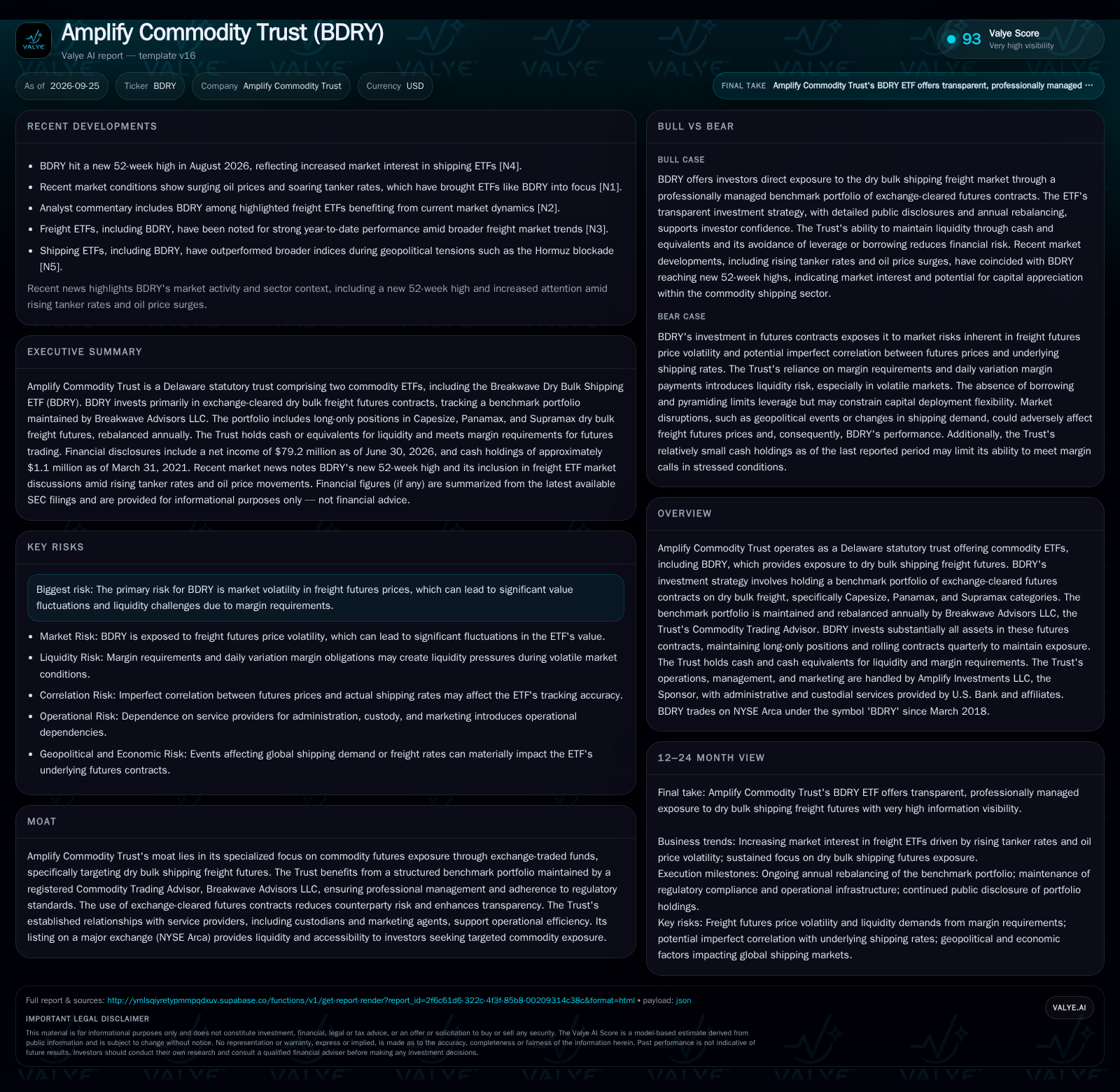
BDRY provides transparent, long-only exposure to dry bulk freight futures, riding recent strength in shipping markets. Key watchpoints include the volatility of freight futures, margin requirements, and the ETF’s ability to maintain exposure amid turbulent global shipping conditions. [S1] [N4] [N2]
Amplify Commodity Trust’s Breakwave Dry Bulk Shipping ETF (BDRY) stands at the intersection of commodity investing and global logistics, offering investors a vehicle to participate in dry bulk freight market moves through a transparent, exchange-traded structure. Recent performance highs underscore the renewed appeal of shipping exposure as tanker rates and oil price volatility capture headlines. Yet, the ETF’s design—centered on rolling futures contracts and strict avoidance of leverage—means that returns are inextricably tied to the highly volatile and cyclical nature of freight markets, with liquidity and margin management emerging as key operational levers.
Recent Market Highs and the Mechanics of BDRY's Freight Futures Exposure
BDRY reached a new 52-week high in August 2026, reflecting a surge in investor interest as shipping rates and global oil prices climbed. This momentum coincides with broader attention on freight ETFs, suggesting that shipping market volatility is translating into capital flows for specialized commodity funds. BDRY’s structure centers on maintaining long-only positions in exchange-cleared dry bulk freight futures—specifically Capesize (50%), Panamax (40%), and Supramax (10%) contracts—rolled quarterly to sustain exposure. The ETF’s avoidance of leverage and use of cash and equivalents for margin and liquidity distinguish it from more aggressive commodity pools. However, the most recent filings reveal that cash holdings are relatively modest, potentially constraining its ability to respond to large margin calls during market turbulence. [N4] [N2] [S1]
How BDRY Converts Freight Futures Volatility into ETF Returns
BDRY’s revenue model is rooted in the appreciation or depreciation of its portfolio of exchange-cleared dry bulk freight futures. Unlike traditional equity ETFs, BDRY’s returns are driven by changes in the forward curve of shipping rates, not dividend income or company earnings. The ETF earns or loses value as the prices of its underlying futures contracts rise or fall in response to shipping market dynamics, supply-demand imbalances, and macroeconomic events.
The fund’s expenses are relatively fixed—primarily management fees to Amplify Investments LLC and trading/advisory fees to Breakwave Advisors LLC. Because BDRY does not employ leverage, margin requirements (ranging from 10% to 40% of notional value) are funded from its own cash and equivalents. This design minimizes the risk of forced deleveraging but also limits the potential for outsized returns during market spikes. The fund’s ability to meet margin calls, particularly during periods of extreme volatility, is a critical operational constraint. Interest income from cash reserves provides a minor offset to management fees but is not a material profit driver.
Operating leverage in BDRY’s model is limited compared to traditional asset managers: higher asset levels may marginally improve scale economics, but the core driver of performance remains the volatility and direction of dry bulk freight futures, rather than cost efficiencies or asset growth.
Specialization, Transparency, and Substitution: BDRY’s Place in the Commodity ETF Landscape
BDRY’s competitive edge lies in its direct, transparent exposure to a niche commodity market—dry bulk shipping—where few ETF competitors offer similar access. The fund’s benchmark, maintained by Breakwave Advisors, is publicly disclosed and rebalanced annually, enhancing information visibility for investors. The use of exchange-cleared futures contracts further reduces counterparty risk compared to OTC derivatives.
However, BDRY faces competition from broader shipping ETFs, maritime equity funds, and even direct futures trading by sophisticated investors. Substitution risk is also present: investors seeking shipping exposure may opt for tanker-focused ETFs, integrated logistics companies, or commodity funds with indirect freight sensitivity. BDRY’s avoidance of leverage and focus on long-only exposure may appeal to risk-aware investors but could be seen as limiting for those seeking higher returns or more tactical strategies.
Switching frictions are relatively low for institutional investors, but BDRY’s transparency, regulatory structure, and major-exchange listing (NYSE Arca) provide comfort and liquidity for a broader investor base. The critical challenge is sustaining relevance as market cycles shift and as freight rate volatility—BDRY’s main value driver—ebbs and flows.
Freight Rate Surge and Structural Demand Shifts: What Fuels an Extended Run?
A favorable scenario for BDRY unfolds if global dry bulk shipping rates experience a sustained surge—driven by structural factors such as persistent supply chain bottlenecks, robust commodity demand from emerging markets, or prolonged disruptions to shipping capacity (e.g., regulatory restrictions, geopolitical events). In this environment, futures curves steepen and roll yields may turn positive, boosting returns for long-only portfolios like BDRY.
Evidence that would confirm this scenario includes continued record highs in dry bulk freight indices, persistent backwardation in futures curves (allowing for roll profits), and strong capital inflows into shipping ETFs. Additionally, if BDRY’s assets under management grow meaningfully and the fund maintains low tracking error relative to spot and futures indices, it would suggest that the ETF is capturing the full benefit of market tailwinds.
This scenario could be falsified if freight rates quickly revert or if the rally is short-lived, causing futures prices to normalize and eroding BDRY’s performance. A sharp drop in trading volumes or assets under management would also signal the reversal of this dynamic.
Volatility as the Norm: Navigating Cyclical Freight Markets with Managed Risk
The most plausible medium-term path for BDRY is continued exposure to a highly cyclical and volatile dry bulk freight market, with returns oscillating based on macroeconomic shocks, seasonal demand, and shipping supply dynamics. The fund’s transparent structure and rolling futures strategy ensure that it closely tracks the direction (and volatility) of the underlying market, but do not guarantee positive returns.
In this scenario, BDRY’s assets under management and trading volumes remain stable, reflecting periodic inflows and outflows as investor sentiment shifts with freight market headlines. Margin requirements are generally manageable, but occasional spikes in volatility require careful liquidity management. The ETF’s ability to roll contracts efficiently and minimize tracking error will be critical to maintaining investor confidence.
This base case would be confirmed by continued investor engagement (as reflected in AUM and trading volumes), stable tracking versus the benchmark, and the absence of significant operational or liquidity disruptions. A divergence between BDRY’s returns and the direction of major dry bulk indices, or evidence of forced position reductions due to margin stress, would challenge this scenario.
Liquidity Squeeze and Market Reversal: When Margin Calls Drive Forced De-Risking
A negative scenario materializes if dry bulk freight futures experience a sharp, rapid decline—perhaps triggered by a global economic slowdown, a collapse in commodity demand, or geopolitical de-escalation restoring shipping supply. In this case, BDRY’s long-only futures positions would lose value quickly, and margin requirements could spike as daily variation margin adjustments force the ETF to post additional collateral.
Given the fund’s modest cash holdings, a severe drawdown could strain liquidity, potentially forcing the ETF to liquidate positions at unfavorable prices or reduce overall exposure to meet obligations. This could amplify losses and lead to material tracking error versus the benchmark. Investor redemptions may compound liquidity stress, especially if market volatility persists.
Confirmation of this adverse scenario would include a steep drop in BDRY’s NAV, significant outflows, and disclosures of operational strain in meeting margin calls. If the ETF is forced to deviate from its stated benchmark exposure or suffers from persistent tracking error, it would indicate that the mechanics of the structure are under stress.
Freight Futures Volatility, Margin Calls, and ETF Resilience: What Will Determine BDRY’s Next Chapter?
The level and volatility of dry bulk freight futures prices—persistent spikes or drops would directly impact BDRY’s returns and investor flows.
Assets under management (AUM) and trading volumes—if disclosed—would indicate investor confidence and the fund’s ability to scale with market cycles.
The ratio of cash and cash equivalents to notional futures exposure—a useful metric if disclosed—to assess liquidity cushion for margin calls.
Frequency and magnitude of variation margin calls—if disclosed—would show operational resilience during volatile periods.
Tracking error versus the published benchmark portfolio—persistent deviations would signal execution or liquidity issues.
Roll yield (positive or negative) on futures positions—would clarify whether contract roll mechanics are benefiting or hurting returns.
Changes in benchmark composition or rebalancing methodology, as disclosed by Breakwave Advisors—could shift risk/return characteristics.
Any material operational disclosures regarding the ability to meet redemptions or maintain benchmark exposure during stress events.
Disclaimer: This is research-only, informational analysis and not investment advice. It may include AI-generated interpretation and general industry context. Always verify important details using primary sources.

Comments