
The cited source reports dividend-related activity; that disclosure alone does not establish dividend-policy continuity, management confidence, or a material constraint on capital flexibility.
Kentucky First Federal Bancorp’s recent return to dividend payments and the lifting of OCC-imposed capital requirements mark a turning point, but the structural realities of mutual holding company control and modest profitability continue to shape its strategic options. As regulatory tailwinds emerge, the company’s ability to convert compliance gains into durable value for minority shareholders remains the central question.
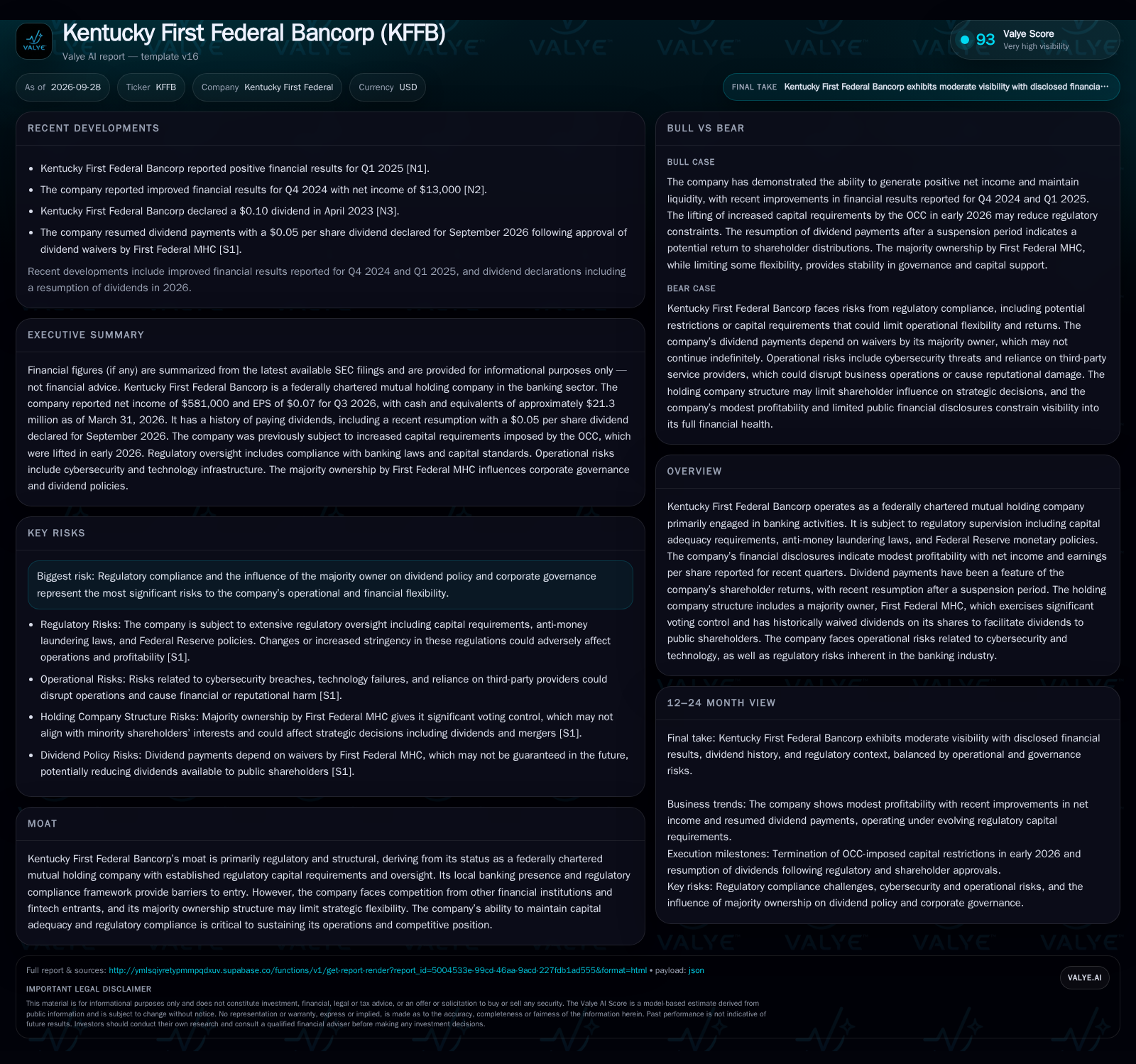
Kentucky First Federal Bancorp (KFFB) has resumed dividend payments and is no longer subject to heightened capital requirements after the OCC lifted restrictions in early 2026. The core challenge is whether these regulatory and capital improvements can translate into improved returns or growth for public shareholders, given persistent operational and governance constraints. [S1] [S2]
Kentucky First Federal Bancorp’s 2026 narrative is defined by the interplay between regulatory relief and the structural realities of mutual holding company control. The central issue for investors is whether these positive regulatory developments can drive improved long-term value for minority shareholders or whether legacy constraints will continue to cap upside.
Regulatory Changes and Dividend Resumption Poise KFFB for 2026
Kentucky First Federal Bancorp ended Q3 2026 with net income of $581,000 and reported $21.3 million in cash and equivalents as of March 31, 2026. After a period of heightened regulatory scrutiny, the company saw the OCC terminate increased minimum capital requirements in February 2026, reducing direct regulatory constraints on operations and capital allocation. In tandem, the company resumed dividend payments, declaring a $0.05 per share dividend for September 2026. The cited source reports dividend-related activity; that disclosure alone does not establish dividend-policy continuity, management confidence, or a material constraint on capital flexibility. [S1] [S2] [N3]
Balancing Profitability and Capital Choices in the Mutual Bank Structure
Kentucky First Federal Bancorp’s economics are shaped by the traditional model of a federally chartered mutual holding company. The bank’s revenue is primarily derived from net interest income, with profitability dependent on prudent loan origination, deposit gathering, and conservative balance sheet management. Fixed costs—such as compliance, branch operations, and technology—create a high baseline for breakeven, meaning operating leverage is modest in the absence of significant growth.
Dividend capacity is structurally limited by both regulatory capital requirements and the need for waivers from the majority owner, which can restrict capital returns to public shareholders. The recent lifting of OCC-imposed capital requirements may increase available distributable capital, but the mutual structure means that strategic investments or acquisitions, if pursued, would still require regulatory and majority-owner approval. The company reported cash and liquidity metrics for the period; these figures do not by themselves establish operating runway, investment capacity, financial flexibility, or financing capacity. [S2] [S1]
Funding needs are generally modest, as mutual banks tend to avoid aggressive expansion or leverage. However, the company’s ability to improve profitability would likely require either deeper market penetration, cost reductions, or a shift toward higher-margin loan products—each of which presents its own operational and regulatory hurdles.
Structural Challenges Within KFFB’s Local Banking Focus
KFFB’s competitive positioning is rooted in its established local presence and regulatory compliance, both of which create moderate barriers to entry for would-be competitors. The mutual holding company structure can offer stability and a long-term orientation, but it also limits responsiveness to market shifts and constrains access to outside capital. The bank competes with regional and community banks, credit unions, and increasingly, fintech lenders vying for deposit and loan market share.
While regulatory compliance and conservative capital management help maintain customer trust, they do not confer significant pricing power or technology-driven cost advantages. The risk is that as digital-first competitors lower service costs and expand customer reach, KFFB’s legacy cost base and slower innovation cycle could erode its local advantages over time. Absent a distinctive product set or superior digital experience, retention of younger or more mobile customers could become challenging.
The majority mutual ownership further reduces the likelihood of aggressive strategic pivots, mergers, or acquisitions—moves that could otherwise help the company respond to competitive threats or consolidate market share.
Using Regulatory Flexibility to Enhance Return Profiles
The most favorable scenario for KFFB is that the lifting of OCC capital constraints enables a period of improved capital allocation—either through higher, more regular dividends or selective investments that boost net interest margins or fee income. [S2] [S1]
Confirmation for this scenario would come from a consistent record of quarterly profitability, a rising or stable dividend payout, and visible reinvestment in technology or higher-yielding loan products.
Falsification would occur if profitability falters, dividend waivers are withheld, or if regulatory or operational setbacks force a return to capital conservation.
Incremental Advancements in the Mutual Banking Framework
The central expectation is that KFFB will continue to operate as a conservatively managed mutual bank with modest profitability, periodic dividend payments, and limited growth. The removal of OCC-imposed capital restrictions reduces downside risk but does not by itself create a path to material earnings expansion. Dividend waivers from First Federal MHC are likely to continue, but may be subject to periodic regulatory review and could be withheld in adverse conditions.
Confirmation of this scenario would include stable net interest income, consistent—if unspectacular—quarterly profits, and the maintenance of cash and capital ratios above regulatory minimums.
This scenario would be challenged if the company either fails to generate consistent profits or if competitive or regulatory changes require a fundamental shift in strategy.
Potential Impact of Regulatory Setbacks and Operational Issues
The primary downside risks for KFFB stem from renewed regulatory scrutiny, operational failures, or erosion of its local franchise. A deterioration in asset quality, a cybersecurity incident, or a failure to comply with anti-money laundering or capital requirements could trigger new OCC actions or restrict capital returns. If First Federal MHC declines to waive dividends, public shareholders could see payouts suspended again.
Material evidence for this scenario would include a spike in loan losses, a sharp drop in quarterly earnings, regulatory enforcement actions, or public statements indicating dividend waivers will no longer be granted. Operational disruptions—such as technology outages or third-party service failures—could also impair customer confidence and lead to deposit outflows.
The company’s limited scale and slow-moving governance structure could magnify the impact of adverse events, as strategic or capital responses may be delayed compared to more nimble peers.
Factors Influencing Value Generation for KFFB Investors
Quarterly net income and return on assets: Persistent, positive earnings would support ongoing dividends and provide a buffer against shocks. Volatility or a return to losses would undermine the thesis. [S2]
Any change in this pattern would be highly material. [S1]
Regulatory capital ratios: Maintenance of ratios above the minimum required after the lifting of OCC restrictions will signal ongoing financial health and regulatory compliance. If disclosed, tracking CET1 or total risk-based capital would help.
Asset quality metrics: Non-performing loans, charge-offs, and loan loss provisions—if disclosed—will indicate whether credit risk is contained or rising.
Technology and cybersecurity investment: Evidence of increased investment in digital platforms or cybersecurity would show management is addressing operational risks and competitive threats.
Deposit and loan growth trends: Sustained growth in core deposits and new loan originations—if disclosed—would suggest the company is defending or expanding its market position.
Majority-owner governance actions: Any change in First Federal MHC’s approach to waivers, mergers, or strategic direction would have outsized impact on minority shareholder value.
Regulatory actions or public enforcement: New OCC or other regulatory interventions would likely signal deteriorating compliance and could restrict shareholder returns.
Disclaimer: This is research-only, informational analysis and not investment advice. It may include AI-generated interpretation and general industry context. Always verify important details using primary sources.

Comments