
Vantage Corp’s OpsWiz Debut: Capital Allocation, Initial Momentum, and Maritime SaaS Economics Under Pressure
Vantage Corp’s IPO-funded push into maritime digitalization hinges on the commercial scaling of its OpsWiz platform, as the company balances early customer traction with profitability pressures and uncertain competitive dynamics.
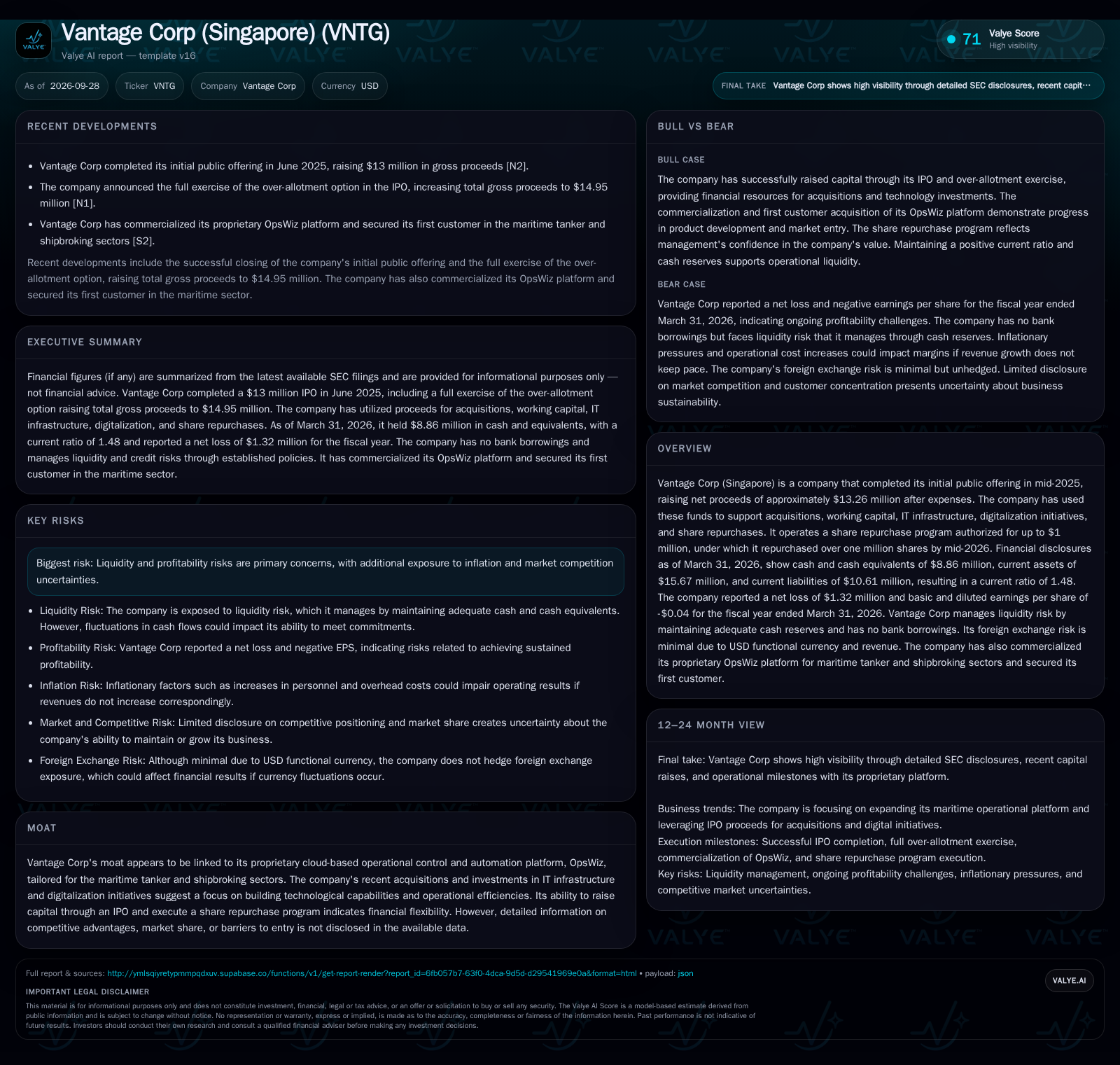
Vantage Corp completed its IPO in June 2025, raising $13.26 million in net proceeds, and has since commercialized its proprietary OpsWiz platform for the maritime sector, securing its first customer. While the company maintains a positive current ratio and has no bank borrowings, it reported a net loss of $1.32 million for the fiscal year ended March 31, 2026. The challenge ahead is converting its initial product traction and capital base into sustainable growth and profitability against the backdrop of competitive and operational uncertainties. [S1] [S2] [N1] [N2]
Vantage Corp’s journey since its 2025 IPO has been defined by aggressive capital deployment into digital transformation and acquisitions, culminating in the commercial launch of its proprietary OpsWiz platform for the maritime tanker and shipbroking markets. The next phase will test whether Vantage can build operational leverage and defend against both established maritime tech incumbents and new digital entrants.
Tracking Progress from IPO Funds to Maritime Digital Transformation
Vantage Corp completed its initial public offering in June 2025, raising approximately $13.26 million in net proceeds, including a full over-allotment exercise. This capital has been allocated toward acquisitions, IT infrastructure, digitalization projects, general corporate purposes, and a share repurchase program authorized for up to $1 million, under which over one million shares were repurchased by mid-2026. As of March 31, 2026, the company reported $8.86 million in cash and a current ratio of 1.48, with no bank borrowings. Critically, Vantage announced the successful commercialization and first customer acquisition for its proprietary OpsWiz cloud-based operational platform targeted at the maritime tanker and shipbroking sectors. However, the company posted a net loss of $1.32 million and negative EPS for the same period, highlighting the early-stage profitability challenge. [S1] [S2] [N1] [N2]
Maritime SaaS Economics: Balancing Fixed Costs and Scaling for Better Margins
Vantage Corp’s current economics reflect a classic early-stage SaaS profile: high upfront investment in product development and digitalization, with operating costs outpacing revenue at the outset. The IPO provided the capital needed for these fixed investments, but recurring revenue from the OpsWiz platform is likely nascent, given only the first customer has been secured. If OpsWiz is sold on a subscription or usage-based model—a common approach in operational SaaS for maritime and logistics—the gross margins could be attractive once a critical mass of customers is achieved, due to low incremental costs for additional users. However, the mix between recurring software revenue and any services or integration work is not disclosed, leaving the long-term margin profile uncertain. The company’s ability to scale without proportional increases in SG&A and R&D will determine operating leverage, while capital needs may resurface if customer acquisition costs or product investments remain high relative to revenue growth.
A critical determinant of Vantage Corp’s path to profitability will be the elasticity of customer acquisition costs relative to lifetime value. In maritime SaaS, onboarding complexity often leads to elevated initial service expenses, which can compress margins until scale is achieved. If Vantage can standardize deployment processes and reduce customization requirements, it may lower these upfront costs, accelerating a positive contribution margin per customer. Additionally, the platform’s pricing architecture—whether tiered by vessel count, transaction volume, or feature access—will influence revenue predictability and upsell potential. Effective segmentation and pricing optimization could enhance monetization without proportionally increasing sales efforts, thereby improving unit economics over time.
Operational scalability also hinges on the platform’s technological architecture and cloud infrastructure choices. If OpsWiz employs a modular, API-driven design, it can facilitate faster integration with customer legacy systems and third-party maritime data providers, reducing friction in sales cycles and enabling incremental feature rollouts. Conversely, a monolithic or rigid platform may require heavier customization, increasing costs and extending implementation timelines. The extent to which Vantage invests in automation of customer support and training will further affect the cost-to-serve metric, a key lever in SaaS margin expansion. Monitoring these operational metrics, if disclosed, would provide insight into the sustainability of fixed cost absorption as the customer base grows.
Positioning Within a Complex and Shifting Maritime Technology Market
Vantage Corp’s proprietary OpsWiz platform targets operational control and automation for maritime tanker and shipbroking firms—a sector historically underserved by modern SaaS but increasingly targeted by both specialist maritime IT vendors and broader supply chain technology players. The company’s initial traction demonstrates product viability, but barriers to entry in software are typically low unless reinforced by deep integrations, data network effects, or regulatory certifications. Maritime customers often face legacy system inertia, high switching costs, and complex integration requirements, which can favor incumbents or well-capitalized new entrants. Without disclosed evidence of recurring contracts, proprietary data advantages, or a broad installed base, Vantage’s current competitive moat appears nascent. Its ability to differentiate on product depth, user experience, or cost of ownership—and to build sticky relationships—will define its ability to defend margin and avoid commoditization as the market matures.
Potential Gains from OpsWiz Network Effects and Recurring Revenue Loyalty
The most favorable scenario for Vantage Corp is that OpsWiz quickly gains adoption across multiple major maritime customers, creating a virtuous cycle of referenceability, integrations, and potentially proprietary data flows. If the platform can demonstrate measurable ROI—such as reduced downtime, regulatory compliance automation, or significant cost savings—customer switching frictions could rise, supporting subscription renewals and price upgrades. Evidence confirming this scenario would include rapid growth in disclosed customer count, rising proportion of revenue from recurring SaaS contracts, and expanding gross margins as fixed costs are leveraged. Announcements of long-term contracts, integrations with third-party maritime systems, or partnerships with major industry players would further validate the thesis. Conversely, slow customer uptake, lumpy project-based revenues, or continued net losses would challenge the plausibility of rapid SaaS scaling.
Commercialization Advances Amid Lengthy Maritime Sales Timelines
The most plausible near-term trajectory is that Vantage Corp continues to invest in OpsWiz and gradually builds its customer base, but faces a protracted sales cycle typical of the maritime sector. The company may secure a handful of additional customers over the next year, leading to modest revenue growth but persistent operating losses as fixed costs remain high. The balance sheet, while currently healthy, could tighten if cash burn persists and customer acquisition is slower than anticipated. Confirmation of this scenario would come from incremental customer wins, stable or slightly improving margins, and measured SG&A growth. Falsification would require either a sudden acceleration in customer adoption (moving toward the upside case) or a lack of new customer announcements and worsening financials (sliding toward the downside).
Risks of Slowed Product Uptake and Rising Profitability Challenges
The adverse scenario is that OpsWiz fails to gain meaningful traction beyond the initial customer, either due to product-market fit challenges, entrenched incumbent solutions, or insufficient differentiation. In this case, revenue growth stalls, IPO proceeds are gradually depleted by ongoing operating expenses, and the company is forced to either seek dilutive financing, pivot product strategy, or significantly reduce expenses. Signs confirming this scenario would include persistent net losses, declining cash balances, minimal new customer disclosures, and potential delays in product upgrades or new feature launches. If the competitive environment intensifies and price competition erodes margins, operational risks could be exacerbated.
Key Events Shaping Vantage Corp’s SaaS Growth Path
Quarterly disclosure of OpsWiz customer count, annual contract value (ACV), and retention rates—if disclosed—would help clarify the pace and quality of platform adoption.
Updates on the revenue mix between recurring SaaS and non-recurring services or integration fees would illuminate the sustainability of margin expansion.
Gross margin trends as reported in future filings: sustained improvement would suggest operating leverage and scalable economics.
Cash burn rate and remaining cash balance, particularly if operating losses persist, to assess the timeline for potential future capital needs.
Evidence of integration partnerships or major reference customers in the maritime sector, which could accelerate network effects and competitive differentiation.
Changes in SG&A and R&D expense as a percentage of revenue, indicating whether cost discipline and scaling efficiencies are being achieved.
Announcements of product expansions, new verticals, or geographic market entries that could broaden the addressable market and revenue opportunity.
Any disclosure of customer concentration or churn, as high dependency on a small number of accounts could increase revenue volatility.
Disclaimer: This is research-only, informational analysis and not investment advice. It may include AI-generated interpretation and general industry context. Always verify important details using primary sources.

Comments