
Golden Star Resource Corp.: The Realities of Exploration-Stage Mining with Minimal Capital
Golden Star Resource Corp. holds Nevada mining claims but faces a critical capital shortfall, no active exploration, and ongoing losses. The company’s future hinges entirely on its ability to secure funding and initiate exploration, with no current path to revenue or resource validation.
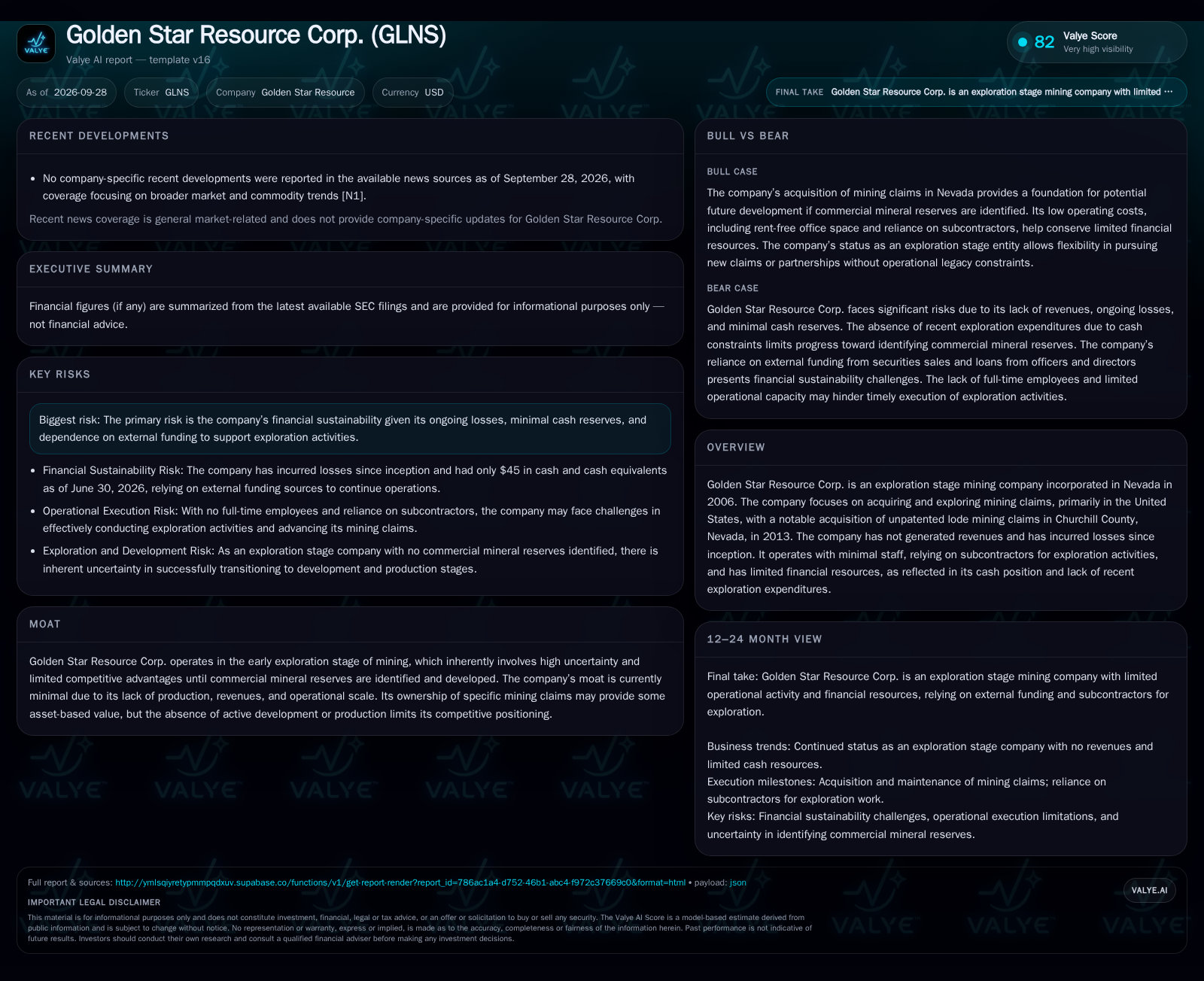
Golden Star Resource Corp. is an exploration-stage mining company with no revenues, minimal cash, and no recent exploration activity. Its business model depends on raising external funds to advance its Nevada claims. Without new capital, operations are likely to remain dormant, and the company faces significant risk of suspension or cessation of business. Any upside depends on securing funding and successful mineral discovery, both highly uncertain at present. [S1]
Golden Star Resource Corp. exemplifies the high-risk, high-uncertainty end of the mining sector: it holds unproven mining claims in Nevada, has incurred persistent losses, and operates with almost no cash and no active exploration. With only a part-time officer and reliance on subcontractors, the company has not advanced its assets or generated any revenue. The pivotal question is whether Golden Star can secure the funding needed to meaningfully explore its claims—or if it will remain in indefinite stasis, with ownership of undeveloped land as its sole asset.
Present Status: Dormant Operations and Capital Deficiency Define the Outlook
As of June 30, 2026, Golden Star Resource Corp. reported only $45 in cash and cash equivalents, with no revenues generated since inception and a net loss of $13,106 for the period. The company has not incurred any exploration expenditures in the past year, directly attributable to its lack of financial resources. Its only officer and director is part-time, contributing about 10% of her time, and the company relies on subcontractors for any physical exploration work. The company reported cash and liquidity metrics for the period; these figures do not by themselves establish operating runway, investment capacity, financial flexibility, or financing capacity. [S1]
The company’s sole tangible asset remains its unpatented lode mining claims in Churchill County, Nevada, acquired in 2013. However, with no recent exploration and no identified commercial mineral reserves, these claims have not been advanced toward any value realization. The ongoing going concern opinion highlights the acute risk that, absent new capital, Golden Star may have to suspend or cease operations entirely. [S1]
How Value Could Theoretically Be Created: Exploration-Stage Mining Economics
In theory, the economics of an exploration-stage mining company like Golden Star hinge on a high-risk, high-reward cycle: acquire prospective claims, invest in geological exploration, and—if a viable mineral resource is discovered—transition to development and, ultimately, production. At each stage, capital needs escalate, with initial exploration funded by equity or insider loans, and later-stage development typically requiring much larger sums and technical expertise.
Golden Star’s current cost structure is extremely lean: it has no salaried employees, minimal overhead (with rent-free office space), and uses subcontractors for any on-site work. This allows the company to conserve its limited cash, but also means it cannot initiate or sustain exploration without immediate infusions of new capital. There is no revenue stream; all potential value is embedded in the option-like nature of its claims. If exploration were to identify a commercial ore body, the economics would shift dramatically—potentially enabling the company to attract joint venture partners or acquirers. However, the vast majority of exploration-stage companies never reach this point, and dilution is almost inevitable given the need for repeated capital raises.
At present, Golden Star’s economics are functionally static: no exploration spending, no progress toward resource validation, and no path to revenues. The company’s only operational lever is the ability to raise new funds, which would be quickly consumed by even modest exploration programs.
Competitive Realities: Asset Ownership Without Scale or Differentiation
Golden Star’s competitive positioning is almost entirely a function of its asset base: unpatented claims in a known mining jurisdiction. However, in the absence of active exploration, technical validation, or a path to resource delineation, these claims confer little meaningful advantage over the thousands of other early-stage mining entities operating in the western United States.
The company has no technical staff, no proprietary technology, no established relationships with offtakers or development partners, and no production. Its only minimal advantage is operational flexibility: with no legacy costs, it could theoretically pivot or partner quickly if funding were secured. However, the lack of any recent exploration activity, combined with extreme financial constraints, leaves Golden Star with negligible competitive moat.
Potential substitutes for Golden Star’s claims are abundant—other junior miners with more advanced projects, or with greater technical expertise and access to capital, are likely more attractive to investors or potential partners. Until Golden Star can demonstrate progress in resource identification, it will remain at the extreme margin of the sector.
Transformational Funding and a Successful Drill Program: What Would Change the Game
The only credible upside pathway for Golden Star is a dramatic improvement in its funding situation—either via a new public or private placement or a strategic partnership that brings in capital for exploration. With new funds, the company could initiate a targeted drill program on its Nevada claims. If drilling were to identify mineralized material with commercial potential, this would fundamentally alter the company’s prospects, potentially enabling access to development capital or attracting acquisition interest.
Confirmation of this scenario would require several concrete milestones: a successful capital raise (well in excess of current cash), engagement of qualified geological consultants, initiation of a drill program, and, most importantly, the public disclosure of positive assay results indicating a viable ore body. The absence of any of these steps would immediately falsify the upside narrative.
Stasis and Survival: The Likely Continuation of Dormancy Absent New Funding
The most plausible trajectory for Golden Star is continued operational stasis. Without a clear plan or progress toward raising new capital, the company is likely to remain dormant: holding claims, incurring minimal administrative expenses, and relying on insider loans or occasional small placements simply to maintain corporate existence. No exploration would occur, and the claims would not advance toward resource validation or commercial value.
Confirmation of this scenario would be the continued lack of exploration expenditures, no new financing arrangements, and ongoing going concern disclosures in filings. Any meaningful deviation—such as disclosed fundraising activity or announced exploration work—would challenge this base case.
Capital Exhaustion and Corporate Suspension: The Path to Asset Forfeiture
On the downside, if Golden Star is unable to secure even minimal funding from insiders or external sources, it risks suspension of all operations. This could result in forfeiture of mining claims (if maintenance fees are unpaid), loss of corporate good standing, and eventual dissolution. Shareholders would be left with no tangible assets or claim on future value.
Evidence for this scenario would include delinquencies on claim maintenance, explicit disclosures of inability to pay basic expenses, or filings indicating plans to wind down or liquidate the company. Any move to sell or relinquish claims at a nominal price would further confirm a downside outcome.
Milestones and External Factors That Will Define Golden Star’s Next Chapter
Announcement of a new capital raise—either public or private—sufficient to fund at least initial exploration work.
Engagement of a qualified geological consultant or technical team to assess the Nevada claims.
Initiation and disclosure of a drill program or other substantive exploration activity on company claims.
Filing of positive assay results or preliminary resource estimates, if disclosed.
Evidence of claim maintenance payments or risk of claim forfeiture due to non-payment.
Any announced partnership, joint venture, or asset sale involving the company’s mining claims.
Changes in insider loan arrangements or evidence of director/officer willingness and ability to continue funding operating expenses.
Ongoing going concern opinions or explicit warnings regarding the company’s ability to continue as a going concern.
Disclaimer: This is research-only, informational analysis and not investment advice. It may include AI-generated interpretation and general industry context. Always verify important details using primary sources.

Comments