
Westin Acquisition Corp: SPAC Structure, Liquidity Frictions, and the Clock Ticking on Value Realization
Westin Acquisition Corp is a blank-check company with no operating business, a current ratio below 1.0, and no cash on hand as of March 31, 2026.
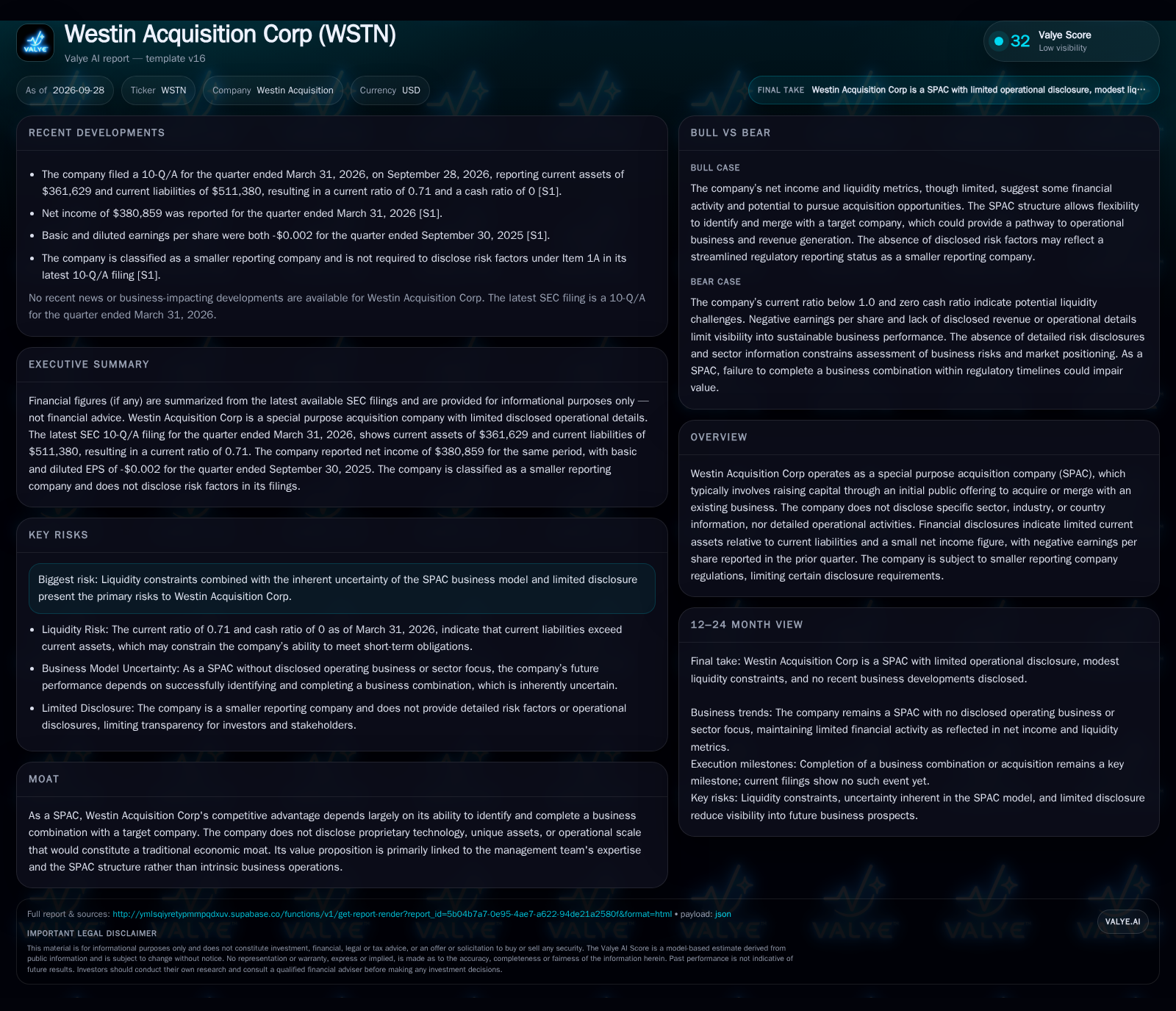
Westin Acquisition Corp is a blank-check company with no operating business, a current ratio below 1.0, and no cash on hand as of March 31, 2026. The primary thesis revolves around whether management can execute a value-creating deal before resources are depleted or timelines expire. [S1]
Westin Acquisition Corp exemplifies the binary nature of SPAC investing: its entire business model centers on deploying IPO proceeds to acquire or merge with an operating company within a tight regulatory window. Investors in Westin are betting not on current operations, but on the management’s ability to identify, negotiate, and close an attractive transaction before time and liquidity run out. [S1]
Liquidity Constraints and Operating Inactivity Define the Near-Term Picture
As of March 31, 2026, Westin Acquisition Corp reported current assets of $361,629 against current liabilities of $511,380, resulting in a current ratio of 0.71 and a cash ratio of 0. This signals that the company’s liquid resources are insufficient to cover its short-term obligations. The company also reported net income of $380,859 for the quarter, but since there is no operating business, this figure likely stems from non-operating items such as interest on trust assets or accounting entries related to the SPAC structure. Critically, Westin has not identified a merger target and has not engaged in substantive discussions for a business combination, according to its latest filings. [S1]
This liquidity profile underscores the inherent tension in SPAC operations between maintaining sufficient operating capital and preserving trust assets for the eventual business combination. The absence of cash on hand outside the trust indicates that Westin relies heavily on minimal operational expenditures and potentially sponsor support to cover administrative costs. If operating expenses accelerate without corresponding capital infusions, the company may face increasing pressure to either secure a transaction quickly or consider alternative financing strategies, each of which carries implications for shareholder value and deal terms.
SPAC Economics: Fee Drag, Trust Capital, and the Binary Outcome Problem
Westin’s economic model is typical of SPACs: raise capital via an IPO, park most proceeds in a trust, and seek to merge with a private company within a set timeframe (often 18-24 months post-IPO). Until a deal is consummated, SPACs generate little to no operating revenue—any reported net income is generally from interest on trust assets rather than ongoing business activity. The proceeds from the November 2025 IPO ($57.5 million gross) and private placement ($2.35 million) are presumably held in trust, but the small current asset balance and zero cash ratio suggest that operating funds outside the trust are severely limited. Fixed costs—legal, regulatory, and diligence expenses—continue to erode the pool of available capital. If Westin fails to complete a business combination within the allowed window, remaining trust funds (minus expenses) are typically returned to shareholders, often at a loss due to fee drag and the absence of deal-related upside. [S1]
The fee drag phenomenon is a critical structural consideration for SPAC investors, as ongoing legal, accounting, and advisory fees gradually diminish the trust account balance over time. This erosion not only reduces the capital available for investment but also shifts the risk-reward profile, making the timing of a transaction pivotal. Additionally, the sponsor’s promote—an equity stake typically granted as compensation—creates a misalignment if the SPAC fails to consummate a deal, as sponsors may have incentives to extend the search period or pursue lower-quality targets to preserve their equity value, potentially at the expense of public shareholders.
Competing for Targets in a Crowded SPAC Market
Westin’s competitive positioning is dictated by the broader SPAC ecosystem, where multiple blank-check companies vie for a limited pool of attractive private targets. Unlike operating businesses, Westin has no proprietary technology, customer base, or recurring revenue to create a moat. Its only potential edge lies in sponsor reputation, deal-making skill, and ability to structure a compelling merger for both target shareholders and public investors. However, with no disclosed sector focus, target pipeline, or management track record, Westin’s ability to outcompete other SPACs is highly uncertain. The crowded SPAC field also drives up valuations for targets and increases the risk of suboptimal deals, especially as the regulatory clock winds down.
The competitive dynamics within the SPAC market also influence deal quality and timing. With numerous SPACs chasing a finite number of attractive targets, competition can drive up acquisition prices, compressing potential returns. Furthermore, the lack of a disclosed sector focus may hinder Westin’s ability to build specialized expertise or relationships that facilitate proprietary deal flow, placing it at a disadvantage relative to sector-focused SPACs. This environment may compel management to consider broader or less differentiated targets, introducing additional execution risk and complicating investor assessment of deal merits.
A Value-Creating Merger Is Secured Before the Deadline
The bullish scenario depends on Westin’s management sourcing and executing a business combination with a high-quality target at an attractive valuation before liquidity or regulatory constraints force a liquidation. Successful execution could unlock upside via access to public capital markets for the target, sponsor promote economics, and potential post-merger appreciation. Evidence that would support this scenario includes public announcements of a definitive merger agreement, regulatory filings detailing a proposed transaction, and shareholder approval of the deal. Falsification would come in the form of missed deadlines, failure to secure a viable target, or material redemptions eroding deal economics.
Most Probable Outcome: Prolonged Search, Rising Costs, and Diminishing Options
The most plausible scenario is that Westin continues to search for a target over the coming quarters, incurring ongoing legal and administrative expenses while its pool of available capital shrinks. As deadlines approach and liquidity tightens, management may face pressure to settle for less attractive deals or seek deadline extensions—potentially at the cost of dilution or unfavorable terms. Confirmation would come from further regulatory filings indicating deadline extensions, additional capital raises, or announcements of non-binding letters of intent. Falsification would be a sudden announcement of a definitive business combination or, conversely, initiation of the liquidation process.
No Deal Materializes: Liquidation and Value Erosion
If Westin fails to secure a business combination before the regulatory window closes, the SPAC will be forced to liquidate, returning remaining trust assets to shareholders after deducting expenses. Given the ongoing fee drag and the low current asset position outside the trust, shareholders may receive less than their original investment, and sponsor capital is likely to be wiped out entirely. Evidence confirming this pathway would include SEC filings initiating liquidation, public notices to shareholders about redemption, or disclosures of insufficient capital to continue operations.
Milestones That Will Determine Whether Westin Acquisition Corp Creates or Erodes Value
Announcement of a definitive agreement for a business combination would be the strongest positive signal for future value creation.
SEC filings or press releases indicating the company has entered substantive negotiations with a target would help clarify the probability of a successful deal.
Any extension of the SPAC’s timeline to complete a business combination, if disclosed, would signal either ongoing target search or difficulties in deal execution.
Disclosure of changes in trust account balance (if provided) would reveal the degree of fee drag and capital remaining for a potential transaction.
A useful metric would be the redemption rate among public shareholders upon announcement of a business combination, as high redemptions can undermine deal viability.
Updates regarding additional capital infusions from sponsors or third parties, if disclosed, would indicate management’s commitment or recognition of liquidity stress.
Any initiation of liquidation procedures or public notice to shareholders of trust distribution would confirm the downside scenario.
Disclaimer: This is research-only, informational analysis and not investment advice. It may include AI-generated interpretation and general industry context. Always verify important details using primary sources.

Comments