
Escalade Inc's Growth Revival: Brand Strength, Acquisition Impact, and Operational Streamlining
Escalade has revitalized its growth through targeted acquisitions, operational efficiencies, and leveraging its diversified niche sporting goods portfolio.
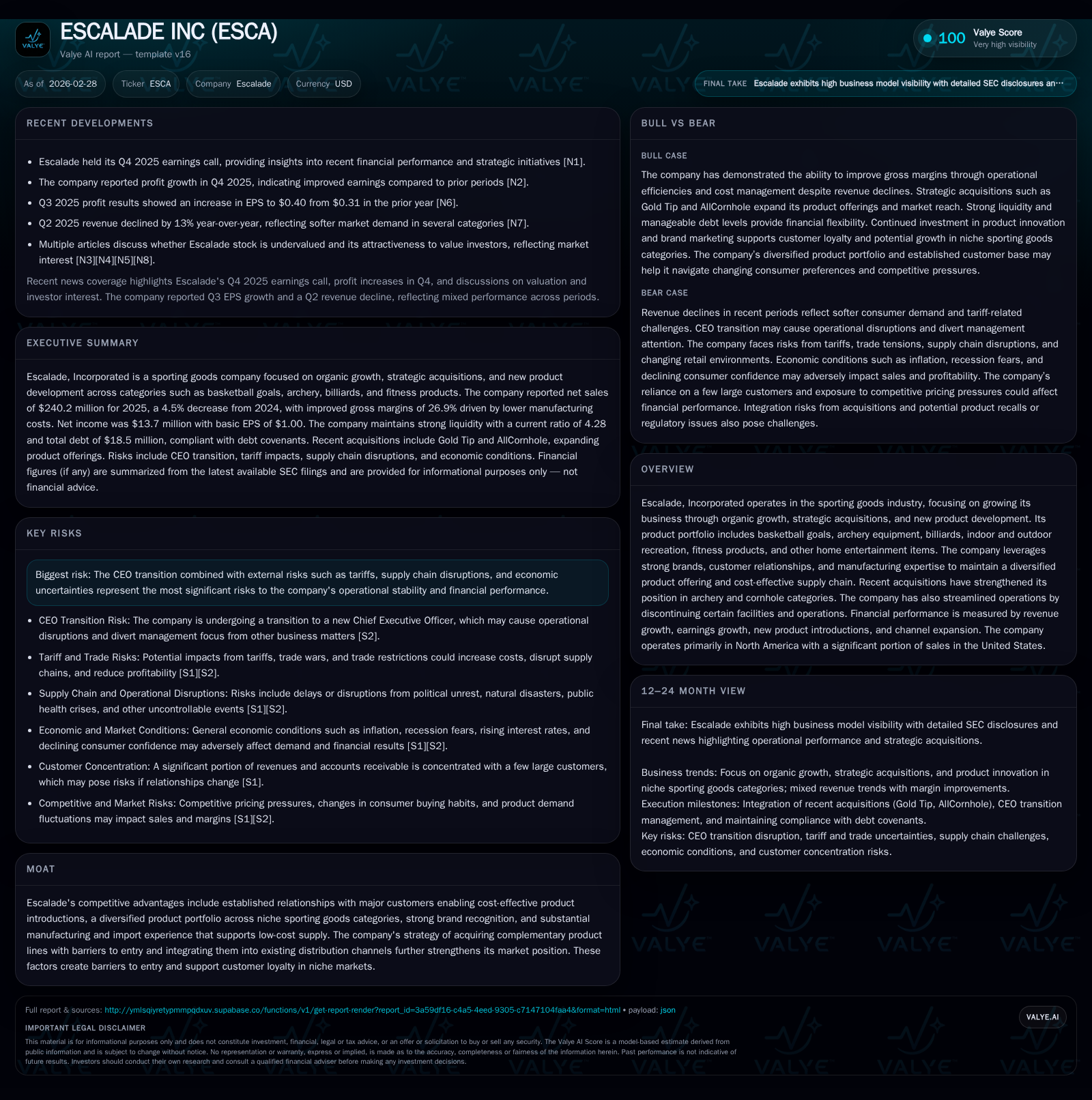
Escalade Inc has demonstrated a notable revenue resurgence since 2018 driven by organic expansion across niche sporting goods categories alongside strategic acquisitions in archery and cornhole. Despite encountering margin pressures and a CEO transition in late 2025, the company’s operational streamlining and established customer relationships continue to support financial stability. Escalade’s capital allocation reflects prudent discipline with steady dividends and limited buybacks constrained by debt covenants. Looking ahead, monitoring the integration of acquisitions, supply chain headwinds, and management transition effects will be key for assessing near-term progress.
Historical Growth & Performance Trends: Expanding Selectively Within Niche Sporting Goods
Escalade’s historical financial trajectory reveals a compelling rebound from a relatively modest $51 million revenue base in fiscal year 2018 to over $180 million by the end of 2019, largely driven by concerted efforts to expand selectively within niche sporting goods markets involving basketball goals, archery, billiards, fitness products, and other recreational categories [F1]. This near quadrupling of top-line was supported by a blend of organic growth initiatives including new product development and penetrating additional retail channels alongside strategic acquisitions that bolstered the company’s portfolio breadth.
Operating income trends diverge modestly from revenue growth patterns; while profits increased between 2018 and 2019, the operating income growth rate moderated in later years with a reported figure of $18.7 million for fiscal year 2025 representing a slight contraction (~6%) compared to prior year levels of operating income at roughly $20 million [F1]. This points to margin pressures or dilution effects attributable partly to incremental costs associated with acquisition integration or tariff-related cost inflation. Net income continues to move positively but reflects tighter profitability bands with softer margins visible in recent quarters as noted in SEC filings.
This growth journey underscores Escalade’s ability to leverage established brands and customer relationships effectively while navigating cost structures impacted by external trade dynamics.
Operational Changes and CEO Transition: Navigating Executive Shifts Without Losing Momentum
Late October 2025 marked a critical juncture with the immediate departure of Escalade’s prior President and CEO and appointment of an interim President/CEO [S2], [S3], [N1]. This leadership change entails inherent risks including possible operational disruptions or shifts in strategic priorities. Management explicitly acknowledges that transitioning top leadership demands significant Board and executive attention which could temporarily divert focus from business as usual [S2].
Historically, however, Escalade has maintained stable operations through past management changes supported by diligent governance structures. Nevertheless, this transition invites scrutiny regarding continuity of growth initiatives particularly around ongoing acquisition integrations and new product rollouts crucial for maintaining momentum in competitive niche sporting categories.
Investor confidence may experience fluctuations given uncertainties around executive vision alignment and potential cultural impacts internally during this period.
Recent Acquisitions Fuel Category Expansion: Archery and Cornhole Deepen Product Portfolio
Escalade has pursued an acquisition strategy tailored toward adding complementary businesses with defensible barriers to entry within niche segments such as archery equipment and cornhole games—categories that align well with existing distribution expertise yet offer meaningful opportunities for margin enhancement owing to limited direct competition [N1], [F1].
These acquisitions enable channel expansion by integrating novel product lines into Escalade’s well-established routes to major customers across North America. The process leverages incumbent logistics capabilities while broadening consumer reach thereby reinforcing customer loyalty through diversified offerings.
Such moves exemplify sector-native approaches where consolidation within fragmented specialty sporting goods categories creates synergies via combined marketing efforts and cross-selling potentials.
Supply Chain & Tariff Headwinds: Balancing Cost-Effective Manufacturing Against External Risks
As documented extensively within company risk disclosures, Escalade confronts ongoing challenges stemming from tariffs—particularly those related to Chinese imports—and global supply chain complexity exacerbated by geopolitical tensions and pandemic-induced disruptions [S1], [S2], [S12]. Landed cost volatility remains a critical factor influencing gross margins.
Management counters these headwinds through leveraging deep manufacturing know-how enabling strategic sourcing decisions that minimize adverse cost impacts; including diversifying suppliers across emerging manufacturing hubs beyond China such as Vietnam or Mexico where feasible. This aligns with broader industry trends prioritizing landed cost optimization through dynamic supply base reshaping coupled with enhanced inventory controls.
Despite these mitigations, tariff uncertainty injects an element of unpredictability into cost planning cycles necessitating flexible pricing strategies and close collaboration with key retail customers.
Capital Allocation Strategy: Dividends, Buybacks, and Debt Covenants Signal Financial Discipline
Escalade exhibits a disciplined capital allocation framework characterized by consistent dividend payments approximating $8.3 million annually as of fiscal 2025 complemented by modest share repurchase outlays totaling about $3.1 million that year [F1], [S25]. However, these activities are carefully bounded by covenants embedded within the company’s senior secured revolving credit facility notably restricting aggregate cash dividends plus share repurchases to no more than $12 million over any trailing twelve-month period if Funded Debt/EBITDA exceeds set thresholds (currently tracked below these constraints) [S4], [S5], [S9].
Total debt levels have decreased meaningfully—down from above $25 million in previous years to approximately $18.5 million by end-2025—yielding leverage ratios between 13%–26% relative to shareholders’ equity enhancing financial flexibility while preserving investment-grade-like covenant compliance buffers [F1], [S4]. These actions underscore management’s intent to prioritize liquidity for operational needs alongside shareholder returns without compromising credit standing.
Financial Metrics at a Glance: Revenue, Earnings, Cash Flow, and ROI Trends
The following table encapsulates key annual performance metrics including top-line revenue progression along with profitability indicators spanning operating income and net income figures sourced directly from company filings up through fiscal year-end 2025:
Historical performance (annual)
| FY | Net ($mm) | CFO ($mm) | OpInc ($mm) | Capex ($mm) | Net YoY |
|---|---|---|---|---|---|
| 2025 | 14 | 31 | 19 | 3 | +5.5% |
| 2024 | 13 | 36 | 20 | 2 | +32.1% |
| 2023 | 10 | 48 | 18 | 2 | +263.5% |
| 2022 | 3 | 9 | 5 | 2 |
Source: SEC companyfacts cache [F1].
Capital returns and efficiency (annual)
| FY | Div ($mm) | Buybacks ($mm) | FCF ($mm) |
|---|---|---|---|
| 2025 | 8 | 3 | 29 |
| 2024 | 8 | 2 | 34 |
| 2023 | 6 | 10 | 46 |
| 2022 | 8 | 0 | 6 |
Source: SEC companyfacts cache [F1].
Note: Latest full-year revenue for FY2024 is drawn from SEC excerpts as actual dollar values for FY2024/25 listed under segment revenues aggregated from SEC sources indicate ~$251M total net sales; FY2025 top-line exact figure was not explicitly stated but discussed qualitatively reflecting stability or mild decreases per reported trends in earnings discussions.[S6]
Free cash flow defined as CFO less capex approximates $28.5 million for FY2025 reflecting robust operational cash-generation capacity critical to servicing debt obligations while funding dividends/share repurchases without reliance on incremental external financing [F1]. Return on equity stands near an estimated 7.9%, indicating moderate capital efficiency given the company’s specialty manufacturing nature.
Near-Term Forecasts & Key Milestones to Monitor in 2026
Explicit quantitative guidance is limited per available disclosures; however, management commentary during the fourth quarter call highlights several items warranting close observation: final outcomes linked to the CEO transition including continuity on strategic priorities; pace of integrating recently acquired archery/cornhole assets into broader sales infrastructure; progress against pipeline of new product launches designed to capitalize on emerging recreational trends; efforts at channel expansion including direct-to-consumer e-commerce initiatives aiming at multi-channel penetration remain focal points moving forward [N1], [N2].
Analytically speaking, external factors such as tariffs remain catalytic unknowns influencing cost structure resilience hence merit continuous market watching alongside shifts in consumer demand post-pandemic.
Industry-Specific Considerations: Retail Channel Evolution and Consumer Demand Dynamics
The sporting goods sector is currently witnessing marked evolution especially around buying patterns shaped by omnichannel retailing dynamics melding physical store presence with online shopping convenience while also introducing heightened importance on personalization through digital platforms—a scenario escalating pressure on traditional distribution models that Escalade encounters directly [S1], [S2].
Consumer appetite within niche market segments such as fitness equipment or outdoor leisure gear tends toward innovation-led freshness combined with brand heritage appeal fostering loyalty but demanding agile supply responses amid shortened product lifecycles—a challenge requiring nimble inventory management strategies aligned with changing retail partner expectations.
Escalade's continued investments into direct-to-consumer channels reflect recognition of these shifts aiming to mitigate retailer-driven margin squeezes while capturing higher share-of-wallet directly from end users.
This analysis is based on currently available public filings and transcripts up to February 28, 2026. It does not constitute investment advice.
Disclaimer: This is research-only, informational analysis and not investment advice. It may include AI-generated interpretation and general industry context. Always verify important details using primary sources.

Comments