
Establishment Labs’ Recovery and Innovation Drive in Breast Aesthetics
The company leverages proprietary implant technology and recent U.S. regulatory approvals to rebound from financial setbacks in the competitive breast aesthetics market.
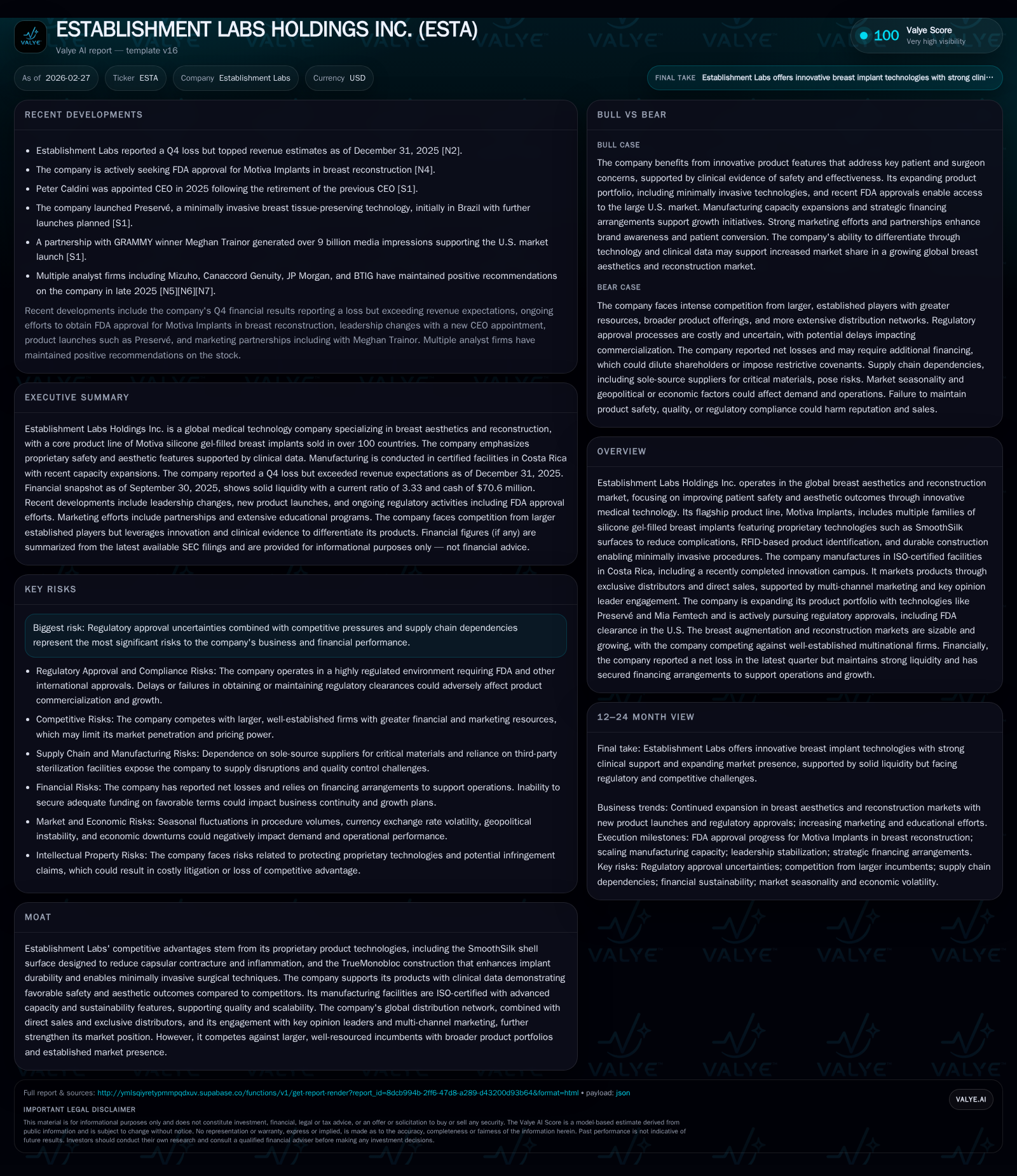
Establishment Labs Holdings Inc. is emerging from several years of operating losses by capitalizing on its patented Motiva Implant technologies and expanding into the U.S. market following key FDA clearances. Despite persistent negative net income and free cash flow pressures, the firm shows signs of margin improvement linked to product launches and geographic expansion. Regulatory complexities and competitive dynamics remain critical risks, while innovation pipelines such as Mia Femtech and Preservé position the company for longer-term growth within women’s health technologies.
Historical Financial Performance: Narrowing Losses Amid Investment
Establishment Labs has faced sustained operating losses over recent years but shows signs of financial stabilization. According to [F1], while revenue figures for recent years are undisclosed, operating income improved from a loss of approximately $50 million in FY2024 to about $39 million in FY2025 — a 22% year-over-year improvement. Net losses similarly narrowed by nearly 40% year-over-year but remained substantial at around -$51 million in FY2025. Operating cash flow was negative $50.9 million in FY2025, reflecting ongoing investment needs despite some recovery from prior larger outflows.
Capital expenditures hovered near $6 million annually supporting manufacturing capacity expansions including proprietary 3D printed molding methods at the Costa Rica facility [S1]. The company’s current ratio exceeds 3x with cash and equivalents at $75.5 million as of December 31, 2025, indicating solid liquidity buffers amid continued operational cash burn.
Historical performance (annual)
| FY | Net ($mm) | CFO ($mm) | OpInc ($mm) | Capex ($mm) | Net YoY |
|---|---|---|---|---|---|
| 2025 | -51 | -51 | -39 | 6 | +39.6% |
| 2024 | -85 | -59 | -50 | 6 | -7.8% |
| 2023 | -79 | -89 | -65 | 8 | -4.4% |
| 2022 | -75 | -52 | -40 | 3 |
Source: SEC companyfacts cache [F1].
Capital returns and efficiency (annual)
| FY | FCF ($mm) | ROE% |
|---|---|---|
| 2025 | -57 | -216.9 |
| 2024 | -65 | -159.3 |
| 2023 | -96 | -426.8 |
| 2022 | -55 | 918.9 |
Source: SEC companyfacts cache [F1].
Motiva Implant Technologies: Clinical Differentiation Driving Growth
The Motiva implants constitute Establishment Labs’ core offering within breast aesthetics. Their proprietary technologies are designed to address key clinical challenges such as capsular contracture through an optimized SmoothSilk / SilkSurface biocompatible smooth surface that reduces adverse tissue responses [S1][S17].
Innovations include Qid RFID technology featuring ZEN electronic serial numbers readable non-invasively post-implantation for enhanced product traceability and patient safety — a feature increasingly demanded in implantable medical devices.
The TrueMonobloc gel-shell-patch configuration enhances mechanical durability while allowing smaller incisions due to increased shell flexibility supporting minimally invasive surgical techniques favored by plastic surgeons seeking improved aesthetic outcomes.
Clinical evidence from a U.S. IDE study demonstrates favorable safety profiles with low rates of rupture or reoperation relative to competitors’ products [S1]. These technical differentiators underpin Establishment Labs’ competitive positioning against larger incumbents whose textured implants face increasing scrutiny due to lymphoma safety concerns.
U.S. Market Entry: Regulatory Milestones and Operational Challenges
FDA clearance of the Motiva Flora SmoothSilk Tissue Expander via 510(k) in October 2023 followed by approval of Motiva Implants in September 2024 marked pivotal milestones enabling Establishment Labs’ entry into the large and highly regulated U.S. market [S1][N1][S3]. This transition expands their presence beyond over 100 international countries where Motiva products have been sold since inception.
However, the company’s limited U.S. commercial history presents risks related to building sales infrastructure and physician relationships amid entrenched competitors with extensive clinical registries and established marketing channels [S1][S17]. Compliance with stringent FDA promotional guidelines—including restrictions on direct-to-consumer advertising—and navigating complex reimbursement frameworks add layers of complexity.
Post-approval surveillance requirements are rigorous following recent Supreme Court rulings that limit deference to agency interpretations of statutes governing FDA actions [S6]. Robust quality assurance and ongoing clinical evidence generation will be critical to maintaining regulatory approvals and market trust.
Regulatory Environment: Compliance Risks Impacting Growth Execution
Extensive regulatory risks characterize Establishment Labs’ operating environment as detailed in filings [S4]–[S16]. These include potential FDA review delays driven by funding constraints or legal challenges such as Loper Bright Enterprises v. Raimondo requiring courts’ independent judgment on agency authority rather than automatic deference.
Federal fraud and abuse statutes—such as anti-kickback laws—govern interactions with healthcare providers; violations risk severe penalties including exclusion from government healthcare programs which are vital reimbursement sources [S7]–[S9][S13].
Data privacy regulations including HIPAA impact handling of clinical data post-market despite indirect applicability; breaches could result in enforcement actions or reputational harm critical for patient trust [S10]–[S12][S20]. European GDPR regimes impose additional compliance costs given global manufacturing footprint.
Mandatory post-market medical device reporting obligations require timely disclosure of adverse events including rare cancers associated with implants; failures here may trigger regulatory sanctions detrimental to commercial viability [S16]–[S19]. Continuous investment in compliance infrastructure is essential for sustainable growth.
Innovation Pipeline: Advancing Beyond Breast Implants
Beyond its implant portfolio, Establishment Labs pursues adjunctive women’s health technologies exemplified by Mia Femtech—an implantable solution emphasizing sensitivity preservation alongside aesthetic outcomes [N1][S1].
A prospective three-year study involving 100 patients reported very low complication rates without capsular contracture cases (Baker Grade III/IV), implant rupture or significant side effects such as nipple/breast sensitivity loss or infection [N1]. Patient satisfaction increased by 87% at three years with surgeons overwhelmingly satisfied.
Preservé technology aims to improve biocompatibility potentially broadening applications toward personalized tissue expanders supporting hybrid surgical protocols like MotivaHybrid integrating fat grafting [N1].
These initiatives diversify product offerings addressing multi-dimensional care facets mitigating concentration risk inherent to silicone implant reliance.
Capital Allocation: Liquidity Strength Amid Cash Flow Deficits
Fiscal year 2025 results reveal net losses near $51 million alongside operating cash outflows approaching $51 million ([F1]). Capital expenditures remained steady at approximately $6 million reflecting ongoing investments in manufacturing capacity.
Free cash flow was negative roughly $56.9 million when subtracting capex from operating cash flow ([F1]). Equity improved modestly from negative $8.2 million in FY2022 to positive $23.5 million in FY2025 indicating recapitalization efforts amid accumulated losses.
Approximate return on equity stands near -217% reflecting continued value destruction absent profitability ([F1]). However, robust current assets exceeding liabilities by over threefold provide healthy short-term liquidity supported by $75.5 million cash reserves ensuring operational continuity.
No dividends or share repurchase programs have been announced consistent with reinvestment focus toward product development and market expansion rather than shareholder returns.
Outlook: Key Milestones and Market Dynamics to Monitor
Investors should track quarterly earnings reports for evidence of revenue ramp strength post-U.S. launch alongside progress managing scaling expenses ([N2]). Additional FDA clearances expanding indications or related products would broaden addressable markets while delays could constrain growth pacing ([N1],[S3]).
Execution of U.S. commercialization will test capacity to establish durable sales channels amidst intense competition characterized by entrenched incumbents leveraging extensive clinical data registries ([S17]). Pricing pressures compounded by healthcare cost containment initiatives pose margin risks requiring strategic vigilance ([S19]).
Reimbursement environment shifts across federal payors critically influence procedural volumes impacting implant demand necessitating close monitoring of legislative changes alongside real-world adoption metrics.
This analysis synthesizes publicly available financial filings [F1], company disclosures [N1,N2,S1,S3], recent news transcripts [N1,N2], and documented risk factors without extrapolation beyond source material indications. Readers should interpret findings within the context of dynamic regulatory environments inherent to innovative medical device sectors.
Disclaimer: This is research-only, informational analysis and not investment advice. It may include AI-generated interpretation and general industry context. Always verify important details using primary sources.

Comments