
East West Bancorp’s Balanced Growth and Dividend Appeal Amid Rising Costs
East West Bancorp delivered strong earnings growth driven by commercial loan portfolio diversification and robust noninterest income while balancing capital returns amid regional concentration risks.
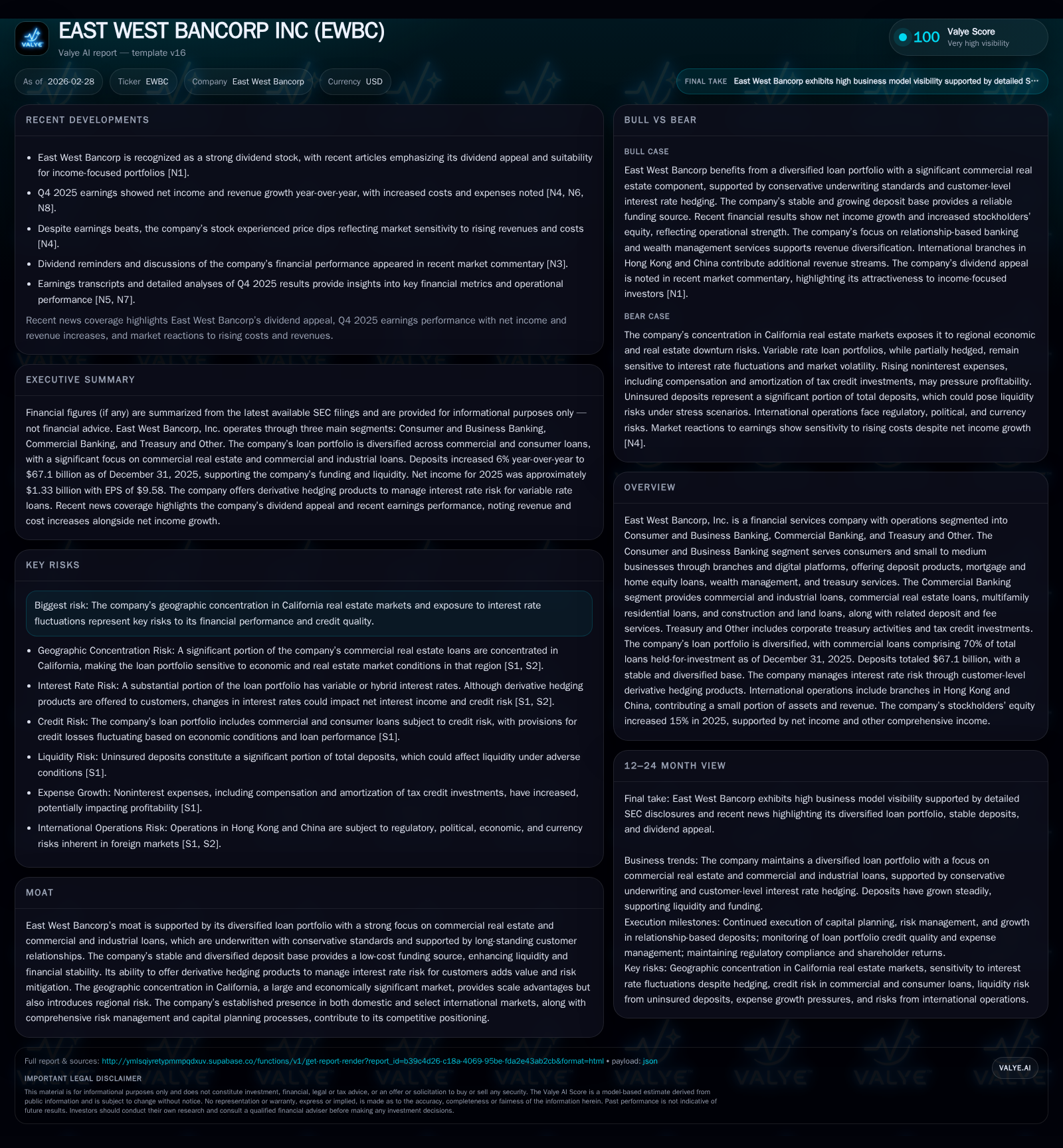
East West Bancorp Inc. (EWBC) reported a 13.7% increase in net income for 2025, underpinned by steady growth in its commercial loan segments and enhanced fee-based revenues. The company’s diversified loan portfolio, with conservative underwriting and interest rate hedges, supports stable earnings despite geographic concentration risks in California’s real estate market. Capital allocation remains disciplined, highlighted by sustained dividends and share buybacks alongside a solid 14.9% return on equity. Going forward, rising funding costs and regional economic sensitivities present challenges to margin expansion, though ongoing demand for commercial credit and fee income growth provide meaningful upside potential.
Financial Growth Trajectory: Key Drivers Behind Earnings Expansion
East West Bancorp's financial results for the full year ended December 31, 2025 reflect a continuation of solid profitability momentum supported by diversified revenue streams. Net income grew by 13.7% year-over-year to $1.33 billion [F1], a strong show considering heightened competitive pressures and increasing operating costs noted in recent earnings commentary [N1][N4]. This growth was primarily fueled by an expanding commercial loan portfolio alongside improved noninterest income.
The company’s net interest income gains reflect nuanced drivers: While average loan volumes rose significantly across commercial segments, interest yield compression from lower interest rates offset some benefits. According to management's detailed breakdown in the MD&A section of the 10-K filing, contributions from volume increases outweighed yield declines on the asset side, yet deposit cost hikes exerted downward pressure on net interest spreads [S1]. Operating cash flow also increased moderately by 6.4% to approximately $1.5 billion, underscoring healthy core business cash generation capacity during moderate capital expenditures [F1].
Historical performance (annual)
| FY | Net ($mm) | CFO ($bn) | Net YoY |
|---|---|---|---|
| 2025 | 1325 | 1.5 | +13.7% |
| 2024 | 1166 | 1.4 | +0.4% |
| 2023 | 1161 | 1.4 | +2.9% |
| 2022 | 1128 | 2.1 |
Source: SEC companyfacts cache [F1].
Capital returns and efficiency (annual)
| FY | Buybacks ($mm) | ROE% |
|---|---|---|
| 2025 | 116 | 14.9 |
| 2024 | 143 | 15.1 |
| 2023 | 82 | 16.7 |
| 2022 | 100 | 18.8 |
Source: SEC companyfacts cache [F1].
Note: Capex data limited; equity presented for ROE context.
Loan Portfolio Composition: Commercial Focus and Risk Controls
EWBC’s core strength lies in its well-diversified commercial loan portfolio which accounted for approximately 70% of total loans held-for-investment at year-end [$56.9 billion outstanding] as of December 31, 2025 [S4]. The breakdown within this segment spans Commercial & Industrial (C&I), Commercial Real Estate (CRE), including multifamily residential properties, as well as construction and land financing.
Management emphasizes conservative underwriting standards targeting loan-to-value (LTV) ratios averaging around or below industry norms—approximately mid-40s to low-50s percentage ranges across CRE property types—and robust debt service coverage ratios (DSCR), which collectively bolster credit resilience under variable economic scenarios [S6][S11]. For instance, owner-occupied CRE comprised roughly one-fifth of CRE loans with the remainder mostly non-owner occupied serviced primarily via third-party rents.
Interest rate risk inherent in a portfolio where over half consists of variable-rate loans is managed via customer-level derivative contracts; about half of variable-rate CRE and multifamily residential exposure had active rate hedges at year-end reflecting thoughtful risk mitigation strategies consistent with supervisory guidance [S1][S2]. Construction loans showed gradual growth totaling several hundred million dollars with unfunded commitments scaling commensurately.
Noninterest Income Trends Reflecting Customer Activity and Fee Increases
Noninterest income has emerged as an increasingly vital component stabilizing East West’s revenue base amid margin pressures from higher deposit costs and shifting loan yields. In absolute terms, total noninterest income expanded by approximately $44 million or +13% to $379 million during fiscal year 2025, maintaining a steady contribution of about 13% of total revenue year-over-year [S1].
Drivers included elevated wealth management fees (+29%) fueled by client asset inflows and enhanced product offerings as well as increased lending-related fees which benefited from stronger trade finance activity (+10%). Commercial deposit-related fees rose around +8%, partially reflecting pricing actions alongside greater transactional volumes from core customers.
Foreign exchange services exhibited incremental gains owing to favorable currency movements coupled with heightened client usage while other investment incomes nearly doubled due to strategic portfolio management initiatives [S1]. This broad fee-income mix supports diversification away from pure net interest margin reliance.
Geographic Market Concentration and Its Double-Edged Effects
While East West Bancorp benefits materially from its scale presence in California — accounting for roughly two-thirds of its CRE loans and over half its single-family residential mortgage portfolio — this geographic concentration exposes it to region-specific macroeconomic risks including real estate market downturns or regulatory shifts impacting property valuations and borrower cash flows [S6][S11].
California’s sizable economy provides ample originations opportunities facilitating relationship depth in commercial lending but necessitates vigilant credit monitoring given sector cyclicality risks articulated explicitly under the Company’s risk disclosures [S2][S17]. This dual nature frames a key challenge: leveraging regional dominance while prudently managing concentrated credit exposure.
Capital Allocation: Dividends, Buybacks, and Return on Equity Analysis
A standout feature of EWBC’s shareholder capital discipline is its consistent delivery of attractive returns alongside measured capital recycling activities to support growth needs.
Stockholders’ equity grew by approximately $1.2 billion or +15% in the latest fiscal year reaching near $8.9 billion driven predominantly by retained earnings accumulation after dividend payouts totaling about $335 million alongside share repurchases amounting to $116 million executed through open-market purchases or RSU tax withholding actions [F1][S16].
Return on equity remained robust at circa 14.9%, evidencing profitability efficiency relative to invested capital even amid upward cost pressures on funding sources and operating expenses.
Free cash flow — approximated at nearly $1.5 billion after adjusting operating cash flow for minimal capex commitments — underscores strong internal cash generation capacity supporting both organic growth investments and shareholder returns without undue leverage strain [F1].
Outlook Signals: Industry Positioning and Key Financial Milestones to Watch
Looking ahead into calendar year 2026, key areas warrant close observation include net interest margin trajectory influenced by evolving funding cost curves versus loan asset repricing capabilities amid still fluid Federal Reserve policy signals discussed during recent earnings calls ([N3]).
Credit quality will remain under scrutiny given geographic concentration linked risks; however conservative underwriting frameworks along with proactive hedging imbue confidence in managing cyclical volatility ([N7]). Loan growth drivers may hinge on sustaining momentum within commercial segments particularly capital call facilitation lending to non-depository financial institutions—a fast-growing niche component within their C&I portfolio that reached $7.6 billion outstandings as of year-end ([S4]).
Investor focus is likely to also weigh on continued expansion of fee-generating services which contribute meaningful noninterest income stabilization amid fluctuating interest rate environments.
Interest Rate Risk Management via Hedge Offerings: A Competitive Edge
East West Bancorp distinguishes itself within regional banking peers through integrating customer-level derivative hedging products embedded specifically into its commercial real estate and multifamily lending programs ([S1],[S2]). These derivatives protect both lender earnings sensitivity and borrower payment stability against volatile benchmark rate movements—a critical value add given the substantial share of variable rate instruments.
This structured risk mitigation approach enhances portfolio resilience, reduces margin compression potential during rate spikes or corrections, and aids client retention by aligning financing costs more predictably over loan lifecycles—illustrating an advanced risk-return management architecture uncommon at comparable financial institutions.
This analysis is based solely on publicly filed financial statements (Form 10-K/10-Q), related SEC disclosures, recent earnings transcripts/news releases up to February 28, 2026, and validated numeric datapoints from East West Bancorp’s SEC XBRL filings without speculative assumptions or projections beyond disclosed data. The information provided reflects historical performance indicators and qualitative assessments pertinent to EWBC’s business profile as presented to regulators and investors; this memo does not constitute investment advice or recommendations.
Disclaimer: This is research-only, informational analysis and not investment advice. It may include AI-generated interpretation and general industry context. Always verify important details using primary sources.

Comments