
First Citizens BancShares: Navigating Regional Banking Through Strategic Expansion and Diversification
First Citizens BancShares Inc leverages diversified lending and deposit-heavy funding to strengthen its regional banking footprint amid evolving market dynamics.
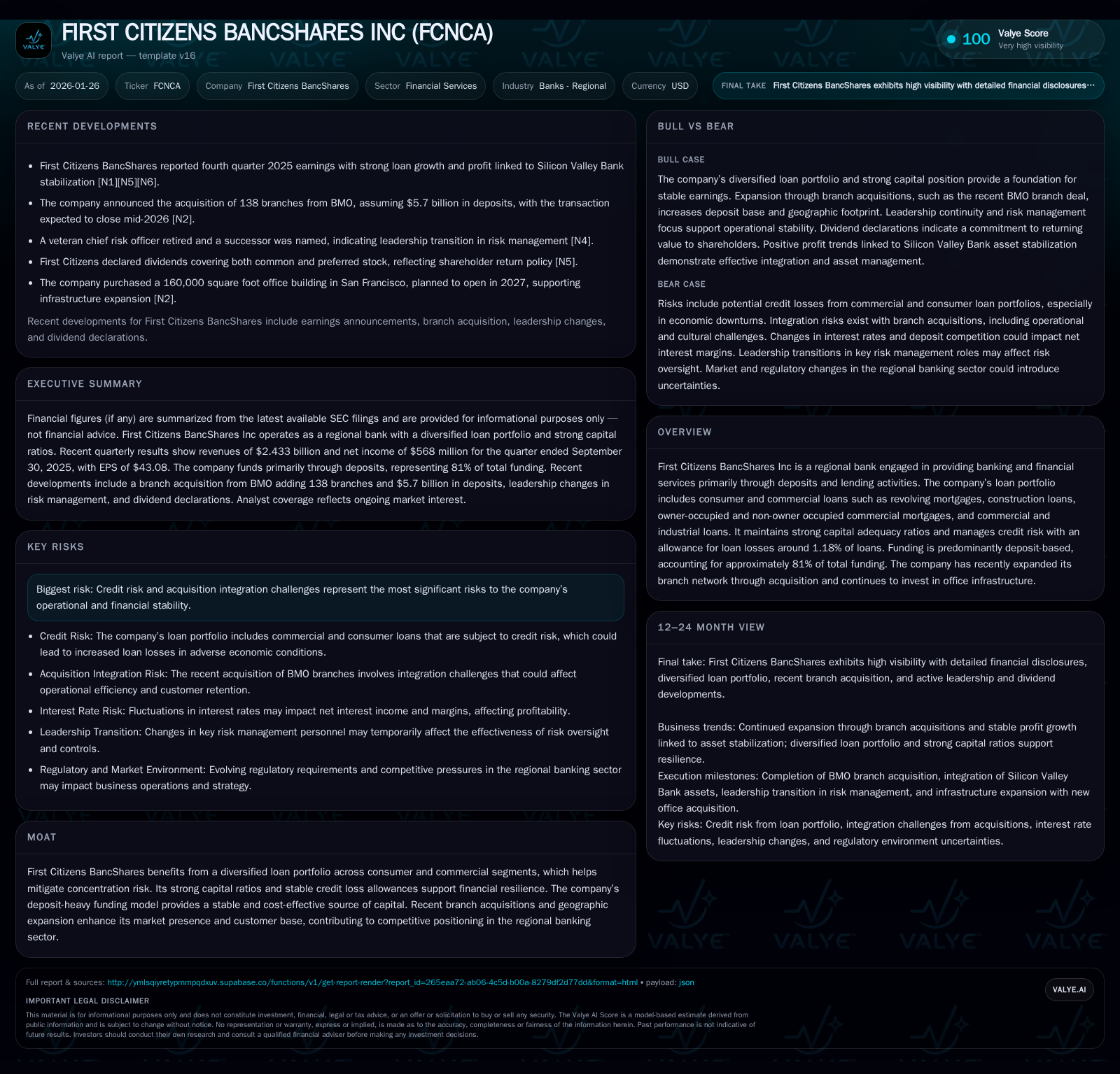
First Citizens BancShares continues to demonstrate solid financial performance driven by a diversified loan portfolio spanning consumer and commercial segments. Recent strategic moves, including the acquisition of BMO branches, underscore its ambition for geographic expansion and deposit base growth. The company's deposit-heavy funding model and strong capital ratios provide stability, while credit risk management remains critical amid acquisition integration challenges. Competitive pressures in regional banking and the evolving regulatory landscape shape operational priorities.
What Changed Recently
Over the past 45 days, First Citizens BancShares has accelerated its expansion trajectory through the announcement of acquiring 138 branches from BMO, which will add approximately $5.7 billion in deposits to its balance sheet. This deal is expected to close by mid-2026, marking a significant national expansion beyond its legacy regional footprint [N7][N8]. Concurrently, the bank reported strong fourth-quarter 2025 financial results, underpinned by robust loan growth and net interest income that exceeded analyst expectations, reflecting integration benefits and favorable interest rate environments [N2][N3][N5]. Capital investments also continue, with the purchase of a large office building in San Francisco set to open in 2027, signaling a commitment to infrastructure supporting growth [N12].
Leadership changes have been noteworthy as well, with a new middle-market banking leader appointed to bolster the Northeast region and a veteran Chief Risk Officer retiring, with a successor named to manage evolving credit and operational risks amid the bank’s expanding footprint [N10][N14]. Dividend payouts continue to be supported for both common and preferred stock classes, reinforcing capital return discipline [N11].
These developments collectively suggest an intentional strategy to scale through acquisition while maintaining financial and operational stability as competitive pressures mount.
Business Model as a System
First Citizens operates a classic regional bank model focused on originating and managing a diversified loan portfolio funded predominantly through deposits. The loan book includes consumer lending products like revolving mortgages and commercial lending such as construction loans, owner-occupied and non-owner-occupied commercial mortgages, and commercial and industrial loans [overview][S3][S4][S5]. This diversification mitigates concentration risks and balances interest rate and credit risk exposures.
Funding is largely deposit-centric, with approximately 81% of total funding sourced from deposits, emphasizing a low-cost and stable funding base. Brokered deposits are minimal, accounting for less than 1%, which limits liquidity risk and regulatory scrutiny often associated with wholesale funding [S15]. The company maintains strong capital adequacy ratios, supporting measured growth and absorbing credit shocks when necessary.
Revenue streams are primarily net interest income driven by loan yields less deposit costs, supplemented by noninterest income such as lending-related fees and other miscellaneous sources [S1][S2]. The allowance for loan losses is maintained at about 1.18% of total loans, reflecting conservative credit risk management [overview].
Operationally, First Citizens invests in branch network expansion and office infrastructure to support client acquisition and retention, with recent branch acquisitions significantly enhancing geographic reach and deposit scale. Risk management and governance structures are evolving alongside growth to maintain credit quality and operational integrity.
Industry Map & Competitive Battlefield
The regional banking sector is characterized by intense competition for deposit and loan market share, often balanced by localized customer relationships and service quality. First Citizens competes with other midsize regional banks, community banks, and large national banks extending regional operations.
Key competitive dimensions include:
Deposit Gathering: A critical battleground where stable, low-cost deposits enable lending growth. First Citizens’ deposit-heavy funding model is a competitive advantage against banks reliant on more volatile wholesale funding.
Loan Portfolio Diversification: Banks that balance consumer, commercial real estate, and industrial loans can manage risk and capitalize on diverse economic cycles. First Citizens’ balanced loan mix helps absorb sector-specific downturns.
Acquisition Strategy: Growth via acquisition is common, but integration capabilities differentiate winners and laggards. The recent BMO branch acquisition is a strategic move to build scale and expand into new markets.
Technology & Infrastructure: Investment in digital platforms and office infrastructure supports customer retention and operational efficiency.
Regulatory & Capital Management: Regional banks face close regulatory scrutiny on capital adequacy and credit risk, especially as they expand. Effective compliance and capital planning are key to sustaining growth.
Against this backdrop, First Citizens aims to leverage its deposit base, diversified lending, and acquisition-driven expansion to strengthen its positioning. However, competitive pressures from both large banks and nimble fintech entrants require continuous operational and technological enhancements.
Where the Economics Become Real
Unit economics for First Citizens hinge on the net interest margin (NIM), credit loss experience, and operational efficiency. Net interest income was approximately $1.414 billion, supported by the loan portfolio yielding interest income and controlled deposit costs [S1]. Noninterest income, while smaller, adds diversification to revenue, including lending-related fees which contribute modestly [S2].
The loan portfolio size was around $86 billion as of mid-2025, diversified across consumer and commercial segments [S16]. Maintaining credit quality is vital, with the allowance for loan losses at roughly 1.18% of loans and charge-offs monitored closely to prevent earnings volatility [overview][S8][S9].
Deposit funding economics are favorable given the 81% deposit funding ratio and minimal brokered deposit reliance, keeping funding costs low. Deposit composition stability is crucial, especially with a sizable portion of uninsured deposits (~36.4%), which could increase the sensitivity to depositor behavior under stress [S15].
Capital structure includes $36.7 billion in long-term debt and lease obligations, with a fixed-to-floating rate note that transitions to SOFR plus 141 basis points after 2030, indicating interest rate risk management considerations [S11][S12].
Operational leverage benefits come from recent branch acquisitions and infrastructure investments, which should spread fixed costs over a larger revenue base but require integration costs and upfront capital expenditures [N12]. Management’s ability to control credit risk and operational expenses will determine sustainable profitability.
Diligence Questions / Disconfirming Signals
Acquisition Integration Risks: How effectively can First Citizens integrate the newly acquired BMO branches? Are there precedents from past acquisitions indicating successful or challenged integrations?
Credit Quality Trajectory: With exposure to commercial real estate and construction loans, what is the trend in nonperforming assets and loan loss reserves? Are there signs of increasing stress or early-stage delinquencies?
Deposit Stability: Given that uninsured deposits constitute over a third of total deposits, how sensitive is the deposit base to interest rate changes or financial stress scenarios?
Regulatory Environment: Are there impending regulatory changes that could materially impact capital requirements or operational practices for First Citizens?
Competitive Differentiation: Beyond scale and deposit base, what tangible competitive advantages does First Citizens have in customer acquisition, technology platform, or service offerings compared to peers?
Leadership and Governance: What are the impacts of recent leadership changes, especially in risk management, on strategic execution and risk culture?
Interest Rate Risk: How is First Citizens managing potential margin compression if interest rates normalize or decline? What hedging or asset-liability management strategies are employed?
Operational Efficiency: With branch and office expansions, is there a risk of rising operating expenses outpacing revenue growth?
Economic Sensitivity: How exposed is the loan portfolio to regional economic downturns, especially in sectors heavily represented in the loan book?
Capital Return Strategy: Are share repurchases and dividends balanced prudently against growth capital needs and regulatory constraints?
First Citizens BancShares operates at a critical juncture of strategic expansion and operational execution within the competitive regional banking landscape. Its diversified loan portfolio and deposit-centric funding provide a stable financial foundation, augmented by acquisition-driven growth. However, the success of recent initiatives and resilience to evolving credit and regulatory risks will be pivotal in realizing sustained value creation.
Disclaimer: This report is for informational purposes only and does not constitute investment advice. All financial data referenced are based on publicly available sources and company disclosures as of the indicated dates.
Disclaimer: This is research-only, informational analysis and not investment advice. It may include AI-generated interpretation and general industry context. Always verify important details using primary sources.

Comments