
FedEx Corp: Navigating Freight Spin-Off and Restructuring Amid Global Logistics Challenges
FedEx is undergoing significant operational and financial restructuring while managing competitive pressures in the integrated freight and logistics sector.
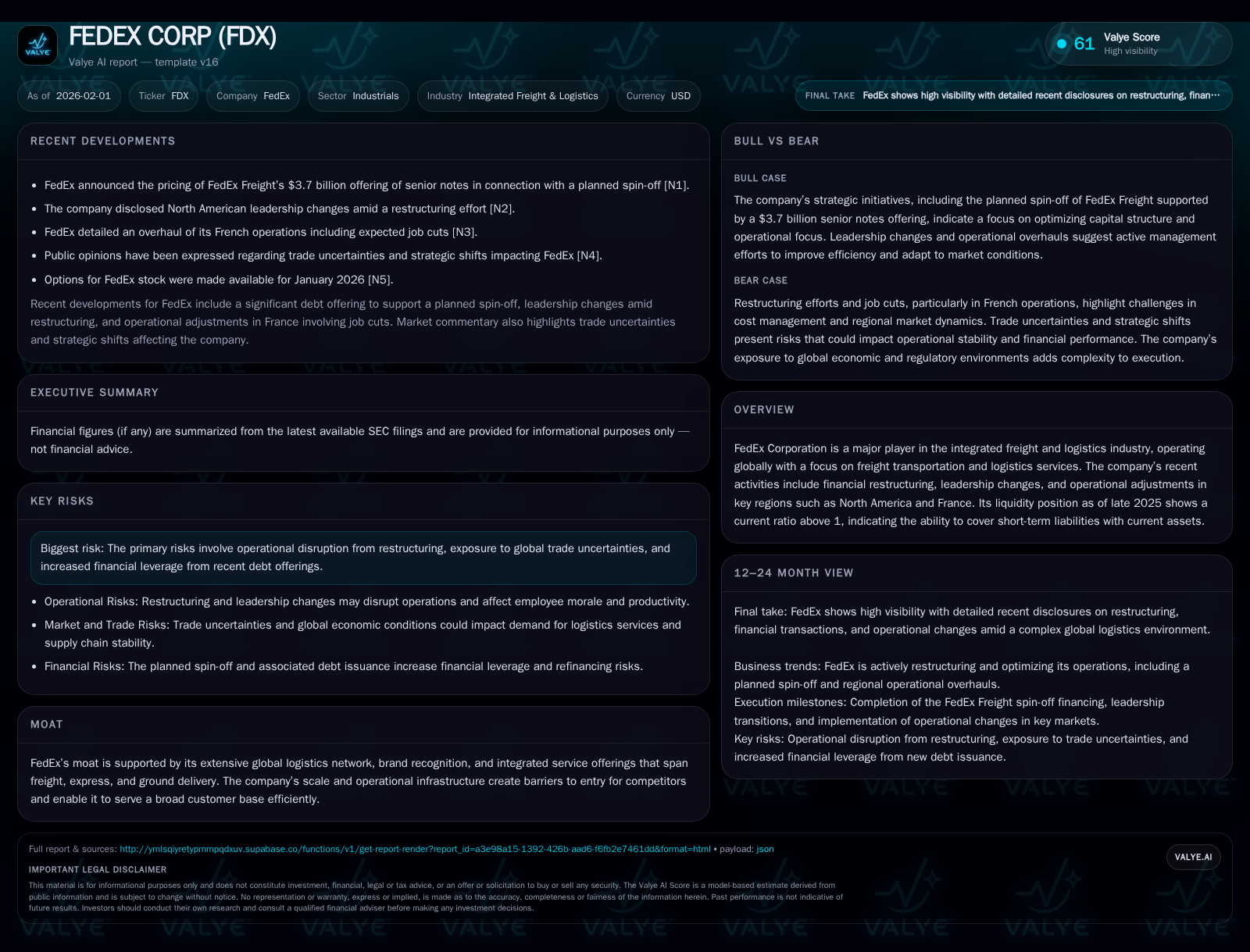
FedEx Corporation is in the midst of a strategic transformation marked by the planned spin-off of FedEx Freight via a $3.7 billion senior notes offering and leadership changes primarily focused on North American operations. The company is also implementing operational overhauls in key international markets such as France, signaling efforts to streamline costs and enhance efficiency. While its extensive global logistics network and integrated services offer a durable competitive moat, FedEx faces execution risks from restructuring, trade uncertainties, and elevated financial leverage.
What Changed Recently
FedEx Corporation has announced several pivotal moves signaling a strategic reshaping of its business portfolio and management structure. Foremost is the pricing of a $3.7 billion senior notes offering tied directly to the planned spin-off of the FedEx Freight segment [N3]. This capital raise appears designed to fund the separation and provide the Freight unit with standalone financial flexibility. Concurrently, FedEx has initiated leadership changes within its North American business segment, aiming to steer the company through ongoing restructuring efforts and sharpen operational focus [N4]. Across the Atlantic, the company is undertaking a significant overhaul of its French operations, including anticipated job cuts, highlighting a drive toward cost rationalization and efficiency improvements outside its core U.S. market [N6]. These developments occur against a backdrop of trade uncertainties and competitive pressures that continue to shape the integrated freight and logistics industry [N1].
Business Model as a System
FedEx operates a complex, integrated freight and logistics platform that encompasses express parcel delivery, ground delivery, and freight transportation services. This multi-modal approach allows it to serve a broad customer base ranging from individual consumers to large enterprises with varying shipping needs. While detailed SEC disclosures on segment economics are not provided in the recent 10-Q filings, the company’s model historically relies on extensive physical infrastructure, including aircraft, vehicles, hubs, and last-mile networks, supported by technology platforms for routing and tracking [Valye excerpt; S1].
The planned FedEx Freight spin-off suggests a strategic move to decouple the less synergistic freight operations from the core express and ground delivery businesses. By isolating Freight, FedEx may enable more targeted capital allocation, operational management, and market positioning. However, this move also entails managing the transition risks inherent in separating integrated logistics services, such as potential disruptions in cross-segment customer service and complexity in shared asset usage.
Liquidity metrics, with a current ratio above 1 (approximately 1.27), indicate FedEx retains sufficient short-term assets to meet liabilities, reinforcing operational stability amid change [S3]. Yet, the incremental debt from the senior notes offering linked to the spin-off elevates leverage, potentially constraining financial flexibility.
Industry Map & Competitive Battlefield
The integrated freight and logistics industry is characterized by scale-driven competition, capital intensity, and sensitivity to global trade flows and e-commerce demand. FedEx competes with other global giants such as UPS, DHL, and regional freight operators, as well as emerging digital-first logistics platforms.
Competitive advantages derive from network density, service reliability, speed, and technology integration. FedEx’s moat is anchored in its vast global footprint and ability to offer end-to-end solutions combining express parcel delivery, ground shipping, and freight forwarding — a combination that creates switching costs and operational synergies [Valye excerpt].
However, margin pressures persist due to rising labor costs, fuel price volatility, and the need for continual investment in automation and digital capabilities. The spin-off of FedEx Freight can be seen as a response to these dynamics, allowing the company to focus on higher-margin, faster-growth segments while enabling the Freight business to pursue its own strategic agenda.
Where the Economics Become Real
At the unit economics level, FedEx faces multiple operational bottlenecks and cost centers. Fleet utilization and capacity management are critical, as underused assets dilute returns while overcapacity inflates costs. Fuel remains a significant variable input, subject to global price swings.
Pricing power varies by segment and geography; express parcel delivery commands premiums for speed and reliability, while freight services compete more on volume and price. Operational efficiency gains, such as through automation in sorting hubs and route optimization, directly impact margins.
The restructuring initiatives in North America and France reflect attempts to tighten cost structures and improve asset productivity. However, these changes also carry risks of service disruption and employee morale impacts, which can influence customer retention and operational smoothness.
Financially, leveraging the balance sheet through debt issuance to fund the spin-off introduces heightened fixed obligations, which must be balanced against the expected cash flow generation of both the parent and the newly independent Freight company.
Diligence Questions / Disconfirming Signals
- How will the spin-off of FedEx Freight affect the integrated service offering and customer experience, particularly for clients using multiple FedEx segments?
- What is the timeline and execution risk associated with the spin-off, and how might market conditions affect pricing and investor appetite?
- Can the leadership changes in North America translate effectively into improved operational discipline and growth, or will there be transition-related disruptions?
- Will the French overhaul deliver meaningful cost savings without eroding market share in a key European market?
- How sensitive is FedEx’s financial position to prolonged trade uncertainties and macroeconomic headwinds that could suppress shipping volumes?
- What are the contingencies if integration of emerging technologies or automation lags competitors, potentially affecting service levels or costs?
This analysis is based solely on publicly available information and does not constitute investment advice. Operational and financial outcomes depend on multiple variables and external conditions that may evolve unpredictably.
Disclaimer: This is research-only, informational analysis and not investment advice. It may include AI-generated interpretation and general industry context. Always verify important details using primary sources.

Comments