
First Hawaiian’s Earnings Surge and Expanding Risk Landscape
First Hawaiian’s robust earnings growth intertwines with heightened regulatory, environmental, and cybersecurity risks that shape its business outlook and capital deployment.
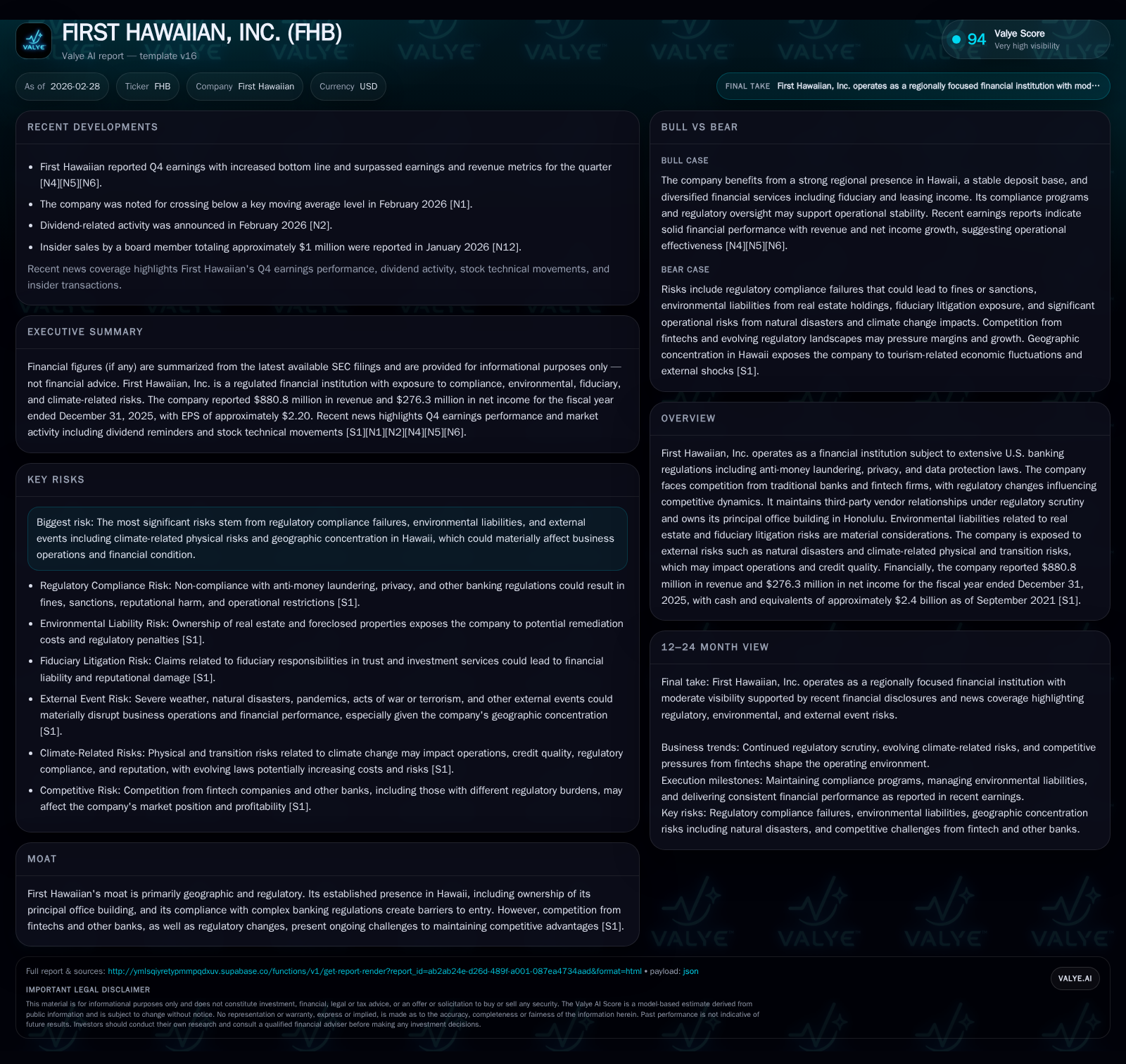
First Hawaiian, Inc. has demonstrated solid revenue and net income growth through 2025, driven by sustained loan portfolio strength and fee income stability. Its geographic and regulatory moat, rooted in Hawaii’s market and compliance regime, buffers competition but faces pressure from fintech entrants and evolving regulation. The firm confronts substantial operational risks from environmental liabilities tied to real estate holdings and heightened cybersecurity threats, with governance frameworks responding accordingly. Capital allocation reflects balanced dividends and expanding share repurchases supported by healthy cash flows. Looking ahead, growth drivers include market demand and deposit trends, tempered by ongoing regulatory expense and climate-related vulnerabilities.
Strong Revenue Momentum and Profit Drivers Over Recent Years
First Hawaiian has displayed noteworthy financial performance improvement up to fiscal year (FY) 2025. Annual revenues reached $880.8 million in FY25, marking an 8.9% increase over FY24's $808.5 million [F1]. Net income advanced even more robustly by approximately 20%, climbing to $276.3 million from $230.1 million the previous year. Operating cash flow (CFO) followed suit with a 5.5% gain to $335.1 million in FY25 compared with the prior year’s $317.5 million, reflecting effective earnings quality and working capital management.
Capital expenditures increased on a comparable basis by around 10%, totaling $31.8 million in FY25 versus $28.7 million in FY24 as the bank invested in maintaining infrastructure aligned with its business scale [F1]. Stability in dividends paid—hovering consistently near $131 million annually over four years—signals disciplined shareholder returns parallel to earnings progress.
The revenue uplift aligns with incremental loan portfolio growth combined with diversified fee income streams highlighted during recent earnings calls [N1], suggesting prudent asset mix adjustments amid Hawaii's unique economic landscape.
Historical performance (annual)
| FY | Rev ($mm) | Net ($mm) | CFO ($mm) | Capex ($mm) | Rev YoY | Net YoY |
|---|---|---|---|---|---|---|
| 2025 | 881 | 276 | 335 | 32 | +8.9% | +20.0% |
| 2024 | 809 | 230 | 318 | 29 | -3.4% | -2.1% |
| 2023 | 837 | 235 | 255 | 16 | +5.5% | -11.6% |
| 2022 | 793 | 266 | 431 | 13 |
Source: SEC companyfacts cache [F1].
Capital returns and efficiency (annual)
| FY | Div ($mm) | Buybacks ($mm) | FCF ($mm) |
|---|---|---|---|
| 2025 | 131 | 100 | 303 |
| 2024 | 133 | 40 | 289 |
| 2023 | 133 | 9 | 239 |
| 2022 | 133 | 9 | 417 |
Source: SEC companyfacts cache [F1].
Note: All figures are annual totals for fiscal years ending December.
Established Geographic Moat Versus Emerging Competitive Pressures
First Hawaiian’s dominant presence within the Hawaii banking market creates significant geographic moats underpinned by its deep customer relationships, well-branded physical footprint—including ownership of its principal office building located in Honolulu—and established community trust [S1]. Regulatory complexities confronting banks act as additional barriers to entry or expansion by new competitors locally.
Nonetheless, this moat is nuanced by emerging pressures from fintech firms disrupting traditional banking through agile digital offerings leveraging newly minted charters or partnerships with conventional banks [S5]. The recent GENIUS Act further complicates this landscape by establishing a framework for payment stablecoins that could divert customer deposits away from bank balance sheets into alternative digital assets regulated differently.
Such evolving competition requires First Hawaiian to continuously innovate while navigating regulatory regimes that vary sharply between traditional banks and fintechs—a challenge compounded by asset threshold changes relaxing enhanced prudential standards for some larger players [S11].
Regulatory Compliance: Navigating Intensified Oversight and AML Obligations
The bank’s operations are tightly regulated under U.S federal statutes including the USA PATRIOT Act and Bank Secrecy Act (BSA), mandating comprehensive programs combating money laundering and terrorist financing [S1][S6]. Compliance entails verifying customer identities meticulously when accounts are opened, monitoring transactions for suspicious activities reported to FinCEN, and maintaining ongoing due diligence particularly regarding third-party relationships.
Non-compliance risks include severe financial penalties, restrictions on branch expansions or acquisitions, potential imposition of monitorships following enforcement actions, reputational harm, as well as civil litigation exposures [S6]. First Hawaiian acknowledges these risks explicitly alongside the reality that policies currently deployed might not entirely preclude violations.
Enhanced federal focus on AML enforcement increases operational costs associated with surveillance technologies, personnel training programs, internal audit functions overseen directly by senior management as well as board-level Risk Committees charged with cybersecurity oversight entwined with compliance roles [S27][S28].
Environmental Liability and Climate Risks: Operational and Credit Implications
Environmental risk factors directly tie to First Hawaiian’s ownership of numerous branch locations across Hawaii coupled with the practice of acquiring real estate via loan foreclosures [S4]. Discovery of hazardous substances on any owned property can trigger costly remediation efforts potentially reducing asset values or limiting property usability legally enforcing penalty risks apart from reputational issues.
Moreover, Hawaii's geography exposes the company heavily to climate-related physical risks: hurricanes, tsunamis, flooding events present credible threats to branch functioning continuity as well as collateral integrity underpinning loan portfolios [S7]. These natural hazards may degrade borrower repayment abilities through economic displacement impacting credit losses indirectly.
Climate transition risks raise compliance burdens as evolving laws impose constraints on activities related to high carbon emissions sectors or require disclosures increasing reporting costs significantly [S12][S14]. Failure or perceived inadequacy in addressing these risks jeopardizes stakeholder confidence further challenging the bank’s brand value.
Cybersecurity Governance: Strengthening Defenses amid Increasing Threats
Recognizing cyber threats’ critical impact on operational integrity, First Hawaiian maintains a sophisticated governance structure led by its Board Risk Committee specialized in cybersecurity oversight enriched with members possessing finance audit expertise along with technology acumen [S27]. The committee receives regular briefings from Chief Risk Officer alongside Senior Vice Presidents responsible for enterprise information security (with GIAC certification) and technology risk who have decades of domain experience administering frameworks harmonized with COBIT, COSO, NIST methodologies [S26][S28].
The company operates a multi-layered defense strategy employing vulnerability scans, scheduled penetration tests conducted both internally and via trusted external consultants annually; this complements mandatory employee security awareness trainings aimed at phishing incident reductions among personnel [S24][S26].
Third-party vendor risk management forms a significant pillar ensuring contractual safeguards compel partners’ compliance while subjecting them periodically to security evaluations mitigating data breach potentials dynamically managed within an enterprise-wide risk management cultural framework embedded into all decision layers [S26][S28].
Capital Allocation Priorities: Balancing Dividends, Buybacks, and Investment
Capital deployment reveals a conservative yet progressive approach balancing shareholder returns against reinvestment needs aligned with corporate growth strategies.
Dividends paid have been remarkably stable at about $131 million annually across recent years despite fluctuating earnings levels indicating consistent payout policy underscoring reliable income streams for shareholders [F1][S8]. Buyback activities have accelerated notably rising from roughly $9 million executed in both FY22/FY23 sequentially before stepping up sharply to $40 million in FY24 then achieving $100 million last year supporting stock price dynamics reflecting management confidence in valuation levels amid expanding free cash flows approximated at over $300 million currently available after capital expenditures [F1][S23].
Capital expenditures have increased steadily reflecting ongoing investments in infrastructure modernization necessary within highly regulated environments emphasizing compliance technology upgrades along with branch network upkeep evidencing prudent financial stewardship compatible with roughly a double-digit return on equity nearing ~10% range implied through net income over shareholder equity calculation for FY25 [F1].
Future Growth Outlook: Market Opportunities and Headwinds to Watch
Management commentary from recent earnings calls affirms an optimistic stance highlighting Q4 outperformance beyond analyst estimates supported by deposit growth plans alongside targeted loan portfolio expansions designed cautiously balancing yield enhancements against credit risk mitigation efforts in line with macroeconomic signals pertaining to regional demand cycles influenced heavily by tourism-dependent economies such as Hawaii’s sectoral profile affecting loan origination velocity positively or negatively depending on external headwinds ([N1],[N6]).
Persistent regulatory cost inflation relating especially to AML compliance programs plus data privacy mandates imposes overhead pressures potentially constraining net margin expansion absent productivity improvements or pricing adjustments [N6].
Climate-related credit risk monitoring will remain essential given borrowers’ increased susceptibility due to recurrent natural disasters possibly exacerbating non-performing loans frequency necessitating vigilant underwriting discipline integrated into portfolio reviews mandates.
Key Metrics to Follow for Investor Insight
For those tracking First Hawaiian’s operational health closely moving forward:
- Revenue growth rates provide early indication whether top-line momentum endures amidst shifting economic variables ([F1]).
- Net income margin fluctuations combined with approximate Return on Equity near ~10% clarify profit efficiency benchmarks setting context for capital return expectations ([F1]).
- Capital expenditure trends reveal capacity enhancement investments against operating cash flow generation revealing cash conversion quality (FY25 CFO at $335M vs capex nearly $32M) ([F1]).
- Regulatory risk indicators comprise enforcement activity disclosures or compliance cost accruals detailed especially within SEC filings ([S4]) tracking deviations or imposed penalties.
- Cybersecurity incident reports guide insight into operational resilience encompassing third-party event consequences along evolving threat landscapes ([N10],[S4]).
- Technical price action indices such as crossing moving average levels hint at sentiment shifts relevant for timing considerations ([N8]).
Persistent evaluation of these metrics will enable comprehensive appraisals incorporating both quantitative performance signals combined with qualitative governance assessments representing holistic informed perspectives on the company’s trajectory.
This report synthesizes publicly disclosed information including SEC filings and major media transcripts current as of February 2026 without extrapolation beyond evidence-supported facts or offering investment recommendations.
Disclaimer: This is research-only, informational analysis and not investment advice. It may include AI-generated interpretation and general industry context. Always verify important details using primary sources.

Comments