
Federated Hermes, Inc.: Surging Earnings Amid Regulatory and Market Challenges
Federated Hermes posted substantial operating income growth in 2025 driven by expense discipline and asset mix shifts, while contending with increased regulatory costs and legal proceedings that shape its capital allocation and growth outlook.
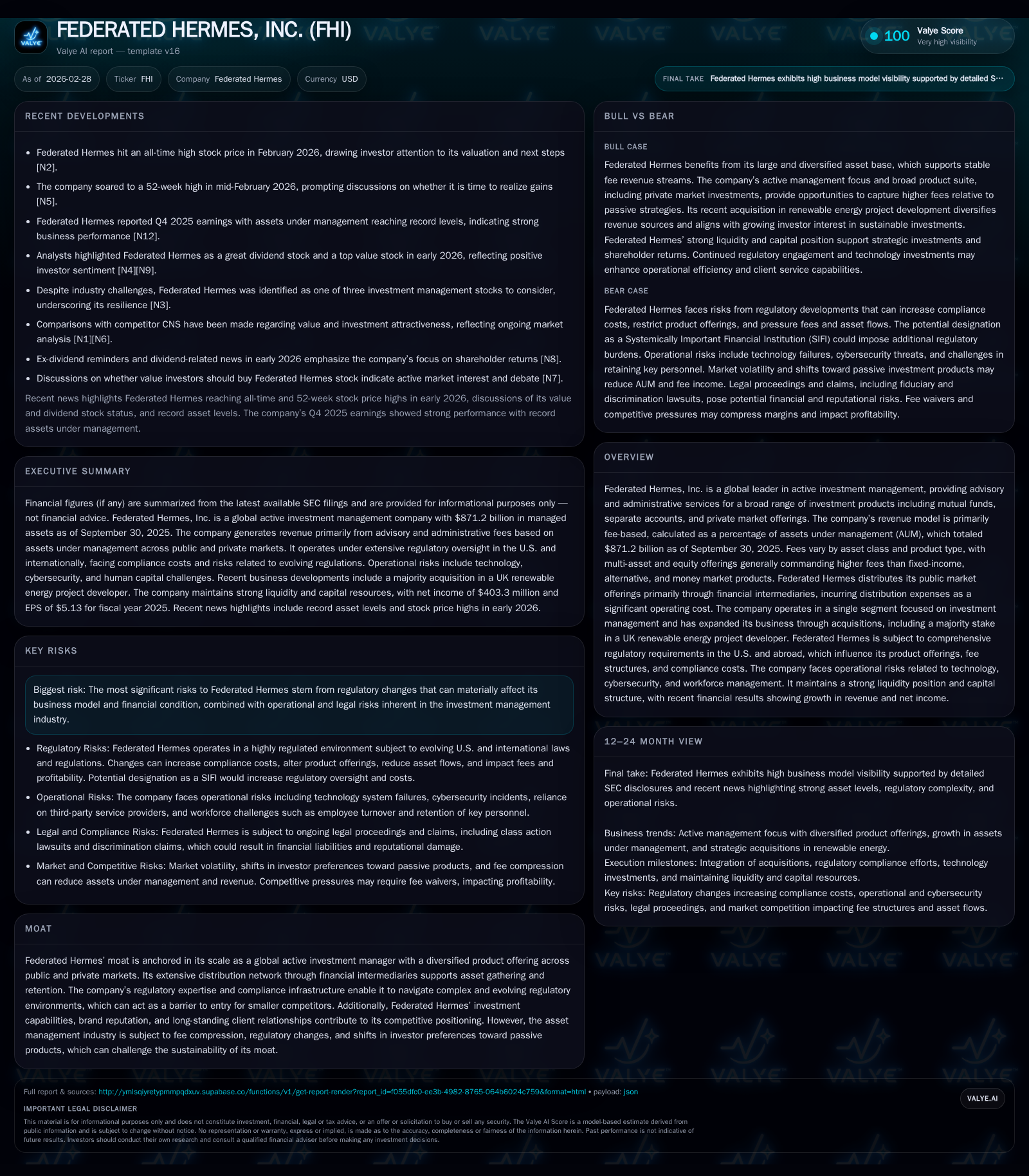
In fiscal 2025, Federated Hermes achieved a 42% increase in operating income despite a 4% revenue decline, reflecting margin expansion through cost management and favorable asset composition. The firm manages $871 billion AUM with fee structures varying by asset class, balancing distribution expenses associated with intermediary channels. Regulatory developments have raised compliance costs and introduced operational risks. Capital deployment prioritized $263 million in share repurchases and $105 million in dividends, alongside planned technology investments to support regulatory demands. Investors should monitor regulatory outcomes, litigation progress, and AUM dynamics impacting future profitability.
Federated Hermes reached new stock price highs early in 2026 following a series of quarterly earnings beats culminating in an exceptional fiscal year performance. While revenues softened modestly — declining about 4% year-over-year — operating income surged over 40%, evidencing disciplined cost management and favorable shifts within its asset base. This operational strength is juxtaposed against increasing regulatory complexity which continues to elevate compliance costs and inject uncertainty into future growth.
Historical Performance: Revenue Pressure Versus Profit Expansion
Federated Hermes' financial results illustrate challenges typical of active managers facing fee pressures during evolving investor preferences. Revenues peaked near $289.9 million in FY2016 before modest declines; by FY2017 revenues stood at approximately $278.3 million. More recently, revenue softened slightly while profits expanded significantly. In FY2025 revenues were down roughly 4% versus FY2024; however, operating income climbed to approximately $513.9 million from $361.5 million the prior year — a roughly 42% increase — driven by tight expense controls including compensation and distribution spending optimization [F1][N2]. Net income also grew robustly by over 50% to about $403.3 million.
Historical performance (annual)
| FY | Net ($mm) | CFO ($mm) | OpInc ($mm) | Capex ($mm) | Net YoY |
|---|---|---|---|---|---|
| 2025 | 403 | 297 | 514 | 3 | +50.3% |
| 2024 | 268 | 347 | 361 | 4 | -10.3% |
| 2023 | 299 | 312 | 388 | 8 | +24.8% |
| 2022 | 239 | 324 | 337 | 4 |
Source: SEC companyfacts cache [F1].
Capital returns and efficiency (annual)
| FY | Div ($mm) | Buybacks ($mm) | FCF ($mm) |
|---|---|---|---|
| 2025 | 105 | 263 | 295 |
| 2024 | 185 | 138 | 343 |
| 2023 | 177 | 304 | |
| 2022 | 218 | 320 |
Source: SEC companyfacts cache [F1].
Note: Operating cash flow declined approximately 14%, reflecting working capital increases related partly to higher distribution expenses.
This trend highlights Federated Hermes' ability to manage costs effectively amid challenging top-line dynamics common to active investment management.
Regulatory Environment: Escalating Compliance Costs and Risks
The firm operates within a complex regulatory framework that has intensified compliance obligations substantially [S1][S10][S23]. Changes such as amended Rule 2a-7 governing money market funds have altered investor behavior, reducing demand for certain institutional prime funds historically generating higher fees.
Potential designation as a systemically important financial institution (SIFI) under the Dodd-Frank Act could impose bank-like regulation on Federated Hermes or its products, constraining operational flexibility [S23]. Restrictions on "soft dollar" arrangements have increased direct costs as the firm must pay more for brokerage research services.
Federated Hermes invests heavily in technology upgrades and legal resources to meet expanded reporting requirements and mitigate regulatory risk globally [S6][S8]. While deregulatory prospects exist, prevailing trends suggest ongoing elevated scrutiny that raises compliance expenses.
Fee Structure and Asset Mix: Drivers of Revenue and Margin
The firm's diverse product suite spans multi-asset funds, equities, fixed income, alternatives/private markets, and money market offerings with varying fee rates [N2][S2]. Multi-asset and equity strategies command the highest advisory fees; alternative/private markets intermediate; money market funds yield the lowest fees per dollar of assets.
Fee waivers are strategically used during competitive periods to maintain net yields when benchmark yields fall or to meet regulatory or contractual requirements [S27]. Most public market products are distributed via financial intermediaries who receive commission payments (distribution expenses) that vary by asset class — heavier for multi-asset/equity products reflecting advisor incentives.
This model influences net fee realization as higher gross fees can be offset partially by elevated distribution costs depending on product mix.
Growth Outlook: Strategic Acquisitions Amid Headwinds
Management highlights moderate organic growth supported by acquisitions like the majority stake in UK-based Rivington, expanding private market capabilities beyond traditional asset management revenues [N2][S15][S22]. However, growth is constrained by fee compression risks amid shifting investor preferences toward passive investments coupled with rising regulatory cost burdens.
Technology investments totaling approximately $278 million over three years aim to bolster operational resilience against compliance demands while enhancing client service platforms [S6]. Nevertheless, persistent margin pressure remains a key consideration.
Capital Allocation: Shareholder Returns Balanced with Investment Needs
Capital deployment prioritizes shareholder returns alongside strategic investments [F1][S9]. In fiscal 2025, share repurchases totaled approximately $263 million — up significantly from prior years — while dividends paid were about $105 million, down from previous periods.
Equity increased moderately to roughly $1.2 billion supporting an approximate return on equity near 34%, indicating efficient use of capital despite industry headwinds.
Legal Proceedings: Ongoing Litigation Risks
Several legal actions are pending including claims filed by Aberdeen City Council’s pension fund in UK courts and U.S.-based fiduciary lawsuits alleging plan administration issues [S3][S7][S14]. While no current quantification of potential liabilities is provided, these matters warrant monitoring due to possible financial or reputational impacts.
Routine regulatory inquiries also continue but remain within expected operational risk parameters.
Distribution Model Economics: Impact on Margins
Heavy reliance on intermediaries for product distribution results in significant commission payments that scale variably across asset classes [N2][S27]. Multi-asset and equity products typically incur higher distribution expenses than fixed income or alternative strategies due to channel incentives.
This dynamic requires ongoing pricing strategy adjustments to optimize net revenue realization across the product spectrum.
Technology Investment: Enhancing Compliance Efficiency
Acknowledging structural cost pressures from regulation, Federated Hermes plans significant technology spending (~$278 million over three years) focused on automating compliance reporting and improving analytics capabilities critical for ESG integration and regulatory adherence [S6].
These investments aim at sustaining scale efficiencies amid rising fixed compliance costs inherent in global asset management operations.
Investor Considerations: Risks and Monitoring Points
Strong earnings growth supports positive sentiment; however heightened regulatory costs, legal uncertainties, fee compression risks, distribution expense volatility tied to intermediary behaviors, and execution of large-scale technology projects present key risk factors [N1][N7][N6][S1][S5].
Investors should monitor:
- Regulatory developments including SIFI designation possibilities,
- Litigation progress,
- AUM composition shifts between higher-fee multi-asset/equity versus lower-fee segments,
- Trends in distribution expenses,
- Execution of technology initiatives aimed at future-proofing operations. Despite challenges common among active managers facing evolving investor demands and governance scrutiny, Federated Hermes' scale combined with targeted investments positions it well for navigating these headwinds.
This analysis synthesizes publicly available information without recommending specific investment decisions; readers should consult additional sources for comprehensive evaluation.
Disclaimer: This is research-only, informational analysis and not investment advice. It may include AI-generated interpretation and general industry context. Always verify important details using primary sources.

Comments