
Fluor’s Transition: Contract Backlog Resilience Amid Profitability Pressures
Fluor Corporation's 2025 financials reveal revenue contraction and losses despite a solid backlog and liquidity position.
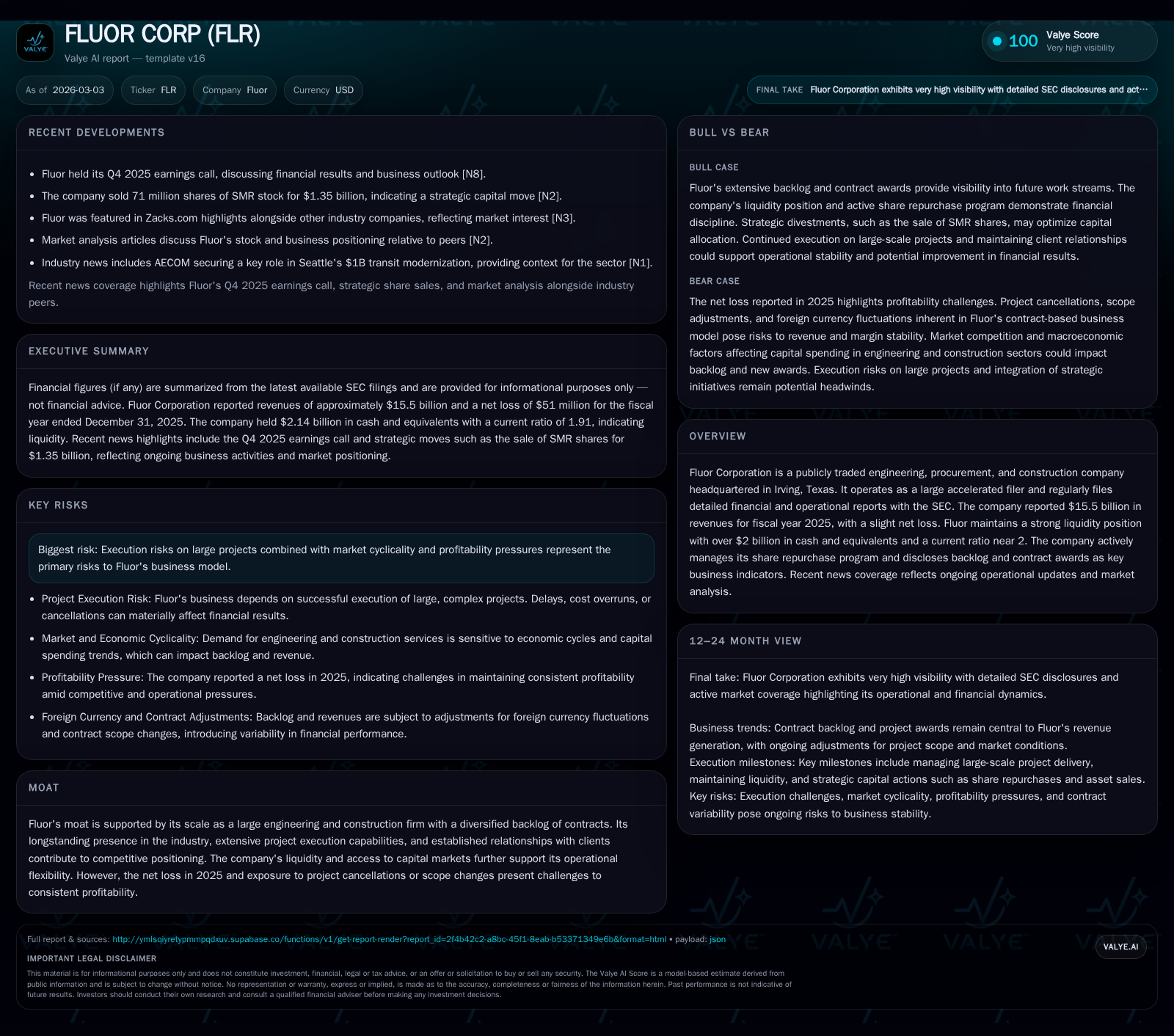
In fiscal year 2025, Fluor Corporation reported a roughly 5% revenue decline to $15.5 billion, with operating income turning negative at a $378 million loss. Net income also swung to a $51 million loss amid project execution challenges including cancellations and scope changes. Despite these headwinds, Fluor's substantial contract backlog and strong liquidity position, supported by over $2 billion in cash equivalents, provide operational flexibility. The company notably increased share repurchases to $754 million in 2025, reflecting a capital allocation focus on buybacks amid earnings volatility. Future recovery will depend on stabilizing project delivery and sustaining contract awards.
2025 Financial Overview: Revenue Decline and Operating Loss
Fluor Corporation's fiscal year 2025 results illustrate significant operational challenges reversing prior growth trends. Revenue decreased by about 5% to $15.5 billion compared with $16.3 billion in 2024 [F1]. Operating income swung from a positive $463 million in the prior year to a loss of $378 million, marking an over 180% decline [F1]. Net income similarly reversed from a $2.15 billion gain in 2024 to a net loss of $51 million in 2025 [F1].
The company’s operating cash flow deteriorated markedly, plunging nearly 147% year-over-year to negative $387 million due primarily to working capital strains during project execution timing issues [F1]. Capital expenditures were curtailed by nearly 70% to approximately $50 million, reflecting cautious investment during this period of volatility [F1].
Historical performance (annual)
| FY | Rev ($bn) | Net ($bn) | CFO ($mm) | OpInc ($mm) | Rev YoY | Net YoY |
|---|---|---|---|---|---|---|
| 2025 | 15.5 | -0.1 | -387 | -378 | -5.0% | -102.4% |
| 2024 | 16.3 | 2.1 | 828 | 463 | +5.4% | +1443.2% |
| 2023 | 15.5 | 0.1 | 212 | 147 | +12.6% | -4.1% |
| 2022 | 13.7 | 0.1 | 31 | 209 |
Source: SEC companyfacts cache [F1].
Capital returns and efficiency (annual)
| FY | Buybacks ($mm) | FCF ($mm) | ROE% |
|---|---|---|---|
| 2025 | 754 | -437 | -1.6 |
| 2024 | 125 | 664 | 54.3 |
| 2023 | 106 | 7.2 | |
| 2022 | -44 | 8.1 |
Source: SEC companyfacts cache [F1].
Financial data highlights the company's sharp profitability reversal despite relatively stable revenues [F1].
Factors Driving Earnings Pressure
Management highlighted several factors contributing to the earnings decline during recent earnings calls and disclosures [N1][S3]. Key among these were cancellations and scope revisions on large projects that compressed margins and elevated costs as fixed overhead remained largely unchanged [S2][S5]. Inflationary cost pressures further exacerbated operational expenses during project execution.
The complexity of managing megaprojects with inherent risks such as change orders contributed significantly to earnings volatility—common challenges within the engineering and construction sector that require close management attention [N7][S8]. These factors explain the disconnect between stable backlog levels and deteriorating profitability.
Backlog Strength and Market Position
Despite near-term financial setbacks, Fluor maintains a solid market position underpinned by a substantial contract backlog that supports revenue visibility going forward [N7]. Backlog represents firm dollar value of work awarded but not yet completed, providing a buffer against short-term demand fluctuations.
The company’s diversified exposure across sectors such as energy infrastructure, government projects, and industrial construction reduces customer concentration risk. Longstanding client relationships support repeat business opportunities which are key competitive advantages.
Operational Risks and Sector Cyclicality
Execution risks remain central given the complexity of large-scale projects where delays, scope changes, or regulatory shifts can cause cost overruns impacting margins [S2][S5][N7]. Additionally, sector cyclicality driven by fluctuating capital expenditures in energy and infrastructure markets introduces variability into contract award timing.
Liquidity Position and Capital Structure
Fluor’s balance sheet remains resilient with cash and equivalents exceeding $2.1 billion at year-end while current assets nearly double current liabilities at about $6.44 billion versus $3.38 billion—yielding an approximate current ratio near 1.9 [F1]. This liquidity cushion supports ongoing operations amidst temporary cash flow disruptions.
Leverage appears manageable without immediate refinancing concerns based on disclosed debt arrangements [S17][S18].
Capital Allocation: Share Repurchases Prioritized Amid Earnings Volatility
The company significantly increased share repurchases totaling approximately $754 million in FY2025 compared with about $125 million in the prior year [F1][S4][S6][S9][S12], indicating management's commitment to returning capital amid valuation pressures.
Dividend payouts were stable without increases reported during this period, suggesting prioritization of buybacks over dividend growth given earnings uncertainty [S21][S23]. Capital expenditures were prudently managed focusing on essential investments.
Outlook Considerations
Key indicators for monitoring Fluor’s recovery include stabilization of project execution margins as referenced in recent calls [N1], trends in backlog awards signaling sustained contracting activity [N7], and operating cash flow improvements reflecting tighter working capital controls.
Maintaining strong liquidity alongside disciplined capital deployment will be vital for navigating sector cyclicality effectively [N7][S24]. Ultimately, reliable megaproject delivery will be decisive for medium-term profitability restoration.
This analysis is for informational purposes only and does not constitute investment advice. All data is sourced from publicly available SEC filings and market reports as cited.
Disclaimer: This is research-only, informational analysis and not investment advice. It may include AI-generated interpretation and general industry context. Always verify important details using primary sources.

Comments