
Aligos Therapeutics Confronts Clinical-Stage Development Costs and Capital Constraints with Modest Net Loss Improvement
The clinical-stage biotechnology company focusing on liver and viral diseases recorded a substantial net loss reduction in 2025 but faces ongoing funding challenges.
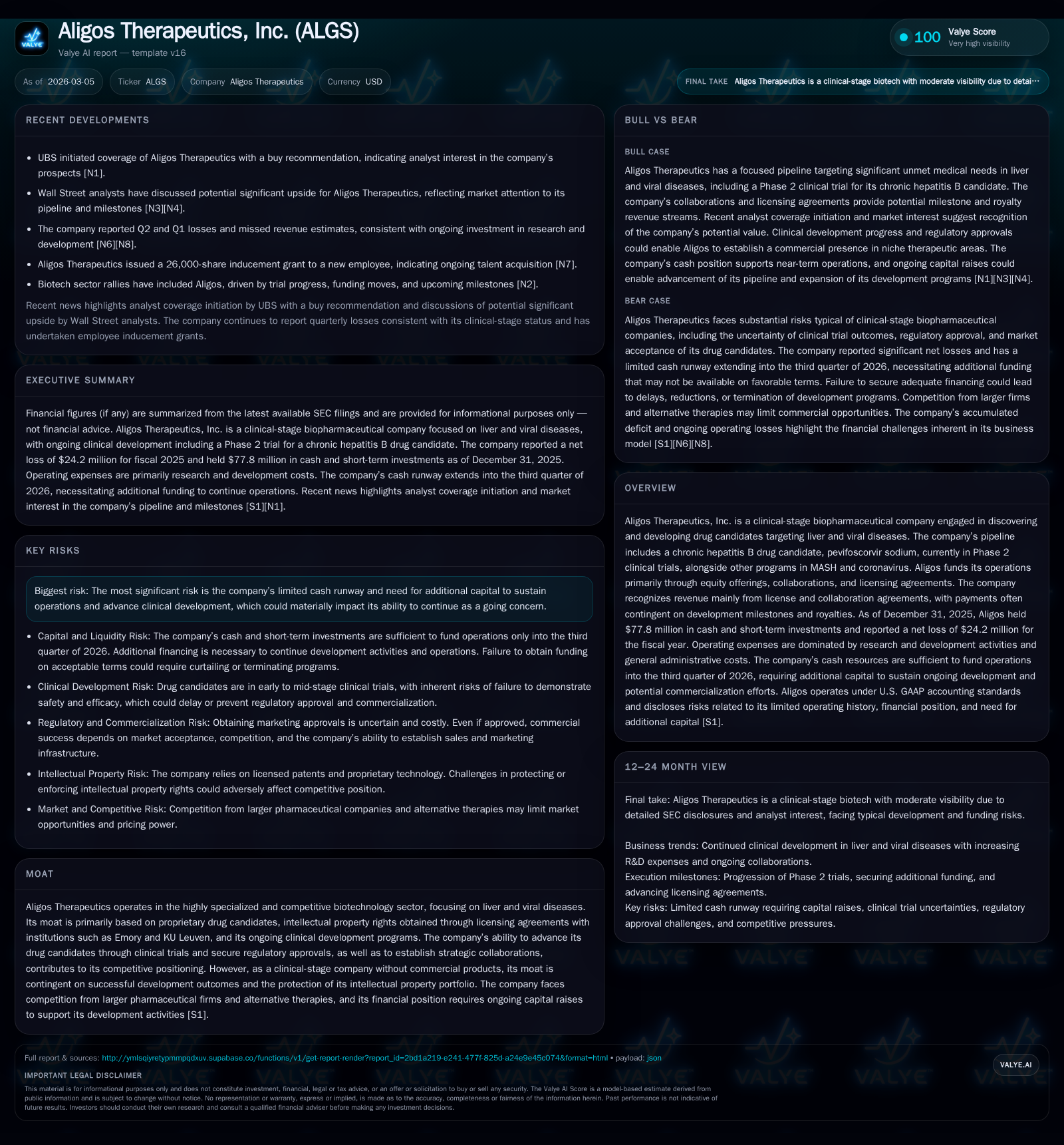
Aligos Therapeutics, Inc., a clinical-stage biopharmaceutical company specializing in liver and viral disease drug candidates, reported a net loss of $24.2 million in 2025, significantly improved from $131.2 million in 2024. Operating income remained negative at approximately -$88 million, reflecting sustained R&D investments. The company held $77.8 million in cash, cash equivalents, and short-term investments at year-end 2025, providing runway into Q3 2026. Ongoing capital raises and collaborations are critical to continue operations amid increasing clinical development expenses. Growth prospects depend on successful clinical outcomes, regulatory milestones, and strategic partnerships.
Company Overview
Aligos Therapeutics is a clinical-stage biopharmaceutical company focused on developing therapies for liver diseases and viral infections. Its lead candidate is pevifoscorvir sodium, an investigational treatment for chronic hepatitis B currently in Phase 2 clinical trials. The pipeline also includes programs targeting metabolic dysfunction-associated steatohepatitis (MASH) and coronaviruses.
Historical Financial Performance
Aligos's financial results over the past four years reflect consistent operating losses driven by extensive research and development efforts necessary to advance its drug candidates.
Historical performance (annual)
| FY | Net ($mm) | CFO ($mm) | OpInc ($mm) | Capex ($) | Net YoY |
|---|---|---|---|---|---|
| 2025 | -24 | -83 | -88 | +81.6% | |
| 2024 | -131 | -81 | -89 | 130000 | -49.6% |
| 2023 | -88 | -79 | -88 | 19000 | +8.7% |
| 2022 | -96 | -79 | -98 | 943000 |
Source: SEC companyfacts cache [F1].
Capital returns and efficiency (annual)
| FY | FCF ($mm) | ROE% |
|---|---|---|
| 2025 | -45.2 | |
| 2024 | -81 | 452.9 |
| 2023 | -79 | -95.2 |
| 2022 | -80 | -92.4 |
Source: SEC companyfacts cache [F1].
Note: Revenue primarily reflects milestone payments from licensing agreements; figures exclude non-recurring items.
Revenue recognized was minimal in FY2025 following milestone completions or deferrals observed in prior periods. Operating income remained consistently negative near $88–90 million annually due to sustained R&D expenditures.
Net losses decreased markedly from $131.2 million in FY2024 to $24.2 million in FY2025 ([F1],[S5]), largely influenced by non-cash gains related to warrant fair value adjustments rather than operational improvements.
Operating cash flow usage remained strongly negative near $80 million per year due to ongoing clinical development costs ([F1]). Capital expenditures increased substantially in FY2025 compared with prior years but remain modest relative to overall spending ([F1]).
Equity transitioned from a negative position of approximately $29 million at the end of FY2024 to positive $53.5 million at FY2025 end following a significant private placement equity raise generating net proceeds of about $101 million ([S17],[F1]). This capital infusion improved liquidity but the balance sheet continues to reflect risks from cumulative deficits.
Operating Expense Breakdown
Research and development costs dominate total expenses:
- Early-stage discovery program costs declined slightly from about $3.5 million in FY2024 to roughly $3.1 million in FY2025.
- Late-stage R&D expenses remain substantial around $66 million annually due primarily to Phase 1/2 clinical trial activities including pevifoscorvir sodium ([S5],[S7]).
- General and administrative expenses decreased moderately but remain material (~$20 million).
This cost structure underscores the company's focus on progressing late-stage clinical candidates while maintaining early discovery pipelines.
Future Growth Prospects
Aligos's growth is contingent upon several factors:
- Clinical trial success: Positive results from ongoing Phase 2 trials of pevifoscorvir sodium could enable regulatory submissions and attract partnerships.
- Pipeline development: Advancing additional candidates or acquiring new assets could diversify risk and broaden future opportunities.
- Strategic collaborations: Partnerships may provide milestone revenues and share development costs while validating science.
- Regulatory approvals: Successful navigation through FDA and other agencies is essential before commercialization.
Challenges include competition from larger pharmaceutical companies with established HBV therapies or novel genetic approaches; regulatory uncertainties; limited sales infrastructure; and ongoing financing needs given persistent cash burn ([S6],[S16],[S18]).
Capital Allocation and Liquidity Profile
Primary uses of capital are research-driven operating expenses with minimal capital expenditures focused on facility upgrades or equipment supporting clinical trials ([F1],[S7]). The company holds no long-term debt but maintains lease obligations for global office locations and lab equipment ([S25],[F1]).
As of December 31, 2025, liquidity totaled approximately $77.8 million comprising cash ($18.3 million) and short-term investments ($59.5 million), providing operational runway into Q3 calendar year 2026 ([F1],[S8],[S15]). Continuing as a going concern beyond this point depends on securing additional funding through equity offerings or licensing arrangements—efforts management acknowledges carry execution risk ([S18],[S21]).
Return metrics such as return on equity remain deeply negative due to accumulated deficits exceeding $642 million as of fiscal year-end ([F1]). The company continues reinvesting heavily into R&D without generating positive cash flows consistent with typical early-stage biotech profiles.
Conclusion
Aligos Therapeutics operates within the high-risk/high-reward biotech sector focused on antiviral therapies for liver diseases. While the company achieved notable net loss improvement through non-cash warrant valuation effects alongside significant capital injections improving its balance sheet,[F1] fundamental challenges persist including substantial operating cash burn driven by late-stage clinical trials coupled with limited liquidity horizons.[S15] Success will hinge critically on positive clinical data readouts combined with timely capital raises ahead of forecasted funding gaps that create substantial going concern risks beyond mid-2026.[S8]
Investors should monitor upcoming clinical data releases, partnership developments, pipeline progress updates, financing activities before Q3–Q4 calendar year 2026 given current runway constraints, and regulatory interactions that collectively will shape Aligos’s valuation and viability outlook.
This report synthesizes publicly available regulatory filings and financial data without providing investment advice or recommendations.
Disclaimer: This is research-only, informational analysis and not investment advice. It may include AI-generated interpretation and general industry context. Always verify important details using primary sources.

Comments