
Great Southern Bancorp’s 2025 Results Reflect Loan Portfolio Adjustments and Capital Discipline
The company’s growth moderated amid commercial real estate concentration and regulatory scrutiny, balanced by strong capital and liquidity management.
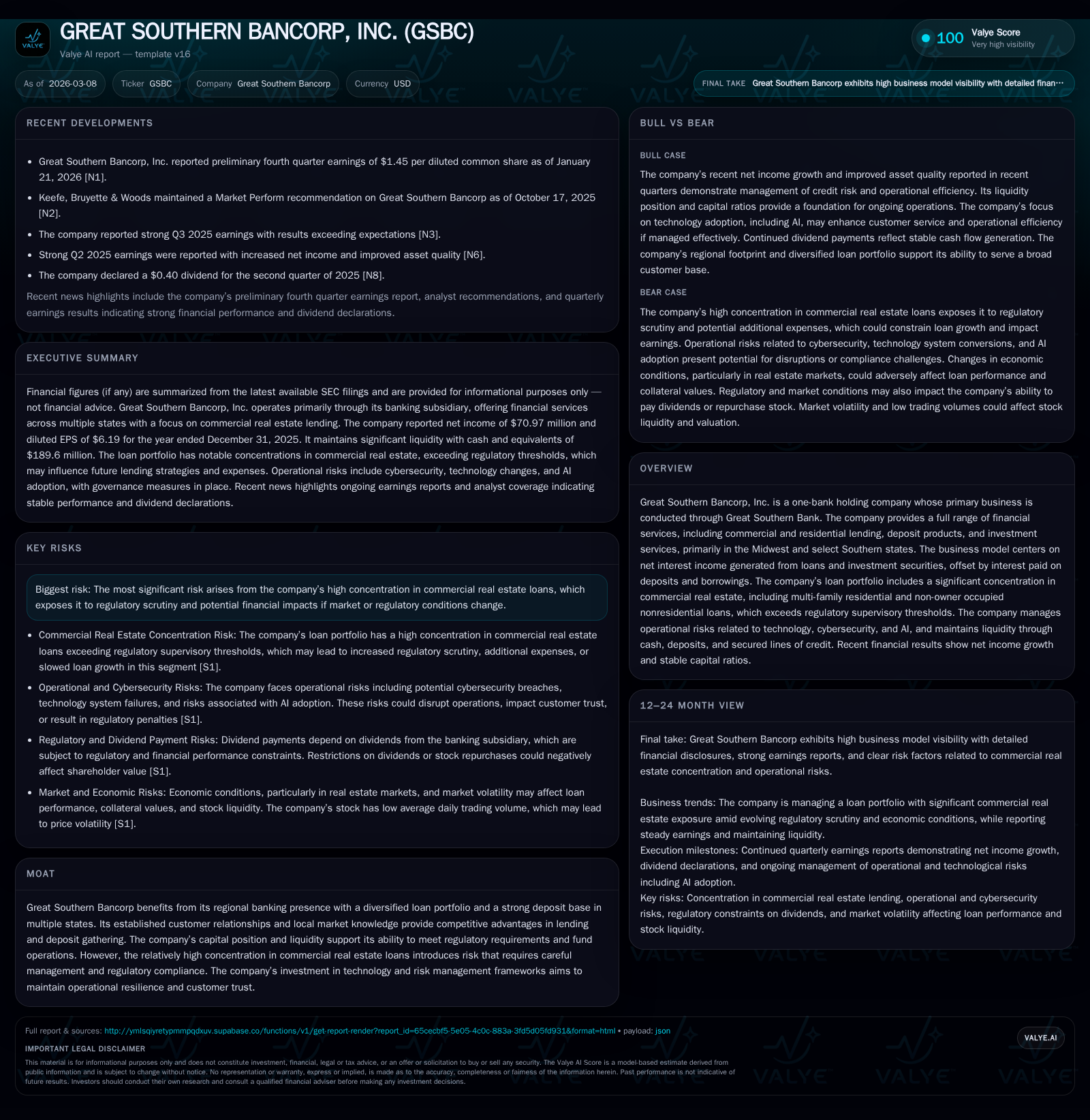
Great Southern Bancorp, Inc. reported $70.97 million in net income for fiscal year 2025, marking a 14.8% increase year-over-year despite an operating income decline. The bank’s strategy centers on a loan portfolio weighted toward commercial real estate, which exceeded regulatory concentration thresholds by the end of 2025. Deposit balances declined modestly, particularly retail CDs, while transaction accounts grew, signaling shifts in funding mix. Strong cash flow generation and an active share repurchase program underpin capital returns alongside stable dividends. The main challenges ahead include managing regulatory risks linked to commercial real estate exposure and adapting to evolving interest rate and technological environments.
Company Overview and Business Model
Great Southern Bancorp, Inc., operating primarily through Great Southern Bank, is a one-bank holding company serving the Midwest and selected Southern states.[S1] Its core business involves extending commercial and residential loans and gathering deposits supported by investment securities portfolios. The company's profitability leans heavily on net interest income generated from its loan book and securities holdings after accounting for interest paid on deposits and borrowings.[S1]
The bank's loan portfolio is notably concentrated in commercial real estate (CRE), including multi-family residential and non-owner occupied nonresidential loans—segments that have experienced growth but also trigger closer regulatory scrutiny due to risk concentration guidelines.[S1][S29]
Historical Performance: Growth Drivers and Portfolio Dynamics
Great Southern Bancorp's net income for fiscal year 2025 was $70.97 million, up 14.8% from $61.81 million in 2024.[F1] Operating income contracted by approximately 24.8% over the same period,[F1] suggesting margin pressure or increased non-interest expenses.
Loan balances decreased by $333.5 million (7.1%) during 2025, largely driven by reductions in other residential multi-family loans ($161.8 million), construction loans ($96.5 million), one- to four-family residential loans ($51.3 million), and commercial business loans ($41.8 million).[S12] This shrinkage reflects either deliberate tightening or market-driven repayment trends, consistent with cautious management amid CRE concentration risks.
Deposits contracted by $122.8 million (-2.7%) in 2025, with retail certificates of deposit declining $87.3 million whereas transaction accounts (checking and money market) increased by $73.2 million.[S12][S18] This shift indicates customer preference changes or strategic funding rebalancing towards more liquid deposit types.
Brokered deposits—a flexible but potentially costly funding source—fell by $108.7 million to $663.4 million at December 31, 2025.[S18] The bank maintains this channel selectively to suit interest rate risk management needs.[S15]
Table: Key Annual Financial Data (USD thousands)
Historical performance (annual)
| FY | Net ($mm) | CFO ($mm) | Capex ($mm) | Net YoY |
|---|---|---|---|---|
| 2025 | 71 | 82 | 11 | +14.8% |
| 2024 | 62 | 44 | 5 | -8.8% |
| 2023 | 68 | 81 | 7 | -10.7% |
| 2022 | 76 | 67 | 20 |
Source: SEC companyfacts cache [F1].
Capital returns and efficiency (annual)
| FY | Div ($mm) | Buybacks ($mm) | FCF ($mm) |
|---|---|---|---|
| 2025 | 19 | 44 | 70 |
| 2024 | 19 | 15 | 39 |
| 2023 | 19 | 23 | 73 |
| 2022 | 19 | 62 | 46 |
Source: SEC companyfacts cache [F1]. Operating Income latest annual detailed values unavailable; growth rates are based on reported figures.[F1]
Capital Allocation and Returns
The company returned capital consistently through dividends totaling $18.72 million in fiscal year ending December 31, 2025,[F1][S4] maintaining stable shareholder distributions over recent years.
Stock repurchases accelerated substantially in the latest year to $44.46 million from $15.15 million in the prior year,[F1][S4] underpinned by a board-approved ongoing buyback authorization that permits up to one million shares repurchased without expiration.
Total stockholders’ equity rose by approximately $36.6 million during the same period to $636.1 million as of year-end,[F1][S18] equivalent to a book value per share increase that supports shareholder value.
Operating cash flow far exceeded capex spending in fiscal year 2025 ($81.52M vs $11.46M), leaving significant free cash flow (~$70M) available for capital returns or balance sheet strengthening.[F1]
Based on reported net income relative to year-end equity levels, approximate return on equity stands at about 11.2% for FY2025,[F1] evidencing solid profitability under current operating conditions.
Balance Sheet Quality and Liquidity
At December 31, 2025 Great Southern carried total deposits of approximately $4.48 billion versus $4.61 billion at December 31, 2024.[S17][S18] This slight contraction is mainly attributable to lower term deposits offset by growth in core transaction accounts.
The Company's liquidity remains robust with access to approximately $1.32 billion in Federal Home Loan Bank advances alongside other committed facilities totaling nearly $1 billion unused lines of credit,[S5][S6][S18]. These provide ample runway for loan demand or unexpected stress scenarios.
The loan portfolio composition continues skewed towards CRE exposures exceeding regulatory self-assessment thresholds: total CRE loans surpassed the supervisory guideline level of three times (300%) Tier 1 capital plus allowance for loan losses as of end-2025,[S1][S29] signaling increased regulatory attention and potential cost implications if lending growth persists unchecked.
Risks: Regulatory Scrutiny and Concentration Challenges
The key risk posed involves the high concentration of CRE loans including multi-family residential and non-owner-occupied properties which heightens sensitivity to real estate market fluctuations.[S21][S24]
This concentration not only amplifies credit risk but places the Company under greater regulatory supervision with potential cost burdens associated with enhanced risk controls or capital buffers.[S21]
Additionally, management must navigate the complexity of transitioning or investing in new technologies such as Artificial Intelligence systems while mitigating associated operational risks like cybersecurity threats and model governance challenges.[S21][S24]
Interest rate volatility introduces further margins risks given the variable-rate nature of much of the loan book indexed to SOFR or prime rates paired against diverse funding costs.[S10][S11][S15]
Industry Context (Analysis)
Regional banks like Great Southern commonly focus on CRE lending as a principal driver of yield enhancement but face cyclical headwinds during periods of property market softness or rising rates compressing borrower capacity.
Increased use of brokered deposits reflects broader liquidity management approaches within mid-sized banks aiming for flexibility amid competition for core deposits; however, brokered funds tend to be more sensitive to rate hikes reducing their attractiveness over time compared with sticky retail deposits.
Technology investments are essential yet challenging given smaller banks’ resource constraints relative to larger peers; compliance with evolving AI/ML regulatory standards requires sturdy governance frameworks to avoid reputational damage or compliance failures.
Outlook Considerations (Analysis)
While explicit company guidance is not disclosed,[N/A] key metrics warrant watching including loan portfolio composition shifts especially within CRE categories that may dictate earnings trajectory and capital needs.
Deposit trends toward transactional accounts versus time deposits could pressure interest margins depending on funding mix costs prevailing amidst competitive regional banking landscapes.
Capital allocation will likely balance continued share repurchases alongside dividend maintenance given positive free cash flow generation but may adjust if credit losses emerge from stressed borrower cohorts tied to concentrated CRE exposures.
Evolving market interest rates pose both earning opportunities via re-pricing floating-rate assets but also risks if funding costs escalate disproportionately or deposit betas increase beyond assumptions.
Continued focus on operational resilience combining technology upgrades with cyber safeguards appears critical given growing AI integration risks flagged internally.[S24]
Summary Table: Annual Financial Highlights
| Year | Net Income ($M) | Net Income % Chg YoY | CFO ($M) | Capex ($M) | Dividends ($M) | Buybacks ($M) | Equity ($M) |
|---|---|---|---|---|---|---|---|
| FY25 | 70.97 | +14.8% | 81.52 | 11.47 | 18.72 | 44.46 | 636.13 |
| FY24 | 61.81 | -8.8%* | 44.06 | 4.92 | 18.71 | 15.15 | 599.57 |
| FY23 | 67.80 | 80.70 | 7.30 | 19.28 | 23.33 | 571.83 | |
| *Net income declined -8.8% from FY23 to FY24 before rebounding FY25.[F1] |
This analysis synthesizes public financial disclosures through March 2026 alongside regulatory filings focusing on key performance indicators without extrapolation beyond source data provided.[F1][S#]
Disclaimer: This report is prepared for informational purposes; it does not constitute investment advice or recommendations regarding securities transactions.
Disclaimer: This is research-only, informational analysis and not investment advice. It may include AI-generated interpretation and general industry context. Always verify important details using primary sources.

Comments