
Flushing Bank Stabilizes Earnings Amid Portfolio Shifts and Competitive Pressure in New York Market
FFIC reversed a deep 2024 loss with strong loan mix management and capital moves, yet Q4 earnings variances highlight integration risks.
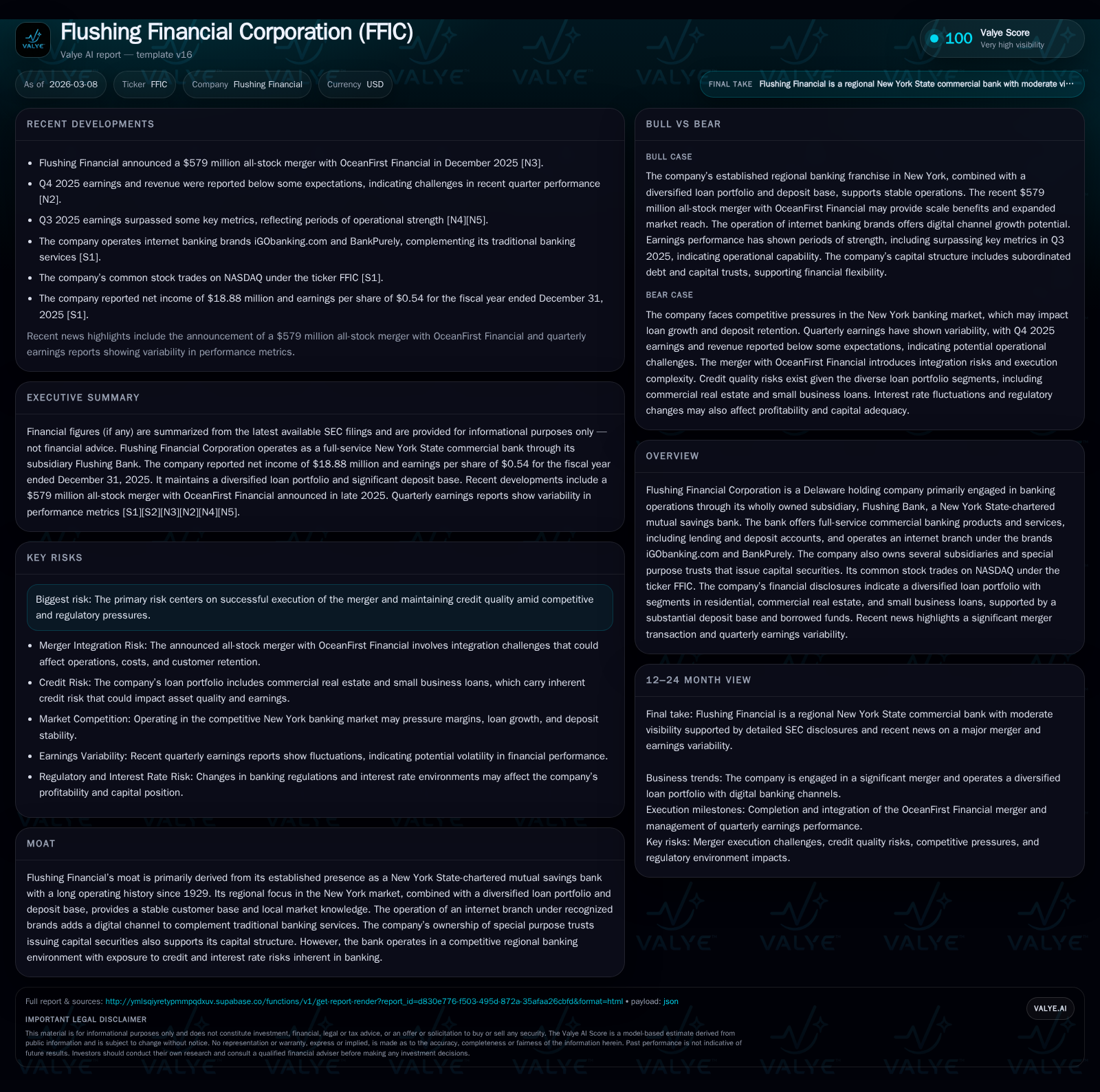
Flushing Financial Corporation (FFIC) emerged from a steep net loss in 2024 to post solid profitability in 2025, powered by diversified lending segments and disciplined capital allocation. The company’s balance sheet remains robust, supported by a stable deposit franchise and strategic use of capital securities. However, recent quarterly misses tied to merger-related execution risks and credit quality challenges underscore ongoing volatility. Going forward, monitoring integration progress and credit controls will be critical within a competitive New York banking landscape emphasizing both traditional community banking and expanding digital channels.
Profitability Shift: From 2024 Losses to 2025 Growth Drivers
Flushing Financial Corp exhibited a striking turnaround going from a significant $49.25 million net loss in fiscal year 2024 to a net income of $18.88 million in fiscal year 2025—a remarkable 138.3% year-over-year increase [F1]. This rebound was accompanied by operating cash flow more than quadrupling to $61.02 million in FY25 from just $12.41 million the prior year (+391.6% YoY), signaling renewed underlying earnings strength beyond mere accounting effects.
The loss in 2024 appears tied to elevated credit costs combined with one-off merger-related charges affecting earnings normalization. By contrast, improved credit metrics alongside higher interest margins contributed materially to the FY25 performance [S1]. Capital expenditures rose moderately (+126% YoY to $5.22 million), reflecting investments likely part of digital initiatives or branch improvements. Equity declined slightly from $724.5 million to about $708 million due primarily to accumulated losses earlier in the period despite profit recovery [F1]. The return on equity stands near 2.7% for FY25—a low but positive reversal from negative territory the prior year.
Historical performance (annual)
| FY | Net ($mm) | CFO ($mm) | Capex ($mm) | Net YoY |
|---|---|---|---|---|
| 2025 | 19 | 61 | 5 | +138.3% |
| 2024 | -49 | 12 | 2 | -708.0% |
| 2023 | 8 | 35 | 5 | -89.5% |
| 2022 | 77 | 86 | 4 |
Source: SEC companyfacts cache [F1].
Capital returns and efficiency (annual)
| FY | Buybacks ($mm) | FCF ($mm) | ROE% |
|---|---|---|---|
| 2025 | 11 | 56 | 2.7 |
| 2024 | 11 | 10 | -6.8 |
| 2023 | 13 | 29 | 1.2 |
| 2022 | 30 | 81 | 11.4 |
Source: SEC companyfacts cache [F1].
Loan Portfolio Composition and Evolution: Residential, Commercial, and Small Business Trends
FFIC's core banking operations are conducted via Flushing Bank, which holds a diversified loan portfolio centered on multi-family residential loans, commercial real estate mortgage loans, small business lending programs, and certain one-to-four family residential loans [S1][S10]. This mix balances yield and credit risk exposure across segments common for regional mutual savings banks operating in urban markets like New York.
Multi-family properties represent a large share given NY market dynamics favoring rental housing; commercial real estate portfolios emphasize stabilized assets with manageable delinquency profiles [S10]. Small business loans provide relationship-based lending opportunities contributing non-interest income streams and cross-selling potential with deposit accounts.
Allowance for credit losses was modestly increased year over year from roughly $40 million to $41.8 million in FY25 as management anticipates gradual normalization post-pandemic credit stresses [S1][S10]. Delinquency rates remain controlled within acceptable peer ranges; however, FFIC flagged competitive pressure on lending spreads which could compress margins absent rigorous underwriting discipline.
Merger Transaction Implications: Execution Risks and Integration Progress
Recent news disclosures highlight FFIC's pursuit of a material merger transaction intended to broaden its geographic footprint and diversify revenue sources beyond its core NY market [N1][N2][S3]. While positioning the bank for scale advantages, integration execution remains uncertain with management openly acknowledging risks related to operational consolidation costs, systems harmonization, and cultural alignment.
This merger activity has contributed to reported volatility in quarterly earnings — particularly Q4 of calendar year 2025 — where additional merger-related expenses weighed on results prompting misses against consensus estimates [N1][N2]. Successful close and integration milestones will be important indicators of the bank's ability to realize projected synergies without impairing credit quality or capital adequacy.
Balance Sheet Strength: Deposit Base, Borrowings, and Capital Securities Analysis
At year-end FY25, FFIC reported total assets around $8.87 billion underpinned by deposits totaling approximately $7.33 billion—a moderate increase over FY24 balances supporting loan growth initiatives [S4][S5][F1]. Non-interest bearing deposits expanded notably ($964 million vs $836 million prior), reinforcing liquidity buffer.
The company reduced reliance on borrowed funds substantially; Federal Home Loan Bank advances fell sharply from nearly $679 million down to about $254 million between years while subordinated debt remained stable near $188 million [S9]. An interesting facet of Flushing Financial's capital structure is its ownership of special purpose trusts issuing junior subordinated debentures aggregated near $50 million at fair value—serving as hybrid capital instruments enhancing Tier 1 ratios consistent with mutual savings bank capitalization norms [S6][S8].
Operating lease liabilities and other short-term obligations remained steady indicating no material leverage shifts outside strategic funding actions.
Navigating Regional Banking Competition: Flushing Bank's Market Position and Digital Strategy
FFIC benefits from its long-standing mutual savings franchise dating back to its founding in 1929—establishing deep local relationships pivotal to maintaining customer loyalty within New York's densely populated markets . Its traditional full-service commercial banking model serves diverse customer cohorts including residential borrowers and small businesses augmented by specialized lending expertise.
Complementing this legacy footprint is investment in internet banking brands such as iGObanking.com and BankPurely enabling channel diversification aligned with consumer shift toward digital engagement . These platforms have facilitated expanded reach beyond physical branch networks while keeping operational costs controlled within current variable cost structures.
Competitive pressures remain intense among regional banks vying for similar client bases amid tightening regulatory expectations related to credit underwriting standards; nonetheless FFIC’s dual focus on personal service backed by tech-savvy delivery provides differentiation.
Capital Allocation Practice: Dividends, Buybacks, and Free Cash Flow Generation
FFIC has historically returned capital consistently via dividends with recent quarterly payouts set at $0.22 per share affirming commitment toward shareholder income stability despite episodic earnings swings [S3][F1]. Buyback activity appears measured with cumulative repurchases around $11.47 million recognized per latest full-year data supporting balanced deployment amid uncertainty.
Free cash flow metrics derived show substantial positive generation: operating cash flow less capex approximates $55.8 million for FY25 signaling ample internal resources for growth reinvestment or shareholder distributions without sacrificing liquidity cushions [F1]. This reflects prudent stewardship given that regional banks often confront cyclical pressures impacting capital needs for loan loss reserves or regulatory buffers.
What the Headlines Miss: Key Earnings Variability Factors in Recent Quarters
While headlines report missed earnings estimates in Q4 calendar year 2025 driven by combined pressures from the ongoing merger transaction costs and certain upticks in credit loss provisioning [N1][N2], underlying annualized trends paint a more resilient picture . Management commentary clarifies that these transitory factors reflect deliberate spending choices on integration support functions plus cautious positioning amid macro uncertainties rather than fundamental operating deterioration [S1][S3].
Additionally, loan growth moderation reflective of rebalancing portfolio mix alongside improved deposit repricing helps explain some margin compression not immediately obvious outside detailed disclosures.
Watching Ahead: Key Catalysts and Risks in FFIC’s Growth Trajectory
Looking forward, several levers will drive FFIC’s trajectory: successfully closing its pending merger with smooth operational integration remains paramount while sustaining stringent credit quality metrics amid persistent local market competition constitutes another major focus area [N1][N2][S3]. Regulatory oversight following combination will warrant attention especially concerning capital ratios linked to trust-issued subordinated debt structures.
No explicit formal financial guidance was stated recently; thus market observers should track sequential quarterly earnings details alongside balance sheet composition updates for emerging signs of synergy realization or unanticipated charge-offs . Also critical will be how effectively digital platforms complement storefront banking going forward—in terms of cost efficiency gains as well as customer acquisition retention dynamics.
This analysis is intended solely for informational purposes based on publicly available data as of early March 2026; it does not constitute investment advice or recommendations.
Disclaimer: This is research-only, informational analysis and not investment advice. It may include AI-generated interpretation and general industry context. Always verify important details using primary sources.

Comments