
Okta's Shift to Profitability and AI Identity Leadership Sets New Growth Trajectory
Okta has transformed its financials during FY2026 while pioneering identity solutions for AI agents, redefining growth opportunities in cloud security.
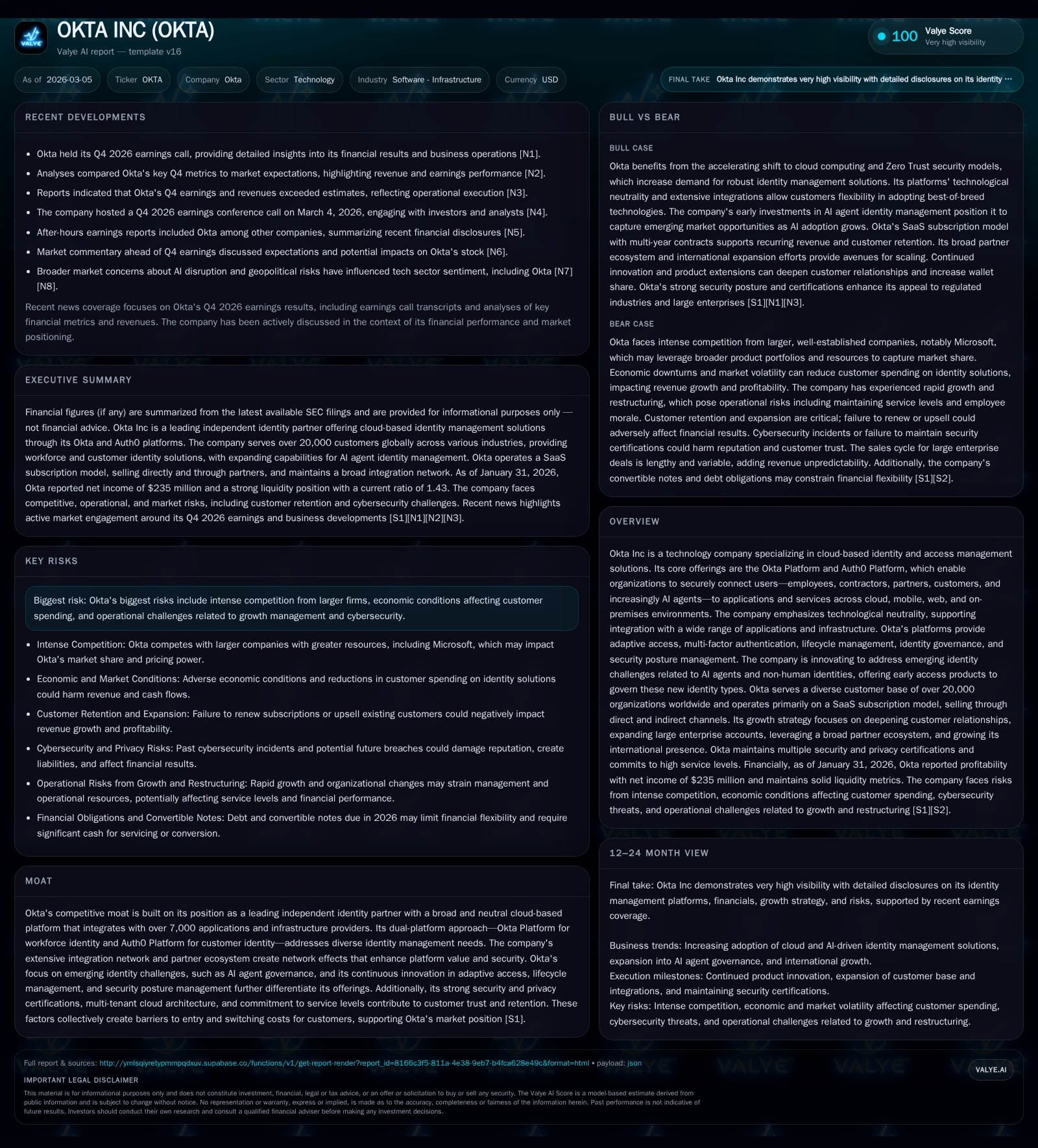
Okta Inc achieved a remarkable financial turnaround in fiscal 2026, swinging from multi-year losses to generating $235 million in net income and strong operating cash flows. This shift stems from operational discipline combined with expanding demand for its adaptable, cloud-neutral identity platforms that now encompass AI agent governance. With over 20,000 customers and a vast integration network, Okta’s dual-platform approach—serving workforce and customer identity needs—positions it well amid fierce competition. The company is advancing its offerings for emerging non-human identities, leveraging network effects and developer ecosystems to broaden its security footprint. Key risks include intensifying rivalry, operational scaling challenges, and compliance with evolving privacy regulations.
Strong Financial Turnaround Marks FY2026
Okta Inc reached a key inflection point in fiscal year 2026 ending January 31. After posting significant operating losses for three consecutive years—from an operating loss of $812 million in FY2023 shrinking to a loss of $74 million in FY2025—the company swung to a positive operating income of $149 million [F1]. This represents an impressive year-over-year growth rate of approximately 301%. Net income showed an even more dramatic reversal: after reporting losses exceeding $800 million in FY2023 and again a $355 million loss the following year, Okta generated a net profit of $235 million in FY2026—an increase of nearly 740% compared to the prior year [F1].
Such results were driven by effective cost controls paired with firm revenue base expansion as subscription income grew alongside rising deployments of their core identity solutions.
Operating cash flow also scaled strongly to $884 million, up nearly 18% YoY [F1]. Meanwhile, capital expenditures remained tightly managed near $9 million annually despite ramped R&D efforts aimed at new product development. The resulting free cash flow approximates $875 million as cash generated outpaces investment outlays [F1].
Historical performance (annual)
| FY | Net ($mm) | CFO ($mm) | OpInc ($mm) | Capex ($mm) | Net YoY |
|---|---|---|---|---|---|
| 2026 | 235 | 884 | 149 | 9 | +739.3% |
| 2025 | 28 | 750 | -74 | 8 | +107.9% |
| 2024 | -355 | 512 | -516 | 8 | +56.4% |
| 2023 | -815 | 86 | -812 | 12 |
Source: SEC companyfacts cache [F1].
Capital returns and efficiency (annual)
| FY | FCF ($mm) | ROE% |
|---|---|---|
| 2026 | 875 | 3.4 |
| 2025 | 742 | 0.4 |
| 2024 | 504 | -6.0 |
| 2023 | 74 | -14.9 |
Source: SEC companyfacts cache [F1].
All figures are USD millions except Approx ROE (%); ROE calculated as Net Income / Equity for each year [F1].
Core Drivers Behind Okta’s Past Growth Performance
Okta’s sustained growth has been fueled primarily by expansion of its diverse customer base exceeding more than 20,000 organizations spanning sectors such as enterprises, SMBs, universities, nonprofits, and government agencies worldwide [S6]. The company’s neutral cloud-based architecture allows seamless integration across thousands of applications and infrastructure providers—more than 7,000 integrations—facilitating widespread adoption by IT environments that rely on heterogeneous ecosystems [S4][S6].
This technological neutrality serves as a critical competitive advantage enabling customers flexibility in deploying best-fit solutions without vendor lock-in—a growing imperative amid proliferation of hybrid-cloud environments. Okta addresses two main identity domains: workforce identity through the Okta Platform focused on employees, contractors, partners; and customer identity through both Okta and Auth0 Platforms targeting external users [S4][S6].
Subscription revenue streams benefit from increased demand across these segments driven by the shift towards Zero Trust security models emphasizing adaptive access control based on continuous risk evaluation rather than perimeter-based defenses [S7]. Rising cyberthreat complexity coupled with regulatory compliance requirements have reinforced demand for automated lifecycle management and strong multi-factor authentication capabilities within enterprise IT strategies.
Pioneering AI Agent Identity: The New Growth Frontier
One notable strategic innovation is Okta’s early movement into managing identities for non-human entities—particularly AI agents—that operate autonomously or semi-autonomously within enterprise environments [S1][S4][S6]. Recognizing that traditional identity frameworks designed for human users fail to adequately address scalability and security challenges presented by AI-driven processes and machine-to-machine interactions, Okta unveiled new product offerings currently in early access:
- Okta for AI Agents: Provides discovery, registration, authentication, governance and lifecycle management tailored specifically for AI agents via the core Okta Platform.
- Auth0 for AI Agents: Enables developers to embed secure authentication flows suited to agentic applications on the Auth0 Platform.
- Cross App Access: Implements an interoperability standard extending the emerging Model Context Protocol (MCP) allowing secure cross-application communication between AI agents.
These offerings anticipate rapid growth in agentic workloads requiring real-time access controls at unprecedented speed and scale while mitigating known risks such as credential sprawl or unauthorized data exfiltration [S10][S23][S24]. Although adoption remains nascent, this initiative represents a potentially transformative expansion of Okta's total addressable market beyond traditional Identity & Access Management (IAM).
Expanding Platform Ecosystem and Network Effects
Okta's dual-platform strategy helps entrench its solutions among distinct customer groups while promoting significant network effects [S4][S6]. The Okta Platform centralizes identity lifecycle management incorporating advanced features such as adaptive MFA that selectively triggers challenges based on contextual risk signals derived from global telemetry aggregated across thousands of deployments.
Auth0 caters primarily to developers embedding customer-facing authentication in SaaS applications offering extensive extensibility via APIs and customization tools supporting fine-grained authorization models essential for secure agentic application development [S24].
The broad depth of integrations—over 7,000—and partnerships across cloud providers, SaaS vendors and system integrators fuel value creation whereby each new user or application connection enhances collective security posture through shared intelligence on emerging threats [S11]. This helps reduce friction while raising barriers for competitors lacking similarly expansive ecosystems.
Competitive Positioning Against Larger Tech Players
Okta faces stiff competition predominantly from tech giants like Microsoft who control widely adopted operating systems and productivity suites often bundled with proprietary identity solutions limiting openness [S5]. These incumbents wield expansive sales forces, deep customer relationships and enormous R&D budgets allowing aggressive pricing strategies including losses or product bundling that challenge independent vendors like Okta.
Nonetheless, Okta brokers a differentiated position emphasizing platform neutrality which appeals to enterprises seeking flexible integration versus lock-in scenarios. However risks remain substantial due to rapidly evolving cybersecurity technologies requiring continuous innovation pace alongside resource constraints relative to larger players.
Price pressures could intensify while potential entrants exploiting AI advancements might develop competing next-generation identity frameworks jeopardizing market share if Okta lags in technology adoption or standardization efforts [S5].
Capital Allocations and Strong Cash Flow Generation
Financial discipline remains evident as Okta invests prudently amid growth initiatives. Annual capital expenditures have stayed relatively stable around $8–$9 million even as operating cash flow expanded nearly tenfold since FY2023 reaching $884 million in FY2026 [F1].
Free cash flow approximates $875 million this latest fiscal year reflecting operational efficiencies balanced against continued R&D investments targeting AI agent product launches [F1]. Equity grew steadily from approximately $5.5 billion in FY2023 to nearly $7 billion by FY2026 indicating healthy balance sheet expansion alongside improved profitability metrics [F1].
Return on equity remains moderate at about 3.4%, signaling room for returns enhancement but aligning with industry expectations given ongoing strategic investments required to sustain competitive positioning within software infrastructure sectors [F1]. No explicit dividends or share buyback programs were indicated.
Sustaining Momentum: Key Milestones and Outlook
Looking ahead into fiscal periods starting post-January 2026 closing quarter earnings calls hinted at several focal points without explicit guidance metrics but suggestive of achievable milestones consistent with operational execution trends reported recently ([N1], [N2], [N3]). Key developments include:
- Accelerated commercial deployments of AI agent identity solutions transitioning from early access toward broader production adoption.
- Continued land-and-expand sales motions penetrating larger enterprise customers especially in regulated verticals where compliance needs reinforce spending.
- Pipeline progression within international markets where current contribution is ~20% yet viewed as expanding opportunity given global digital transformation waves ([S15]).
- Sustained high renewal rates underpin recurring subscription revenues reflective of platform stickiness critical to longer-term financial stability.
Investor focus should center on demonstrated traction of next-gen identity products amidst intensifying industry innovation cycles alongside continued margin improvement signaling operational scalability.
Risks Impacting Future Scalability and Profitability
Okta faces multiple material risks detailed extensively including:
- Macroeconomic conditions impacting IT budgets could restrict new acquisitions or renewals targeting workforce/customer identities reducing revenue growth prospects ([S1], [S2]).
- Intense competition particularly versus well-resourced incumbents could erode pricing power or market share ([S5]).
- Cybersecurity incidents remain a persistent threat potentially affecting service reliability or causing reputational harm despite robust internal controls ([S12], [S16], [S20]).
- Compliance complexities rise given patchwork privacy regimes globally increasing operational costs with risk exposure from regulatory enforcement actions ([S14], [S18]).
- Technology pace demands continuous innovation; delays or failure adapting quickly especially regarding AI identity standards could weaken competitive positioning ([S25], [S26]).
- Dependence on third-party service providers creates potential vulnerabilities if interruptions occur impacting platform availability or functionality ([S12], [S20]).
Mitigating these demands sustained investment balanced against operational efficiency gains intertwined with agility managing emerging regulatory landscapes critical to retaining market leadership.
This analysis is based exclusively on publicly filed documents including SEC filings dated March 5, 2026 (10-K), recent earnings call transcripts from March 2026 quarters ([N1]-[N3]), Nasdaq news summaries ([N4]-[N14]), and numerical disclosures aggregated via authoritative companyfacts database ([F1]) without speculative projections or investment advice.
Disclaimer: This is research-only, informational analysis and not investment advice. It may include AI-generated interpretation and general industry context. Always verify important details using primary sources.

Comments