
Fastly’s Record Revenue: Can Edge Cloud Scale to Profitability Amid Leadership Change?
Fastly, Inc. posted record third-quarter revenue and improved its internal controls, but persistent net losses and an impending leadership transition spotlight the challenge of converting operational momentum into sustainable profits in a fiercely competitive edge cloud market.
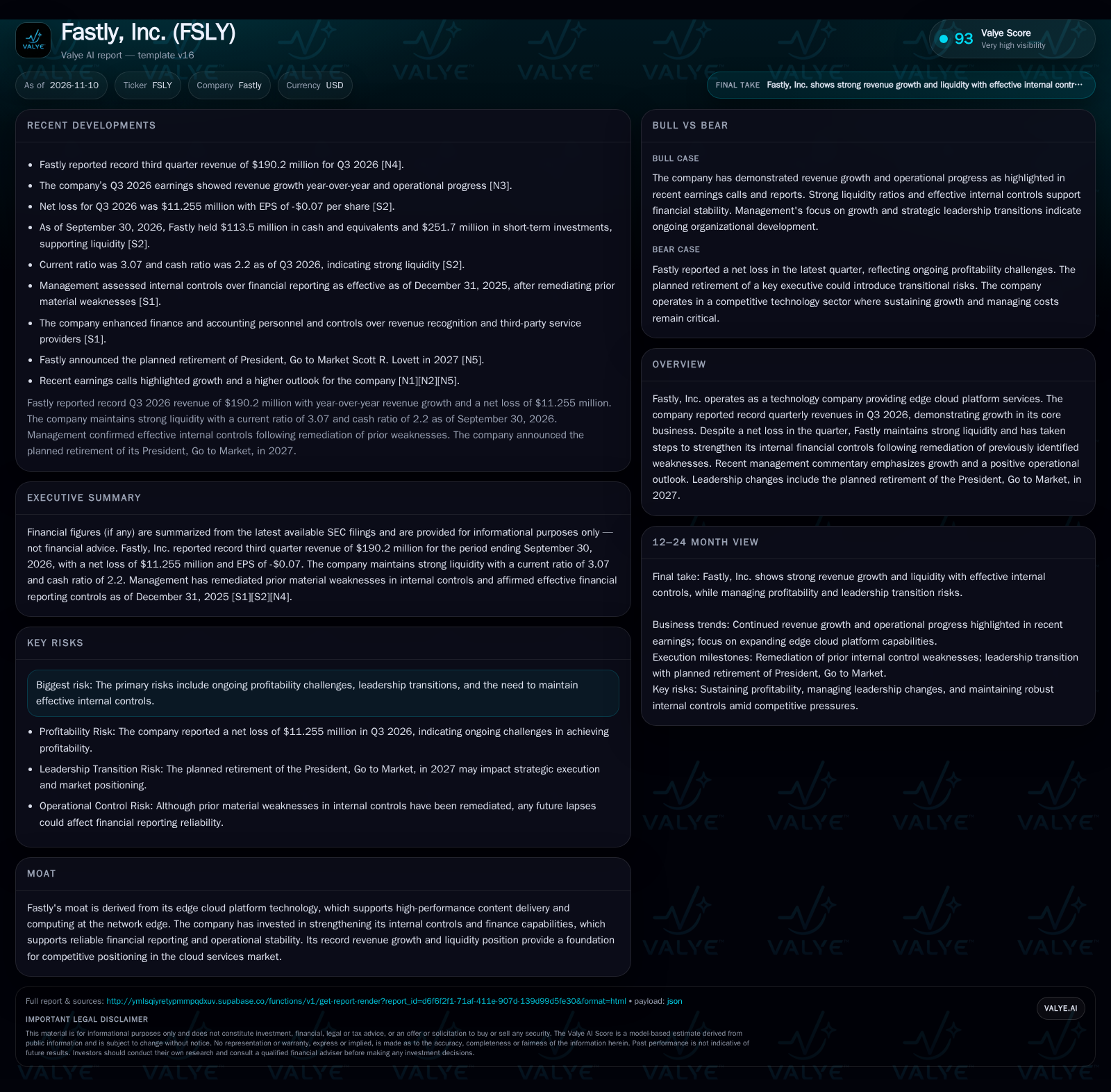
Fastly reported record Q3 2026 revenue of $190.2 million and maintains reported liquidity position, but continues to operate at a net loss and faces a pending executive retirement. The company’s operational progress and remediated controls may support future growth, yet durable profitability and competitive differentiation remain open questions. [N4] [S2] [N5]
Fastly, Inc. is riding a wave of operational and revenue growth, reporting record third-quarter sales and highlighting progress in shoring up its financial processes. Yet, the company remains unprofitable, with a net loss of over $11 million in Q3 2026, and is approaching a significant leadership transition as its President, Go to Market prepares to retire in 2027. With a reported liquidity position as of quarter-end, the fundamental question is whether Fastly’s edge cloud platform can generate sustainable margins and defend its position in a crowded, rapidly evolving market.
Recent Financial and Operational Milestones Set the Stage for Fastly’s Next Phase
Fastly reported record third-quarter revenue of $190.2 million for the period ending September 30, 2026, marking continued year-over-year growth and underscoring demand for its edge cloud platform. However, the company posted a net loss of $11.255 million, with basic and diluted EPS of -$0.07, indicating that profitability remains elusive even as top-line momentum builds. As of quarter-end, Fastly reported $113.5 million in cash and equivalents and $251.7 million in short-term investments, yielding a current ratio of 3.07 and cash ratio of 2.2. The company reported cash and liquidity metrics for the period; these figures do not by themselves establish operating runway, investment capacity, financial flexibility, or financing capacity. Operationally, management completed remediation of prior material weaknesses in revenue process controls, affirming effective internal controls by the end of 2025. Leadership transition is on the horizon, with the planned retirement of the President, Go to Market announced for 2027. [N4] [S2] [S1] [N5]
Edge Cloud Economics: Revenue Expansion vs. Margin Pressure
Fastly’s business model is rooted in providing edge cloud platform services, a sector that relies on a mix of usage-based and subscription revenue streams. The company’s record revenue growth suggests successful customer acquisition and increased network utilization, but its ongoing net losses highlight the difficulty of converting incremental revenue into sustainable profit. In edge computing, gross margins are often constrained by high fixed infrastructure costs—including global points of presence (PoPs), bandwidth, and security investment—while variable costs scale with traffic and value-added service adoption.
However, persistent losses imply that operating leverage is not yet sufficient to offset infrastructure and personnel expenses at current scale. Whether Fastly can achieve durable margin expansion depends on its ability to upsell higher-value services (such as security, edge compute, and real-time analytics), optimize network efficiency, and manage customer churn. Pricing power is typically limited by intense competition and the commoditization of basic content delivery, so differentiation and customer stickiness are critical to improving overall economics.
Defining Differentiation in a Crowded Edge Cloud Market
Fastly operates in a highly competitive landscape dominated by global cloud providers, traditional CDNs, and emerging edge compute specialists. Its moat is built on platform performance, developer experience, and the ability to deliver low-latency, programmable edge services. However, rival offerings from hyperscalers and well-capitalized CDNs can quickly neutralize technical advantages, particularly as edge and security features become table stakes.
Switching costs in this sector may be moderate: while integration with customer applications and APIs creates some friction, the prevalence of multi-CDN strategies and the ease of migration tools reduce customer lock-in. Fastly’s investments in internal controls and operational resilience may support its reputation for reliability, but long-term differentiation will likely depend on its pace of innovation, breadth of value-added services, and ability to foster a sticky developer ecosystem. The planned leadership transition could affect strategic continuity at a critical juncture.
Margin Expansion and Platform Upsell Drive a Profitable Growth Cycle
If Fastly successfully shifts its revenue mix toward higher-margin edge compute, security, and analytics products, operating leverage could improve meaningfully. Upselling existing customers on advanced services and expanding wallet share would increase average revenue per user (ARPU) while reducing churn and pricing pressure. Effective execution of internal controls and seamless leadership transition could reinforce customer trust and operational discipline.
Confirmation of this scenario would include: meaningful gross margin expansion in subsequent quarters; rising ARPU or revenue per customer, if disclosed; evidence of increased sales of value-added services; and net income trending toward breakeven or positive territory. Strong customer retention rates and positive commentary on new product adoption would further validate this trajectory.
Growth Continues, but Profitability Remains a Medium-Term Challenge
The most plausible path is that Fastly sustains revenue growth in the mid-teens annually, leveraging its liquidity to invest in network capacity and product development. However, margin improvement may prove gradual, with persistent competitive pricing and infrastructure costs offsetting operational efficiencies. The leadership transition could cause temporary disruption but is unlikely to fundamentally derail the company’s trajectory if a strong successor is appointed and internal controls remain robust.
Evidence supporting this scenario would be continued revenue growth and stable or modestly improving gross margins, but ongoing net losses or only incremental progress toward profitability. Any delay in the rollout of new high-margin services, or lackluster customer uptake, would reinforce the likelihood of this outcome.
Competitive Pressures and Execution Risks Erode Growth and Margin Potential
In a less favorable scenario, Fastly’s growth could slow due to aggressive competition, industry price compression, or customer churn to larger cloud providers with broader integrated offerings. If the company fails to differentiate its platform or capitalize on emerging edge use cases, revenue growth may decelerate and margin pressures could intensify. The leadership transition, if mishandled, could disrupt go-to-market execution or strategic focus, exacerbating operational risks.
Falsifying signals would include: revenue growth falling below industry averages; flat or shrinking gross margins; rising operating losses; and negative customer retention or satisfaction trends, if disclosed. Any renewed internal control issues or high-profile service outages would further undermine the company’s position.
Milestones and Metrics That Will Determine Fastly’s Edge Cloud Trajectory
Gross margin trends: Sustained or expanding gross margins would indicate improved operating leverage and successful upsell of higher-value services.
Net income progression: Movement toward breakeven or positive net income, rather than persistent losses, would signal that scale benefits are materializing.
Revenue per customer (ARPU): If disclosed, growth in ARPU would suggest effective cross-selling and increased product adoption.
Churn and customer retention rates: High or rising retention would support the case for customer stickiness and product differentiation.
Adoption rates of value-added services: Growth in security, edge compute, and analytics revenue, if reported, would confirm the platform’s ability to move up the value chain.
Impact of leadership transition: Smooth succession in the President, Go to Market role and continuity in sales execution will be critical to maintaining momentum.
Internal control reliability: Sustained effectiveness of financial controls, with no new material weaknesses or restatements, will support investor confidence.
Competitive pricing dynamics: Monitoring price trends in the CDN and edge markets will help assess Fastly’s ability to maintain or grow margins.
Disclaimer: This is research-only, informational analysis and not investment advice. It may include AI-generated interpretation and general industry context. Always verify important details using primary sources.

Comments