
Invesco CurrencyShares Australian Dollar Trust: Currency Exposure and Passive ETF Dynamics
FXA offers transparent, direct Australian Dollar exposure through a grantor trust backed by AUD deposits, navigating currency volatility with a passive structure.
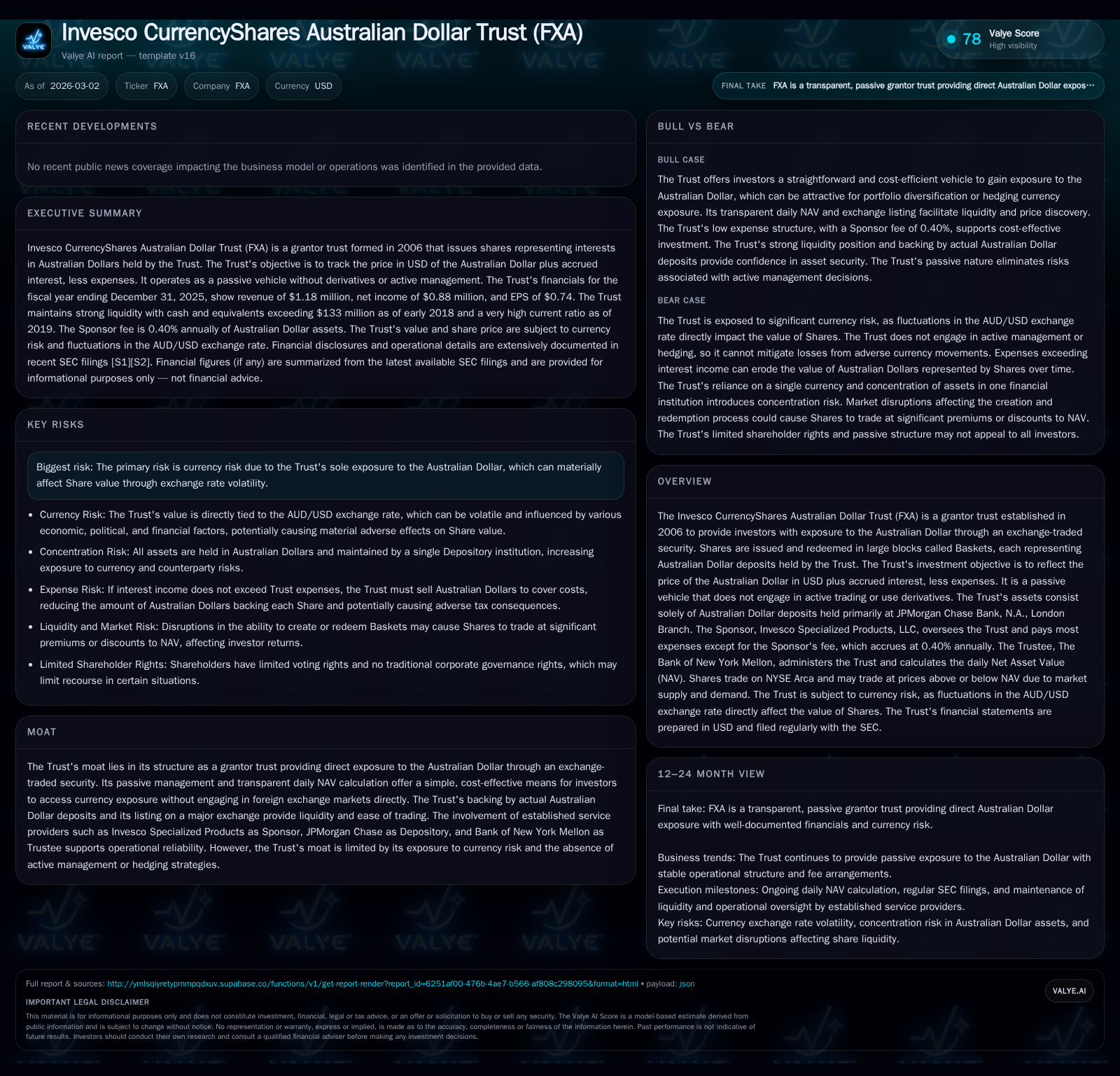
The Invesco CurrencyShares Australian Dollar Trust (FXA) is a grantor trust providing passive, direct exposure to the Australian Dollar via exchange-traded shares backed by physical AUD deposits. Its financial results reflect currency fluctuations impacting revenue and net income, with a decline in 2025 due to AUD valuation changes. FXA’s capital management revolves around share Basket issuances and redemptions rather than traditional capital returns, complemented by monthly distributions funded from accrued interest net of a 0.40% Sponsor fee. The trust's moat lies in its simplicity, transparency, and operational reliability through partnerships with established financial institutions; however, the absence of active management leaves FXA fully exposed to currency risk and interest/expense mismatches.
FXA’s Historical Financial Performance: Growth and Drivers
FXA has delivered fluctuating financial results reflecting direct impact from Australian Dollar (AUD) valuation against the U.S. Dollar (USD). Revenue rose significantly from approximately $187k in FY2022 to $1.36M in FY2024 before contracting by about 12.7% to $1.18M in FY2025 [F1]. Net income improved from an operating loss of $180k in FY2022 to net profits exceeding $1M in FY2024 but contracted nearly 18.5% to around $879k in FY2025—a reflection of currency depreciation affecting underlying AUD-denominated assets [F1]. Operating cash flow followed a similar profile with $727k generated in FY2023 increasing substantially in FY2024 then declining by roughly 19% YoY in FY2025 [F1].
This performance highlights that earnings depend largely on interest income earned from AUD deposits held by the Trust minus expenses accrued primarily through the Sponsor fee and other operational costs [S1]. The improvement post-2022 likely reflects recovery in AUD/USD rates and higher accrued interest returns amid rising yields on AUD deposits. Conversely, the decline seen in 2025 corresponds with renewed volatility and a weaker Australian Dollar impacting NAV valuations even after accounting for accrued interest [F1][S1].
Historical performance (annual)
| FY | Rev ($) | Net ($) | CFO ($) | Rev YoY | Net YoY |
|---|---|---|---|---|---|
| 2025 | 1184327 | 878882 | 892716 | -12.7% | -18.5% |
| 2024 | 1356538 | 1078586 | 1102559 | +24.8% | +35.5% |
| 2023 | 1086795 | 796270 | 727127 | +479.9% | +542.3% |
| 2022 | 187406 | -180023 | -250997 |
Source: SEC companyfacts cache [F1].
Capital returns and efficiency (annual)
| FY | Div ($) |
|---|---|
| 2025 | 906329 |
| 2024 | 1094626 |
| 2023 | 731919 |
| 2022 | 40442 |
Source: SEC companyfacts cache [F1].
Table: Key financial metrics for FXA showing fluctuating revenue and profits impacted directly by currency moves.
Currency Exposure Mechanics and Passive Management Implications
The Invesco CurrencyShares Australian Dollar Trust operates as a grantor trust established June 2006 [S1]. Unlike actively managed funds or those employing derivatives for hedging or speculation, FXA solely holds Australian Dollars deposited at JPMorgan Chase Bank’s London branch—its Depository [S1]. Investors acquire exposure via Shares representing fractional interests linked proportionally to these underlying Australian Dollar holdings plus accrued interest less expenses.
Shares are created or redeemed only through “Baskets” comprising blocks of 50,000 Shares each [S1]. Authorized Participants—typically institutional intermediaries—deliver or receive Australian Dollars when creating or redeeming Baskets; retail investors trade Shares on NYSE Arca without impacting underlying assets directly [S1].
Each business day the Trustee calculates the Trust's Net Asset Value (NAV) using the Closing Spot Rate published by The WM Company at London fixing time (~4 PM London time), ensuring transparency and up-to-date reflection of AUD/USD FX movements [S1][S20]. Interest on AUD deposits accrues daily and is paid monthly; this interest forms part of shareholder returns after deducting operating expenses including a fixed Sponsor fee accruing annually at nominal rate of 0.40% charged on total Australian Dollars held [S13][S26].
This passive approach offers clarity—investors’ returns approximate holding physical Australian Dollars converted daily into USD plus any accrued yield—with no complex derivative overlays or active trading strategies complicating NAV calculations [S1]. The physical deposit backing ensures direct correlation with spot Australian Dollar valuations enabling straightforward access to currency exposure usually costly or complex through other channels.
Key Risk Factors Shaping FXA’s Share Value
As an instrument tied uniquely to Australian Dollar deposits without hedging mechanisms or diversification across currencies/assets, FXA inherits comprehensive currency risk [S3][S12]. The Trust’s share value swings directly with AUD/USD exchange rate volatility influenced by domestic/foreign inflation disparities; sovereign debt levels; monetary policies like RBA interest rates; trade balances; geopolitical events impacting investor sentiment; and central bank interventions aiming to stabilize or manipulate FX markets [S3].
When interest earned falls short of expenses the Trustee must withdraw Australian Dollars from the Trust reducing amounts represented per Share over time—the "expense drag" effect—which erodes NAV even if local currency prices remain stable [S1]. This introduces erosion risk for longer-term holders absent upward movement in AUD value. Distributions funded below expense coverage can trigger adverse tax implications for shareholders receiving reduced dividends yet facing taxable events based on indirect unrealized losses embedded via NAV adjustments [S3][S13].
Concentration risk arises as all assets are deposited at a single custodian institution (JPMorgan Chase Bank), exposing shareholders to counterparty credit risks should insolvency or operational failures occur—though such risk is generally considered remote given bank stature [S23]. Overall forex market volatility combined with FXA’s structural design limits mitigation possibilities reinforcing sensitivity to macroeconomic fluctuations beyond management control.
Analyzing FXA’s Capital Allocation: Share Issuance, Redemptions, and Distributions
Traditional capital allocation strategies like buybacks or dividend growth policies do not apply here since FXA issues Shares exclusively via Basket creations/redemptions conducted by authorized intermediaries exchanging physical AUD deposits [S15]. Recent reporting shows moderate fluctuations reflecting market demand for direct AUD exposure causing corresponding changes in aggregate asset levels backing Shares outstanding (e.g., net decrease ~50k shares between early-to-late-2025 quarters) [S4][S5][S15].
Distribution policy pays out excess interest after deducting Sponsor fees and ordinary expenses monthly converted into USD distributed pro-rata to shareholders [S9][S21]. Distribution yields have hovered near approximately 1% annualized reflecting low-risk deposit yields minus fee drag—for example monthly distributions ranging roughly $0.05-$0.07 per Share over mid-2025 referencing NAV near $60-$65 per Share range [S10][S21]. These modest payouts provide some return component over base currency appreciation potential.
The Sponsor absorbs many operational costs including trustee fees up to certain thresholds permitting expense containment benefiting overall efficiency; non-recurring extraordinary costs beyond these limits may be payable by the Trust altering expense profiles temporarily but have been rare historically [S13][S6]. Cash flow statements confirm stable positive operating cash flows derived mainly from accrued interest netted against fees rather than active investment gains reinforcing reliance on passive deposit returns [F1][S18][S7].
What Investors Should Watch: Future Prospects and Operational Constraints
FXA’s growth prospects align with broader flows into foreign exchange focused products seeking simple vehicles for direct currency exposure without derivative complexity—a niche segment within currency-tracking ETFs/ETNs lacking broad active overlays.
Demand drivers include cross-border portfolio allocations adjusting emerging market exposure or hedging tied explicitly to AUD/USD cycles influenced by trade relations Australia maintains especially with China and U.S., commodity price dynamics integral to Australia’s economy (e.g., iron ore), as well as global monetary policy developments.
Operationally FXA faces intrinsic constraints owing to its pure passive design disallowing active management interventions such as hedging or signaling-based trading limiting ability to respond dynamically to sharp downside moves potentially reducing appeal during turbulent forex environments. Its fixed fee accrual could increasingly weigh on returns if deposit rates compress amid macroeconomic shifts leading to persistent negative spreads between income earned versus expenses incurred further depressing distributions and NAV stability absent robust appreciation.
No explicit forward-looking statements or guidance appears within recent SEC filings indicating forecast assessments rely predominantly on macroeconomic scenarios contingent upon expected AUD/USD trajectories coupled with global economic developments affecting interest income generated on held deposits.
Routine milestones include monthly NAV calculations incorporating official WM Company London Fixing closing spot rates alongside monthly income distributions plus continued Basket creation/redemption cycles facilitating liquidity for institutional Authorized Participants maintaining stable market functioning documented thoroughly in quarterly SEC reports without planned structural alterations indicated forthcoming.
Monitoring geopolitical developments impacting major trade partners or central bank policy shifts remain critical variables influencing future performance dynamics.
The Trust’s Structural Moat and Industry Positioning
FXA’s moat stems primarily from being a passively managed grantor trust offering direct exposure to the Australian Dollar via physical deposits rather than synthetic exposure through derivatives which dominate other currency ETFs/ETNs reducing counterparty risks typically associated with swaps used elsewhere.
This design affords investors highly transparent daily NAV disclosures tied strictly to underlying assets rather than complex valuation models bolstered further by reliable administrative support provided by service providers:
- Sponsor: Invesco Specialized Products LLC overseeing Trustee performance.
- Depository: JPMorgan Chase Bank N.A., London Branch holding actual AUD deposits.
- Trustee: Bank of New York Mellon managing operational records and valuations.
These relationships underpin operational reliability facilitating daily liquidity via exchange listing on NYSE Arca simplifying access for institutional/retail investors alike contrasting favorably against more opaque OTC foreign exchange structures often requiring intermediated execution at wider spreads.
Nevertheless this moat has limits intrinsically imposed through lack of active management tools denying strategic positioning against adverse movements inherently exposing shareholders directly to full market risk without mitigation instruments translating purely spot rate fluctuations into Share price outcomes emphasizing need for investor sophistication recognizing passive nature balanced against cost efficiency advantages offered cleanly here.
This analysis synthesizes information obtained from verified SEC filings ([S#]) complemented by XBRL financial data ([F1]) aligned with best practices for objective company evaluation absent investment recommendations.
Disclaimer: This is research-only, informational analysis and not investment advice. It may include AI-generated interpretation and general industry context. Always verify important details using primary sources.

Comments