
Selectis Health Transitions Leadership Amid Strategic Portfolio Changes
Recent executive departures and asset sales mark a pivotal operational reset for Selectis Health's integrated care and real estate business.
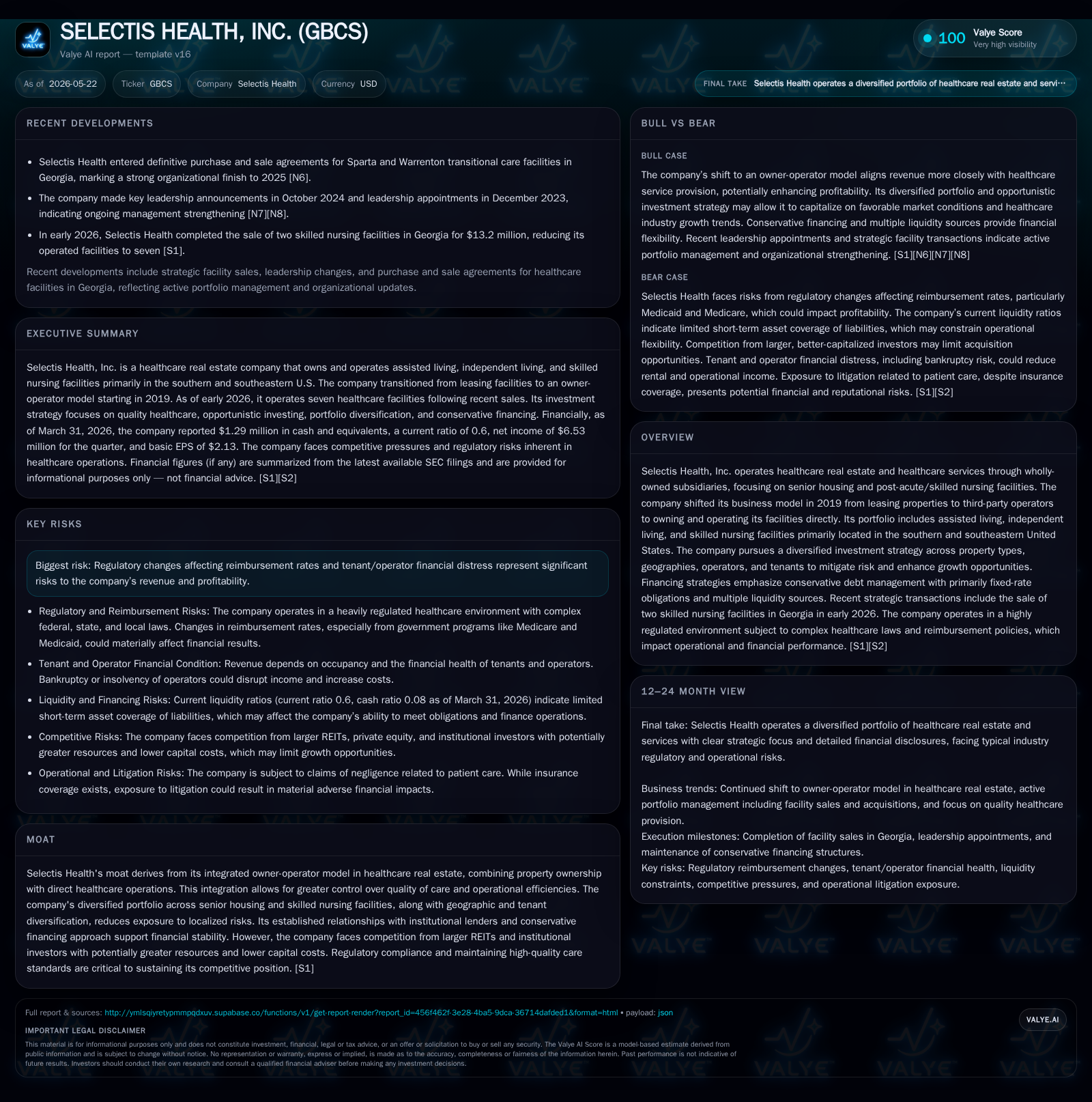
In the latest quarterly filing dated May 22, 2026, Selectis Health announced the resignation of its CEO and CFO, replaced by Krystal Eckhart, a seasoned healthcare finance executive. Concurrently, the company completed the sale of two skilled nursing facilities in Georgia, signaling a strategic portfolio recalibration. Since 2019, Selectis shifted from leasing to an integrated owner-operator model in senior housing and post-acute care, balancing control over operations with increased execution risks. Its diversified portfolio across the southern U.S., combined with conservative financing policies, underpins a cautious but growth-oriented approach amid competitive pressures from larger REITs and regulatory complexities. Key risks include occupancy volatility, regulatory reimbursement changes, and tenant financial stability. The near-term focus lies on governance stabilization and effective deployment of proceeds from recent dispositions.
Recent Leadership Changes Signal Strategic Realignment
In May 2026, Selectis Health experienced a significant management overhaul when Adam Desmond resigned as both CEO and CFO as well as from the Board of Directors effective May 14 [S3]. This abrupt departure was immediately followed by the appointment of Krystal Eckhart as CFO on May 15. Eckhart brings over 15 years of progressive experience in healthcare revenue cycle management spanning multi-state skilled nursing operations. Given her previous roles overseeing Medicare/Medicaid financial operations at multiple healthcare entities affiliated with Selectis since 2016, Eckhart’s ascendancy reflects an effort to strengthen financial governance during ongoing operational transitions [S3].
Such leadership changes during strategic asset sales signal a potential inflection point where operational execution priorities and capital allocation strategies will be reassessed. The appointment of a specialized healthcare financial leader underscores heightened emphasis on managing complex reimbursement environments and multi-state facility operations.
Business Model Evolution: From Triple-Net Leasing to Integrated Operations
Originally operating primarily as a triple-net landlord leasing healthcare properties to independent operators, Selectis pivoted its business model in 2019 toward becoming an integrated owner-operator of healthcare facilities including assisted living (ALF), independent living (ILF), and skilled nursing facilities (SNFs) [S1]. This shift allows greater control over quality standards and operational efficiency but introduces direct exposure to the complexities inherent in healthcare service delivery.
Revenue mechanics now combine lease income where applicable with direct healthcare service revenues driven by occupancy levels, payer mix (notably Medicare/Medicaid), case mix intensity under PDPM reimbursement rules, and ancillary services [S1][S2]. Operational costs have expanded accordingly to cover personnel expenses aligned with CMS mandates, infection control protocols post-pandemic, regulatory compliance costs, and quality measurement reporting
The owner-operator model enhances margin control opportunities via active management but also increases volatility exposure linked to occupancy fluctuations or operator financial distress—a tradeoff the company navigates carefully.
Portfolio Composition and Operational Quality Control
Selectis maintains a portfolio concentrated geographically in the southern and southeastern United States encompassing diverse senior housing types alongside post-acute/skilled nursing facilities [S1][S2]. This geographic focus leverages demographic trends favoring aging populations in these regions while maintaining risk diversification across different property types.
The company implements strict operating standards aligned with CDC guidelines, CMS regulations including Five Star Quality Ratings for SNFs, ADA compliance mandates, and local health codes. Maintaining these quality benchmarks is crucial not only for regulatory compliance but also for sustaining resident satisfaction thus preserving occupancy rates.
By diversifying across property types—independent living offers lower acuity residential options while skilled nursing focuses on more acute rehabilitative care—Selectis balances risk profiles within its asset base. Operators are contractually bound to maintain the real estate assets responsibly even when leasing arrangements exist.
Competitive Landscape in Healthcare Real Estate and Services
Healthcare real estate is intensely competitive with pressure from large REITs, private equity funds, institutional investors, sovereign wealth funds as well as operator entities who may possess deeper pockets or lower cost-of-capital advantages than Selectis [S1][S22]. This competitive environment constrains deal flow quality and pricing flexibility.
Selectis’ niche lies in its integrated owner-operator approach which differentiates it from pure-play landlords dependent solely on lease income. However, this model demands higher operational expertise and exposes the company to service delivery risk absent at pure landlords.
Financial institutions scrutinize earnings volatility inherent in healthcare operations tied to regulatory shifts; thus access to capital may occasionally be more costly relative to non-operating peers.
Catalysts for Growth: Diversification and Investment Flexibility
Growth initiatives are anchored around expanding investments via six distinct mechanisms: direct property ownership; mezzanine or senior debt financing; development/redevelopment projects; investment management platforms; leveraging RIDEA structures permitting joint venture operational ownership; along with wholly owning healthcare operations [S1][S4]
RIDEA investments permit enhanced tax efficiencies and closer alignment between real estate ownership and operating partners enabling margin accretion potential. Redevelopment projects focus on repositioning assets for higher acuity or senior housing upward migration which can justify rate increases.
Geographic expansion opportunities remain largely regional but strategic acquisitions or developments could capitalize on favorable demographic or reimbursement trends. Opportunistic capital deployment into niche post-acute segments or undercapitalized markets also presents upside.
Key Risks: Regulatory Shifts and Occupancy Sensitivities
Occupancy remains a critical driver underpinning both rent collections (where leasing applies) and direct operational revenues. Pandemic-induced disruptions elevated move-in screening protocols restricting new admissions thereby negatively impacting occupancy rates across facilities [S1]. Ongoing vaccination dynamics plus regulatory mandates continue influencing pandemic-related costs such as PPE procurement labor surcharges further pressuring margins.
Medicare/Medicaid reimbursement reforms related to PDPM raise uncertainty regarding future payment levels; CMS actively reviews claims for compliance raising audit risks exposing operators to clawbacks or sanctions [S18]. Financial distress among tenants/operators can cause lease defaults or bankruptcy proceedings which delay or reduce rent recoveries creating cash flow pressures on Selectis [S1].
Additionally insurance cost inflation affects coverage expenses while litigation from negligence claims remains an inherent hazard despite insurance protections [S9]. Operational complexity necessitates continuous investment in staffing retention incentives amid labor scarcity issues affecting service continuity.
Upcoming Milestones: Governance Stabilization and Portfolio Optimization
Immediate operational priorities following the leadership change include stabilizing governance structures with newly appointed directors expected to reinforce oversight [S3][S25]. Integration of new financial controls aligned with Eckhart’s extensive sector-native background will impact working capital cycles especially accounts receivable processes tied closely to government payors.
The recent disposition of two skilled nursing properties in Georgia valued collectively at $15.7 million ($9 million net proceeds after liabilities) represents tactical portfolio pruning intended to deleverage balance sheet exposures while focusing resources on core properties with higher return profiles [S12][S25]. How Selectis reinvests proceeds – whether into development pipelines or debt reduction – will provide actionable signals of growth strategy.
Navigating ongoing regulatory adjustments while upgrading property-level quality metrics remains paramount for sustaining market competitiveness.
Current Financial Position and Capital Management Overview
As of March 31, 2026 quarter-end per the latest filing [[F1]], Selectis holds cash & equivalents totaling approximately $1.29 million against reported current assets near $9.82 million but faces current liabilities exceeding $16.3 million yielding a constrained current ratio around 0.6 indicative of tight working capital conditions.
Notably though, the company successfully retired its outstanding Senior Secured Notes worth $1.775 million as of January 2026 reducing refinancing risks associated with prior note maturities targeted February 28, 2026 [S5][S6]. Commercial lines of credit previously utilized have likewise been refinanced or repaid improving liquidity profile modestly.
Longer term debt outstanding is shown at roughly $2.65 million (best effort measurement last updated late 2021) indicating modest leverage levels when normalized against asset base though precise current figures remain undisclosed [[F1]]. The conservative approach favors fixed-rate financing instruments mitigating interest rate risks given prevailing macroeconomic uncertainties.
Overall capital discipline evidenced by debt retirement funded through asset sales reveals prudent balance sheet stewardship during transition periods coinciding with evolving business model dynamics.
This analysis synthesizes publicly available disclosures aimed solely at understanding Selectis Health's evolving operating context without implying any investment opinion or research view.
Disclaimer: This is research-only, informational analysis and not investment advice. It may include AI-generated interpretation and general industry context. Always verify important details using primary sources.

Comments