
Greenbrier Companies’ Integrated Railcar Model Under Strain from Trade Policies and Backlog Decline
Latest quarter shows margin gains amid delivery shortfalls and mounting tariff risks, highlighting resilience and vulnerabilities in Greenbrier’s dual manufacturing and leasing operations.
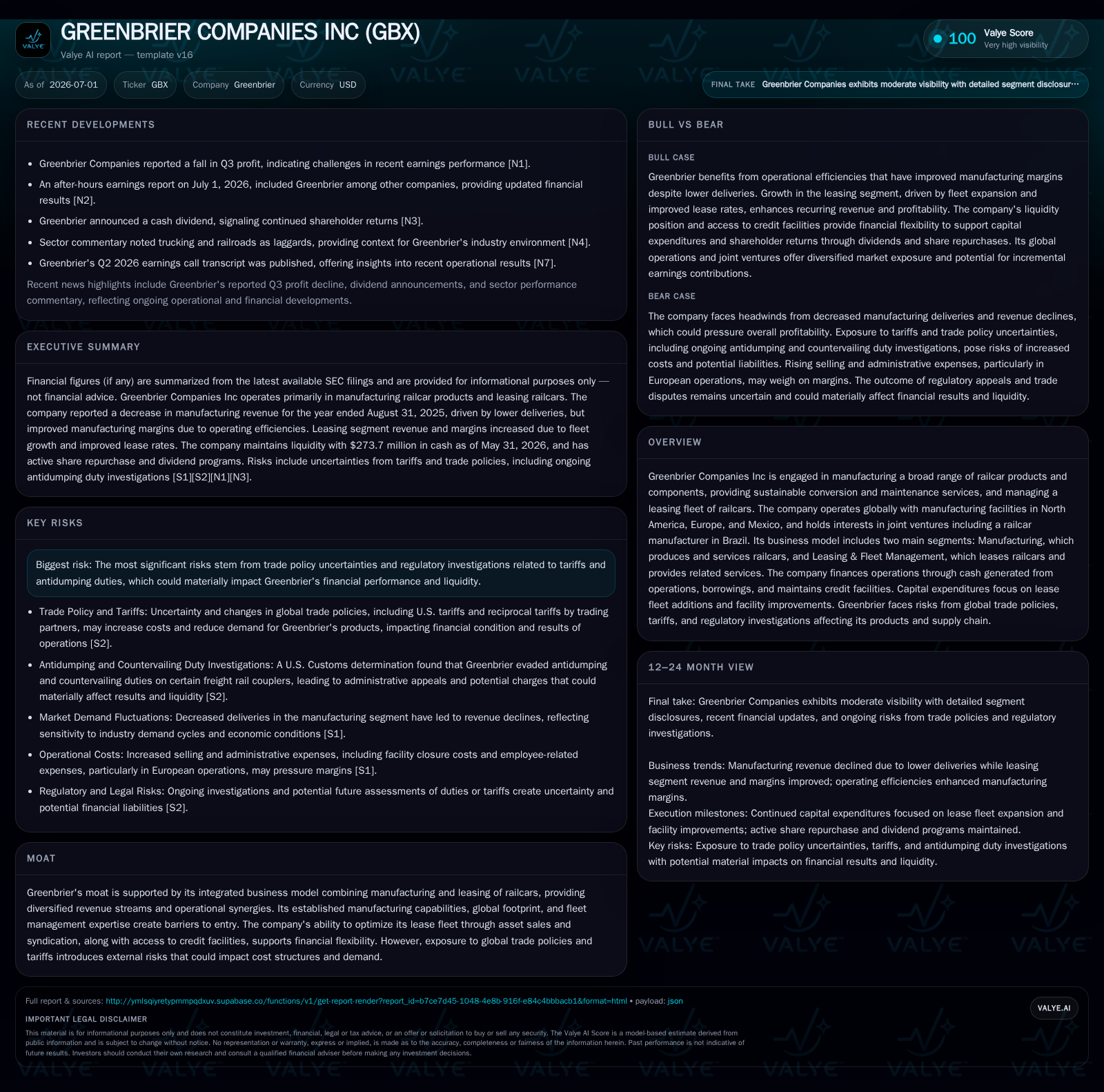
Greenbrier Companies Inc reported its third-quarter results ending May 31, 2026, revealing operational resilience in an environment challenged by declining railcar deliveries and tariff uncertainties. While manufacturing deliveries declined approximately 8.5%, operating margin expanded owing to efficiency gains. The leasing segment grew revenue and earnings through fleet expansion and improved lease rates. However, recent U.S. antidumping determinations and steel/aluminum tariffs introduce significant cost pressure and regulatory uncertainty. Greenbrier’s integrated manufacturing and leasing business model offers diversification benefits, but growth is constrained by trade policy risks, cyclical transportation demand, and capital intensity.
Recent Operating Update
Greenbrier Companies' latest quarterly filing for the period ended May 31, 2026 [S2] underscores a challenging near-term operating environment sustained by external trade policy headwinds and subdued railcar deliveries. The company reported consolidated financial results reflecting a revenue base predominantly split across Manufacturing and Leasing & Fleet Management segments.
Manufacturing revenues declined nearly 10% year-over-year primarily due to an 8.5% fall in railcar deliveries during fiscal year 2025 [S1]. Despite volume contraction, the manufacturing segment attained margin expansion—operating income rose 6.1% while margins improved from 9.3% to nearly 11%—reflecting gains in operating efficiencies likely linked to cost control or production optimization measures.
Conversely, the Leasing & Fleet Management segment posted resilient growth with revenues increasing over 7%, fostered by strategic lease fleet expansions and elevated lease rates [S1]. This led to a substantial operating income jump of approximately 15.5%, driving operating margins higher than 60%, indicative of the high-margin profile typical of asset leasing businesses in this sector.
However, regulatory risks have intensified mid-2026 with U.S. Customs issuing a Notice of Determination accusing Greenbrier of evading antidumping and countervailing duties related to freight rail couplers attached to railcars since April 2024 [S2]. The company has filed an administrative appeal but acknowledges inherent uncertainty around potential retroactive liabilities or future tariffs that could materially affect profitability or liquidity.
The imposition of Section 232 tariffs on steel and aluminum imports further exacerbates cost pressures on the manufacturing side [S2]. Given the capital-intensive nature of railcar production—with raw materials representing significant input cost—these tariffs threaten gross margins unless offset by pricing power or supply chain adjustments.
Business Model Analysis
Greenbrier operates a vertically integrated model combining railcar manufacturing with leasing operations complemented by maintenance and conversion services [S1]. This dual-segment approach diversifies revenue streams: Manufacturing creates upfront sales proceeds from newly built or converted railcars while Leasing & Fleet Management generates recurring rental income plus syndication proceeds from managed lease assets.
Customers include freight rail operators who require reliable rolling stock either through outright purchase or lease arrangements depending on their capital strategy or fleet needs. Greenbrier's capacity to deliver custom or standard railcars with sustainable conversion options positions it well in an industry where compliance with evolving safety and environmental standards is increasingly pivotal.
Revenue mechanics hinge heavily on volume cycles influenced by freight demand growth, infrastructure investment trends, replacement cycles for aging fleets, and regulatory drivers mandating equipment upgrades. Leasing revenues depend crucially on fleet size/quality, utilization rates, lease rate levels set by market supply-demand dynamics, as well as syndication activities that optimize asset rotation.
Margins fluctuate between segments: Manufacturing typically commands lower but stable margins constrained by commodity exposure and production cycles; leasing enjoys higher margins driven by asset utilization leverage though it carries residual value risks tied to railcar lifecycle longevity.
Greenbrier's global footprint—with manufacturing sites primarily in North America, Europe, Mexico plus joint ventures like the Brazilian railcar manufacturer—offers geographic risk dispersion but also exposes complexity in supply chain management against shifting trade tariffs or currency fluctuations [S1].
Industry Structure and Competitive Position
The railcar manufacturing industry is capital intensive with high barriers from scale economies in plant operations plus regulatory compliance capabilities. Integration with leasing operations is less common but favoured among large players such as Trinity Industries or GATX Corporation for portfolio diversification and optimizing capital usage.
Demand drivers include freight transport volumes driven by economic growth patterns across commodities (e.g., agriculture, chemicals), infrastructure investments requiring new rolling stock replacements, regulatory mandates enhancing safety/environmental features on railcars, plus the strategic shift of logistics customers toward flexible leased assets versus ownership.
Greenbrier’s leasing segment benefits from market preference shifts towards rental models offering flexibility without capital expenditure burdens for end users. Additionally, their syndication activities allow them to sell leased assets selectively improving cash flow recycling.
Competitive positioning hinges on manufacturing quality/reliability reputation combined with ability to service lease fleets actively including maintenance/conversion expertise—a key switching cost factor for customers wary of downtime risk or obsolescence in equipment.
Growth Drivers
Key growth vectors include:
- Incremental freight transportation volumes boosting underlying demand for new railcars.
- Replacement demand triggered by aging fleets coupled with tightening regulations mandating safer or environmentally compliant cars.
- Lease fleet expansion fueled by customer preference shifts towards outsourcing asset ownership risks.
- Capital investment programs targeting facility upgrades enhancing productivity/sustainability which may reduce unit cost over time.
- Geographic diversification via joint ventures broadening addressable markets especially in emerging regions like Latin America.
- Potential technological advancements improving railcar designs aligning with efficiency/environmental objectives.
Monitoring leading indicators such as order backlog status (book-to-bill ratio), pipeline of leasing contracts/syndication volume, and prevailing lease rate trends will provide insight into demand sustainability.
Risks and Constraints
Trade-policy uncertainties represent Greenbrier’s most immediate material risk factor [S2]. Tariffs on steel/aluminum inflate input costs disproportionally impacting manufacturing margins without guaranteed pass-through mechanisms given competitive pressures or contract structures. Antidumping allegations carry potential back payments plus ongoing compliance costs that could pressure liquidity given their unresolved status.
Cyclicality inherent in freight transport volumes can produce fluctuating order flows creating troughs in manufacturing throughput impacting fixed cost absorption.
Residual value risk arises if leased assets lose market value faster than depreciation schedules anticipate due to technological obsolescence or decreased demand for specific car types.
Supply chain resilience remains critical given global component sourcing complexities; disruption could delay deliveries negatively affecting customer relationships.
Competition from alternate transportation modes (trucking/ship) also introduces longer-term structural challenges though current dynamics still favor rail for bulk goods over certain distances.
What To Watch Next
- Updates on administrative appeals related to antidumping determinations including timing/outcome,
- Quarterly metrics around manufacturing backlog levels and book-to-bill ratio indicating order flow health,
- Lease fleet utilization rates combined with average lease rate movements signaling pricing power,
- Syndication activity volumes reflecting asset turnover effectiveness,
- Capital expenditure pace relative to announced plans especially within Leasing & Fleet Management,
- Any ad hoc announcements regarding supply chain disruptions or regulatory changes impacting cross-border operations,
- Comparative operating margin performance trends highlighting efficiency improvements or cost pressures,
- Freight volume trends in key end markets signaling macro demand shifts.
Financial Profile Discussion
As of May 31, 2026 [F1], Greenbrier held approximately $274 million in cash and equivalents. Total debt was approximately $1.76 billion and net debt stood near $1.49 billion as of August 31, 2025 [F1].
In summary, Greenbrier's integrated business model combines long product cycles of manufacturing with recurring leasing revenues that complement cyclical swings while exposing it to material policy-driven cost shocks demanding vigilant operational execution and financial prudence.
Disclaimer: This is research-only, informational analysis and not investment advice. It may include AI-generated interpretation and general industry context. Always verify important details using primary sources.

Comments