
PennantPark Investment Corp's Leverage and Portfolio Income Trends Amid Interest Rate Shifts
Latest quarterly filings reveal PNNT's mix of operating losses and capital management under evolving financing costs.
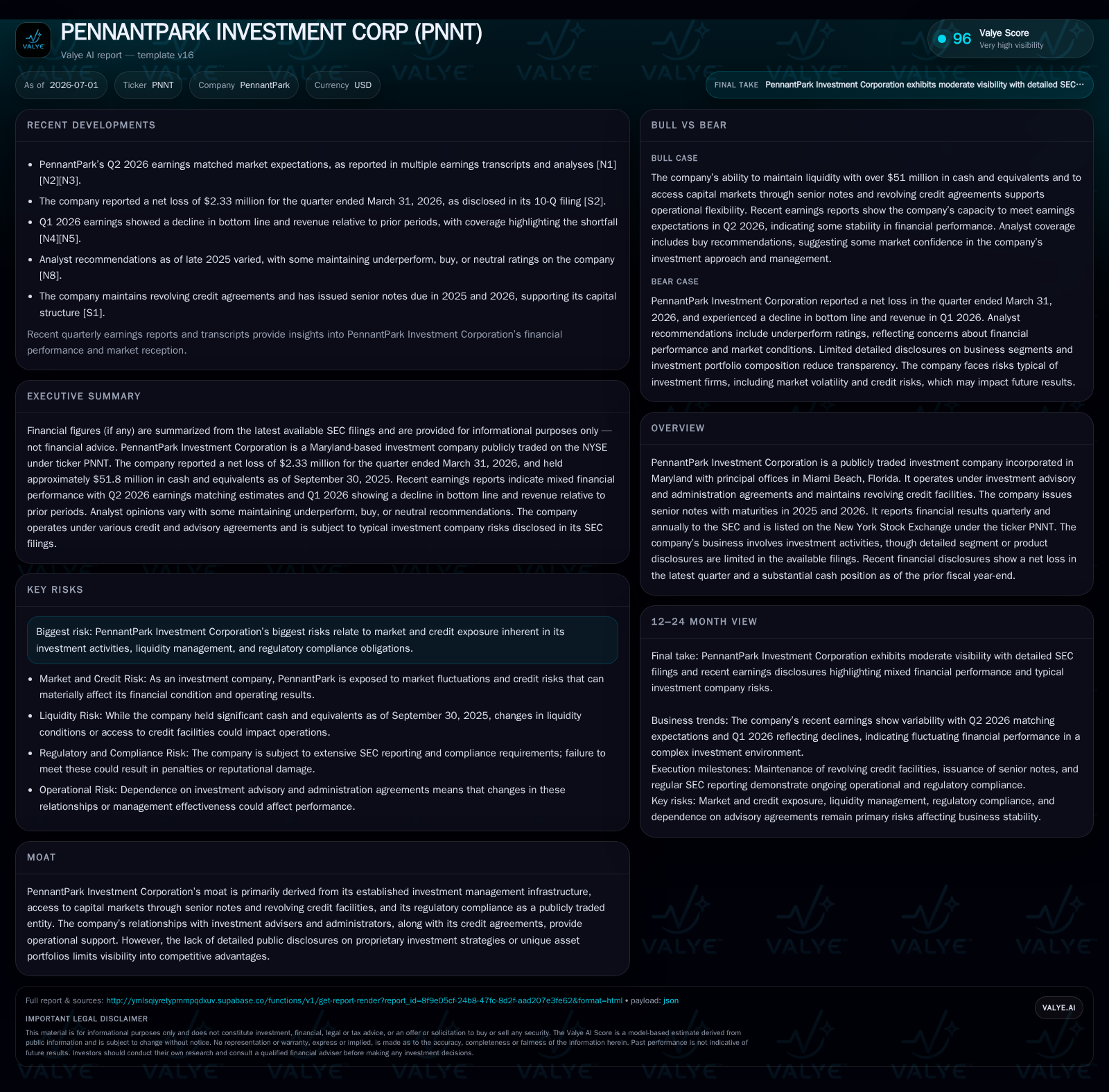
PennantPark Investment Corporation (PNNT) reported a net loss in its latest quarter ending September 2025 while maintaining over $51 million in cash and equivalents. The company operates as a publicly traded investment company, leveraging senior notes and revolving credit facilities to finance a portfolio primarily comprising middle-market debt investments managed by affiliated advisers. PNNT’s operating performance is influenced by credit risk exposures, interest rate volatility impacting investment income versus funding costs, and its ongoing capital deployment strategy. Recent filings confirm monthly distribution payments continue despite near-term profitability pressure, underscoring a focus on yield distribution amid portfolio adjustments.
Recent Operating Update
Monthly distribution payments continue unabated as confirmed in multiple recent Form 8-K disclosures issued between March and June 2026 ([S3], [S13], [S15]), signaling management’s focus on sustaining shareholder returns even when quarterly earnings falter. The persistence of distributions amidst operating losses may exert pressure on net asset value (NAV) per share if portfolio yields do not meet or exceed capital costs over time.
Business Model Overview
PNNT functions as a business development company (BDC)-style investment firm that mobilizes capital raised via equity issuance and debt instruments—including senior notes due in 2025 and 2026 as well as revolving credit facilities—to invest primarily in loans, debt securities, or equity interests predominantly within middle-market companies. The company relies on PennantPark Investment Advisers, LLC for sourcing deals and ongoing portfolio management services under advisory agreements ([S1]).
Revenue is principally derived from interest income on invested assets, supplemented by dividends or gains from equity stakes subject to fair value accounting adjustments. Pricing power within this model derives from the firm’s ability to source attractive yield relative to cost of funds. Volume drivers are linked to capital deployment pace into new investments balanced against portfolio repayments or write-offs.
Operating expenses reflect adviser fees plus borrowing costs which fluctuate with leverage strategy and market interest rates.
Industry Structure and Competitive Positioning
PNNT situates itself among mid-tier publicly traded BDCs competing for allocations within the increasingly crowded alternative credit market. Its competitive moat stems from established advisory relationships enabling access to proprietary deal flow alongside capital markets access through note issuance backed by sizeable revolving credit agreements ([S1]).
However, the lack of detailed disclosure around proprietary underwriting criteria or specialized asset classes limits visibility into differentiation versus peers such as Ares Capital Corporation or Golub Capital BDC.
Operationally, PNNT experiences similar sector-wide risks including sensitivity to increasing non-accrual loans amid economic cycles, regulatory mandates for transparent NAV calculations, and reliance on market conditions for cost-effective refinancing strategies.
Growth Drivers
PNNT’s growth potential is chiefly tethered to:
- Capital raising capability: Equity distribution agreements executed in mid-2024 facilitate incremental funding sources essential for expanding the investment base ([S1]).
- Portfolio yield enhancement: Rising interest rate environments potentially boost floating rate loan returns which can augment net investment income if funding costs are controlled.
- Credit quality improvements: Active management of non-accrual loan ratios enhances realized yields while constraining impairment losses.
- Deal sourcing prowess: The advisory arm's expanded capabilities help target niche middle-market opportunities delivering favorable risk-adjusted returns.
These drivers intertwine; improving portfolio health supports higher sustainable distributions essential given the company’s yield-focused investor base.
Risks and Constraints
Key risks include:
- Credit risk escalation: Defaults or downgrades within portfolio companies could impair income streams and trigger write-offs impacting NAV.
- Interest rate volatility: Funding cost rises may outpace investment income growth especially if fixed-rate liabilities dominate balance sheet structures.
- Liquidity pressure: Market disruptions might challenge debt refinancing at attractive terms when senior notes are approaching maturity.
- Distribution sustainability: Upholding monthly payouts amid operational losses could erode capital base absent accretive reinvestment opportunities.
- Regulatory compliance burdens: Ongoing adherence to SEC regulations governing investment companies demands robust internal controls impacting operating expense ratios ([S1]).
Investor communications around distribution policy continuity will also provide clues regarding management’s risk appetite under prevailing market pressures.
Financial Profile Discussion
Operating expenses connected to adviser fees combined with financing costs impose additional margin pressure threatening net income stability if portfolio yields cannot keep pace. The company publicly maintains monthly distributions consistent with a yield-driven shareholder base but must reconcile payout levels versus declining quarterly earnings to avoid NAV dilution over time.
Overall, PNNT exemplifies the operational dynamics faced by mid-market BDCs managing the tradeoff between leverage-fueled income generation and episodic credit/market headwinds influencing profitability and growth trajectories.
This analysis synthesizes recent SEC filings and publicly available information without offering investment advice or forecasts.
Disclaimer: This is research-only, informational analysis and not investment advice. It may include AI-generated interpretation and general industry context. Always verify important details using primary sources.

Comments