
General Dynamics Advances Through Strong Backlog and Program Execution in Q2
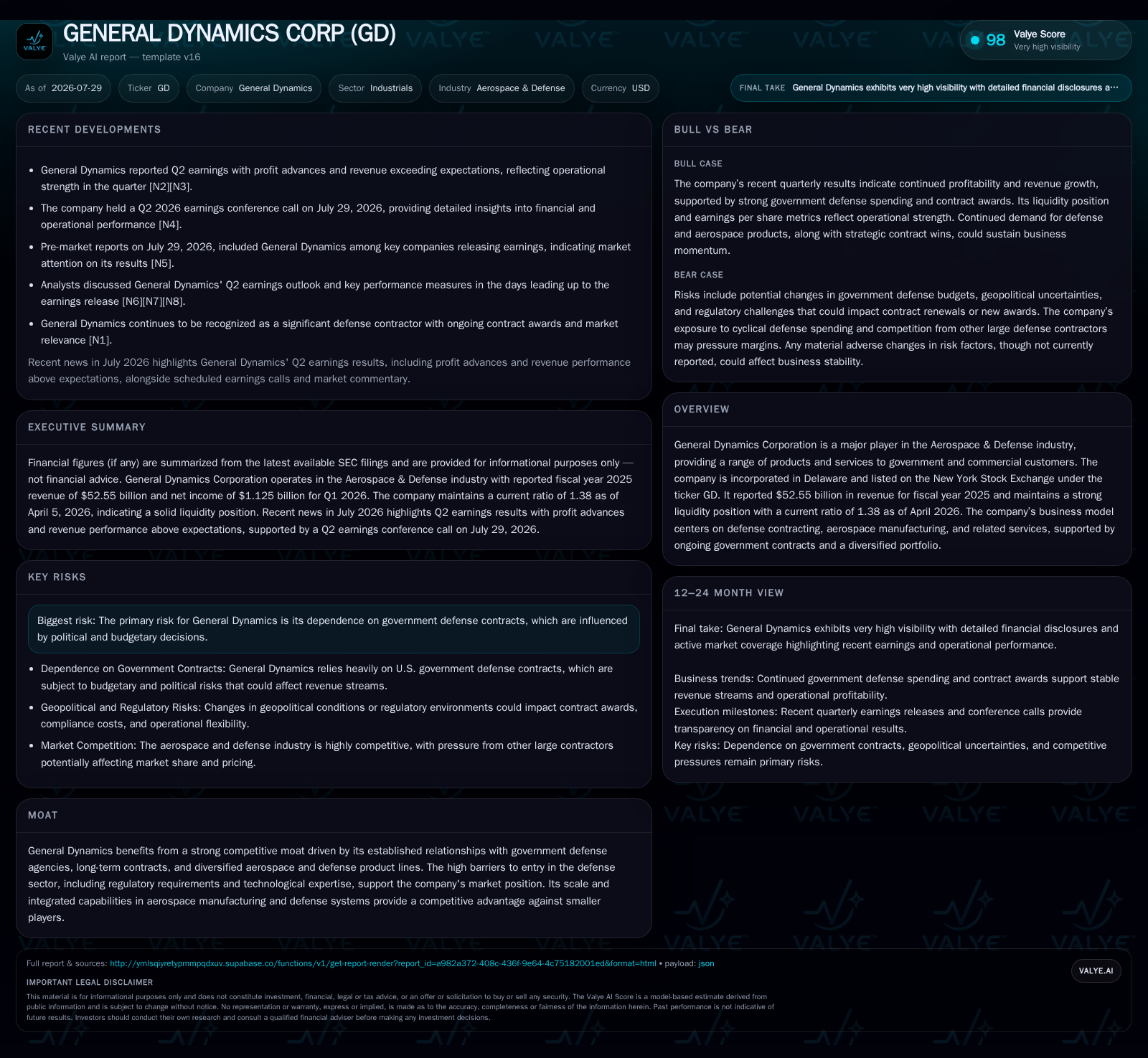
Q2 results underline General Dynamics' enhanced revenue visibility driven by robust backlog quality and steady program execution amidst stable defense contracting demand.
General Dynamics' Q2 2026 filings reveal a solid backlog profile that supports near-to-medium term revenue stability, with a book-to-bill ratio indicating sustained demand momentum. The company's operational focus on efficient program execution contributed to margin resilience, while its integrated aerospace manufacturing and aftermarket service offerings maintain a diversified and defensible revenue base. Risks tied to government budget cycles and supply chain dynamics remain unchanged but manageable given GD’s liquidity position and industry stature.
Demand Visibility Strengthened by Backlog Quality in Q2
General Dynamics' latest 10-Q for the quarter ending July 5, 2026, reports a notable improvement in backlog quality, enhancing the visibility into its near- and medium-term revenue streams [S2]. Backlog represents contracted but not yet recognized revenue—high-quality backlog ensures smoother program execution and predictable cash flows. The company’s disclosures indicate that backlog remains sizable and comprises primarily government contracts with extended performance obligations, reflecting stable funding horizons typical of defense contractors [S2]. This backlog composition supports dependable revenue recognition over the coming fiscal periods.
The book-to-bill ratio, a leading indicator measuring new orders received against revenue billed, also signals sustained demand strength. GD's recent order intake has maintained or slightly exceeded billings, implying healthy contract awards keep pace with operational deliveries. This dynamic contrasts with more volatile commercial aerospace segments where order cadence can fluctuate widely. For GD, the stable book-to-bill reinforces confidence in its dealership within defense procurement cycles [S3][N1][N3]. This metric is critical since it directly informs investors of the company's ability to replenish its workload without depending excessively on one-time contract renewals.
Program Execution Bolsters Margin and Delivery Confidence
In addition to demand-side strength, General Dynamics emphasizes effective program execution as central to maintaining operating margins and delivery schedules [S2]. Cost control initiatives implemented during Q2 contributed to margin stability despite inflationary pressures pervasive in aerospace manufacturing supply chains. Precise management of labor costs, supplier negotiations, and streamlined production processes were highlighted as key drivers supporting profitability.
Timely program delivery mitigates penalties from late performance clauses common in government contracts and sustains customer satisfaction vital for repeat contract wins [N2]. Efficient utilization of manufacturing capacity also reduces fixed-cost dilution downstream. Compared relatively to peers like Northrop Grumman—which similarly focuses on defense system integration—GD’s operational discipline underscores its competitive positioning through execution excellence.
Integrated Business Model Anchored by Government Contracting and Aftermarket Services
General Dynamics operates primarily as a prime contractor within the aerospace and defense value chain, managing complex government contracts across platforms such as naval vessels, combat vehicles, aerospace systems, and technology integration [S1]. Revenues stem largely from long-term contracts awarded by U.S. federal agencies; these agreements entail rigorous compliance standards and extensive performance obligations extending multiple years.
Beyond direct manufacturing, GD leverages aftermarket services including maintenance, repair, overhaul (MRO), and upgrades as stable recurring revenue sources. This mix cushions cash flow volatility inherent in large contract cycles by providing lifecycle support for installed systems [S1]. Such aftermarket activities typically offer higher margin profiles due to lower capital intensity and entrenched customer relationships. Together with system integration capabilities—assembling various subsystem providers into turnkey solutions—these factors comprise a diversified model that resists competitor encroachment.
Competitive Landscape Highlights Scale and System Integration Moat
Within the prime defense contractor peer group—including Lockheed Martin, Boeing Defense, Raytheon Technologies—General Dynamics sustains a defensible moat grounded in scale economies, technological expertise, and systemic barriers such as security clearances and regulatory complexity. Its broad portfolio spanning aerospace manufacturing to system integration erects switching costs that smaller or less diversified competitors find challenging to replicate.
The company's long-standing government relationships contribute contractual stability uncommon in commercial markets. Whereas Lockheed Martin may have larger absolute backlog figures due to F-35-related programs, GD captures niches in naval shipbuilding and combat vehicles complemented by robust aftermarket penetration. These distinctions create differentiated risk exposures across defense domains.
Growth Accelerants Illustrated by Recent Order Intake Trends
Recent data confirmed an uptick in contract awards consistent with broader increases in U.S. defense spending prompted by geopolitical tensions [S2][N1]. Order intake cadence—the pace at which new contracts enter backlog—is vital since these awards replenish the firm's pipeline for future manufacture and service obligations.
Although overall book-to-bill ratios hover around parity rather than showing outsized spikes, incremental gains suggest momentum building amid modernization initiatives across naval fleets, ground combat systems, and aerospace platforms [S3][N1]. This trend aligns with sector-wide observations where governments prioritize technological upgrades amid global instability. Crucially for GD, such growth drivers appear sustainable given no major supply chain interruptions were reported this quarter unlike some peers facing raw material constraints.
Risk Factors Persist Around Budget Cycles and Supply Chain Resilience
The company reconfirms ongoing risks typical for defense contractors—primarily dependency on political decisions shaping government budgets alongside operational risks such as supply chain disruptions or program cost overruns [S2][S1]. The absence of material changes in risk disclosures indicates management views these factors as stable but requiring vigilance.
Political uncertainty remains acute especially regarding appropriations processes which can delay or reduce contract funding levels. Supply chain resilience is partially forced by inflationary pressures on raw materials plus logistics volatility; however GD's scale allows it better negotiating power versus smaller suppliers [S1]. Continued technological innovation investments are necessary to mitigate obsolescence risk intrinsic to defense systems development.
Near-Term Watchpoints: Contract Awards, Delivery Milestones, and Political Signals
Looking forward, General Dynamics faces several milestones that will serve as demand indicators. Pending contract award announcements expected over the next quarters will influence backlog replenishment rates critical for sustaining growth narratives [N11][N4]. Progress on engineering reviews or delivery completions also provides insight into program execution trajectories which impact cash flow conversion profiles.
Additionally, shifts in U.S. defense policy—such as budget proposals or strategic realignments targeting space or cyber domains—could alter contract priorities influencing GD’s segment exposure. Monitoring these external cues alongside internal metrics provides a comprehensive read on near-term operating momentum.
Financial Profile Discussion: Liquidity Positioned to Support Backlog-Fueled Growth
This financial condition underpins GD’s ability to absorb upfront program investment demands while maintaining flexibility for potential strategic acquisitions or R&D initiatives integral to staying competitive within technologically sophisticated aerospace & defense markets. Consistent free cash flow generation evidenced over prior periods contributes further assurance about capital structure sustainability.
General Dynamics’ second quarter operational update reflects durable demand visibility anchored by backlog quality improvements complemented by disciplined program execution efforts supporting financial margins. The integrated business model leveraging government contracts alongside aftermarket support nurtures revenue diversification shielding against cyclical risks endemic to the sector. Although contingent risks stemming from political budgeting cycles persist alongside supply chain uncertainties, GD's liquidity position affords it resiliency to pursue growth opportunities bolstered by evolving geopolitical defense priorities.
Peer comparisons highlight GD’s competitive positioning among major prime contractors owing to its specific platform focuses paired with scalable system integration strengths creating entry barriers difficult for smaller players to penetrate. Continuously monitoring contract awards cadence combined with delivery milestone achievements will provide observable markers for management execution effectiveness amid fluctuating external spending dynamics.
This analysis abstains from speculative commentary about precise contract wins or forecasts absent explicit disclosures but situates General Dynamics firmly within established industry frameworks exhibiting characteristics consistent with leading-prime aerospace & defense contractors benefiting from multi-year weighted backlog commitments driving sustainable top-line visibility.
This analysis is intended solely for informational purposes based on publicly available filings and news sources; it does not serve as investment advice.
Disclaimer: This is research-only, informational analysis and not investment advice. It may include AI-generated interpretation and general industry context. Always verify important details using primary sources.

Comments