
Great Elm Capital Corp. Faces Earnings Setbacks But Leverages Structural Advantages
GECC’s financial challenges in 2025 contrast with its strategic positioning in middle market credit and CLO investments.
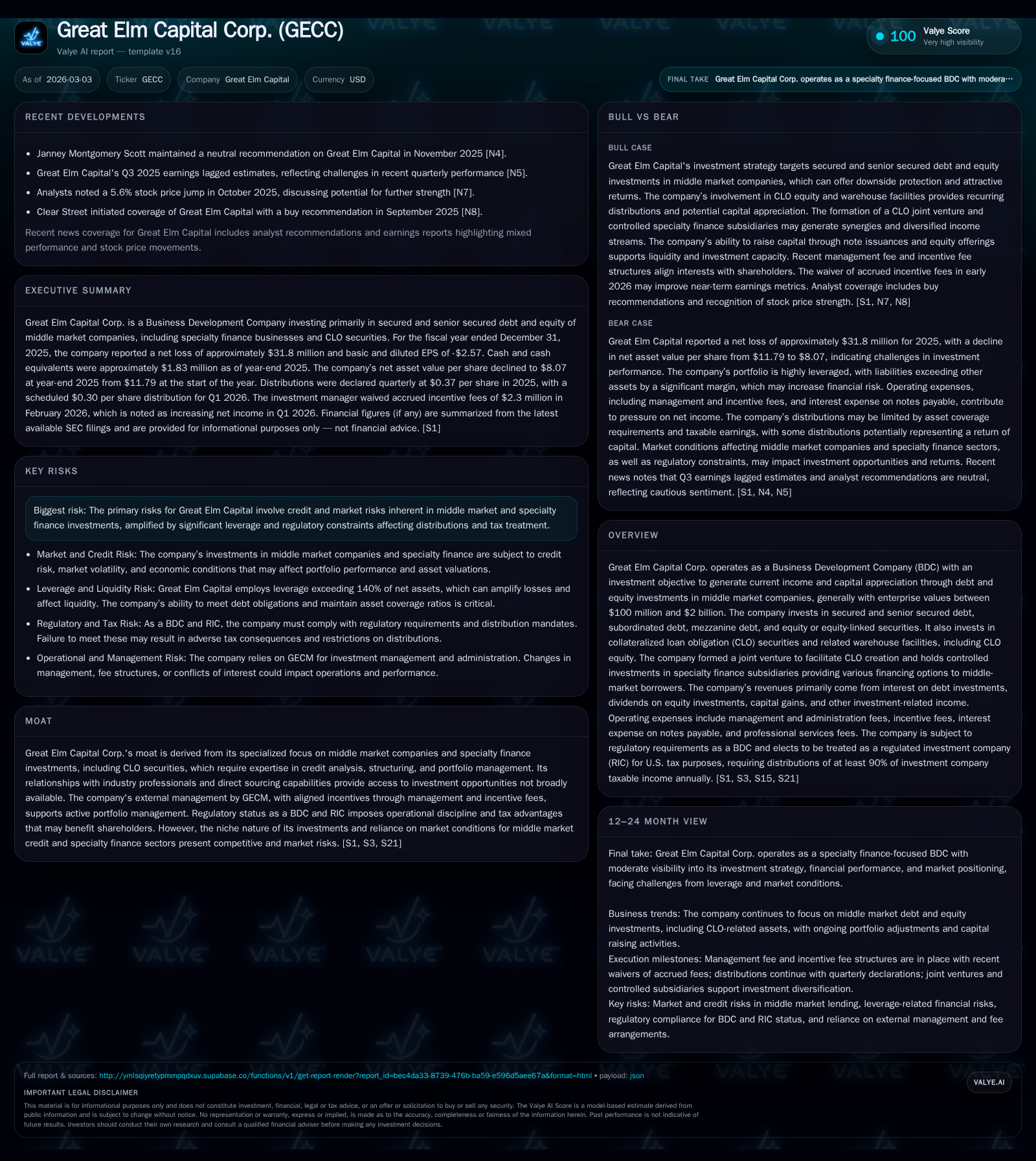
Great Elm Capital Corp. (GECC) experienced a stark reversal in earnings during FY2025, with net income plunging to a $31.8 million loss from modest profits in 2024, driven by volatility in interest income, capital gain recognition, and portfolio revaluations. Despite these setbacks, GECC’s focused strategy on secured middle market loans and CLO equity positions underpin its competitive moat within the specialty finance sector. The company maintains a complex but disciplined capital structure incorporating unsecured notes and a substantial revolving credit facility, supporting liquidity for investment activity. Dividend payments increased even amid negative returns on equity and operating cash flows, underscoring tension between distribution policy and underlying profitability. Key risks include exposure to credit cycles in the middle market and regulatory constraints affecting leverage and distributions. Upcoming debt maturities, management fee waivers, and equity issuance under shelf agreements are critical milestones to monitor for potential earnings stabilization.
Navigating Recent Earnings and Growth Trajectory
Great Elm Capital Corp. (GECC), a business development company concentrating on middle-market debt and specialty finance investments, faced pronounced earnings headwinds during the fiscal year ended December 31, 2025. The firm reported a net loss of $31.79 million for FY2025 compared to a net income of $3.55 million in FY2024 and $25.33 million in FY2023 according to SEC filings [F1]. This represents an almost tenfold percentage decline year-over-year (approximately -995%) underscoring significant volatility impacting profitability.
Several drivers underpin this earnings reversal including fluctuations in interest income tied to portfolio valuation changes, realized capital gains reversal or lack thereof compared with prior years, and increased credit provisions or impairments embedded within its middle-market loan book as the economic cycle shifted [N1]. Operating cash flow also reflected strain but showed improvement — moving from a substantial negative $82.67 million during FY2024 to a significantly narrower negative $2.82 million in FY2025 [F1]. This improvement implies more disciplined capital deployment and/or improved collection timing amid the earnings pressure.
Dividends paid to shareholders have increased steadily over this period despite deteriorating net income—from $10.64 million in 2023 to $15.07 million in 2024 and further to $19.24 million in 2025 [F1], signaling management's commitment to dividend continuity even as profitability faltered.
Historical performance (annual)
| FY | Net ($mm) | CFO ($mm) | Net YoY |
|---|---|---|---|
| 2025 | -32 | -3 | -994.7% |
| 2024 | 4 | -83 | -86.0% |
| 2023 | 25 | 26 | +262.6% |
| 2022 | -16 | -42 |
Source: SEC companyfacts cache [F1].
Capital returns and efficiency (annual)
| FY | Div ($mm) | ROE% |
|---|---|---|
| 2025 | 19 | -28.1 |
| 2024 | 15 | 2.6 |
| 2023 | 11 | 25.7 |
| 2022 | 13 | -18.4 |
Source: SEC companyfacts cache [F1].
The sharp net income plunge contrasts with a more stabilized operating cash flow and rising dividends, illuminating tensions between earnings quality and shareholder payout commitments.
Specialized Investment Strategy in Middle Market & CLOs
Great Elm’s investment approach centers explicitly on enterprises valued between approximately $100 million and $2 billion—a segment often underserved yet demanding rigorous credit underwriting expertise given smaller deal sizes and less transparency relative to large-cap markets [S1]. The portfolio includes secured senior debt layers extending down into mezzanine tranches plus equity or equity-linked securities providing layered risk exposure.
GECC deploys capital not only directly into debt instruments but also strategically through collateralized loan obligation (CLO) securities ownership via controlled joint ventures established for CLO origination activities [S1]. This approach leverages specialized skill sets for tranche structuring, asset coverage tests typical of CLO warehousing loans, and ongoing portfolio surveillance crucial for mezzanine tranche risk management.
The company's subsidiary GESF offers alternative financing solutions such as receivables factoring and asset-based lending complementing the core secured lending strategy, creating revenue diversification along the middle market finance continuum [S21]. This specialization creates barriers via proprietary sourcing relationships with industry professionals as well as operational capabilities tied into managing secondary CLO warehouse investments.
Leverage Structure and Capital Allocation Mechanics
GECC maintains considerable leverage common among externally managed BDCs, with notes payable aggregating roughly $195 million outstanding as of end-2025 distributed across multiple unsecured note issuances due through late-decade maturities—ranging from the near-term June-30-2026 GECCO Notes ($39 million post-repurchase) through GECCI ($56.5 million), GECCH ($41.4 million), up to GECCG ($57.5 million) maturing at end-2030 [S4–S7].
Additionally, the company commands an expandable revolving credit facility extended recently from an initial $25 million up to potentially $90 million subject to lender discretion—providing liquidity optionality crucial for timely portfolio deployment or opportunistic capital needs without immediate note issuance [S8–S9]. As of year-end no borrowings were outstanding under the revolver.
Financial covenants impose minimum net asset requirements (~$80M), asset coverage ratio floor at or above 150%, and bank asset coverage minimum of at least 300%, tested quarterly—all designed as safeguards aligned with Investment Company Act leverage restrictions which cap borrowing relative to equity base ([S5], [S18]). As of December 31, 2025 GECC’s asset coverage ratio hovered close at approximately 158%, narrowly above regulatory minimums but comfortably compliant [S11], reflecting limited room for incremental borrowings without fresh equity or earnings growth.
Interest expense rose accordingly with higher average balances—totaling roughly $18.4 million for FY2025 up from prior periods—and an average weighted cost near prevailing market rates post amortization effects [S20]. Strategic redemption activities such as repurchasing principal on notes partially de-risked nearer maturities while fresh issuances funded balance sheet optimization initiatives.
Such leverage layering amplifies return volatility but is integral within BDC structures seeking yield enhancement while navigating dual constraints imposed by regulator-defined asset coverage thresholds.
Dividend Policy and Shareholder Returns Under Pressure
Despite challenging operating performance producing a negative ROE estimated at -28% for FY2025 (net loss relative to average equity base of ~$113 million) [F1], Great Elm increased annual common dividends by nearly 28% year-over-year from about $15 million paid in calendar year 2024 up to roughly $19 million distributed during the latest fiscal year [F1].
This payout expansion amidst headline losses epitomizes dividend policy tension frequently observed among leveraged BDCs balancing steady income distributions demanded by their investor base against fluctuating underlying investment returns exacerbated by mark-to-market adjustments on debt portfolios including CLO equity positions.
Notably GECC maintains a dividend reinvestment plan facilitating shareholder compound growth while preserving internal liquidity; however sustained cash dividends amid shrinking CFO erode this buffer over time creating longer-term distribution sustainability concerns absent portfolio recovery or new capital infusions [N1],[S1].
Careful observation is warranted given that operating liquidity was marginally negative (-$2.8M), suggesting dividends exceeded readily available free cash flow absent capital raising transactions or sales proceeds reinvested into yield-generating assets.
Risk Factors Central to Credit and Regulatory Environment
GECC faces layered risks inherent in middle market lending: credit risk concentration given borrower sizes susceptible to economic cycles; market risk tied directly to CLO tranche valuations which fluctuate with broader credit spreads; alongside structural leverage prescription imposed under federal regulations governing BDCs limiting borrowing relative to equity base ([S21]).
Credit spread compression events reduce yield on new deals while elevated defaults or distressed credits can prompt impairments requiring valuation write-downs detrimental to NAV and income generation capacity once realized or accrued during periods of tightening liquidity conditions all visible elements influencing earnings swings captured recently by large losses[S21],[N1].
Additionally, regulatory mandates dictate minimum asset coverage ratios currently near threshold levels creating operational discipline but potential constraints on growth initiatives when balance sheet expansion bumps into these ceilings without concomitant equity raises like those pursued through public shelf offerings detailed below[S18], limiting tactical agility.
Legal exposure exists relating to ongoing litigation disclosed since earlier years involving portfolio companies though judged remote as per disclosures[S21], yet represents cautious factor investors must acknowledge regarding contingent liabilities.
What To Monitor: Catalysts For Potential Turnaround
Looking ahead several key milestones will serve as important gauges of turning points for Great Elm Capital’s operational fortunes:
- The maturity/refinancing status of the June-30-2026 GECCO Notes where partial repurchases occurred late-2025 but further refinancing would influence interest charge trajectory and liquidity profile[S3],[S24];
- Performance updates on CLO JV structures formed recently aiming at recurring residual cash flows central for incremental income generation capacity through subordinate tranche exposure[S16];
- Quarterly NAV trends vis-à-vis share price discounts/premiums reflecting market sentiment about portfolio quality amid macroeconomic uncertainty[S1];
- Utilization levels and extensions under the revolving credit facility revealing tactical flexibility preserved for opportunistic investing or smoothing out capital calls[S8];
- Management commentary including incentive fee waivers granted early-2026 indicative of proactive cost discipline aligned towards reversing prior period losses aiding net income rebound potential[S25];
- Equity issuance pace under effective shelf registration potentially augmenting net asset base enabling deleveraging room or funding pipeline deployment with less expense-heavy debt instruments[S24],[N1].
Stakeholders should track evolving macro conditions impacting middle market borrower solvency alongside CLO valuation dynamics impacted by credit spreads movements which heavily influence residual distributable cash streams critical for sustaining overall return profiles across layered security classes GECC holds.
This analysis is based exclusively on publicly available data extracted from recent SEC filings ([F1],[S#]) combined with news reports ([N#]). It does not provide investment advice nor predict future performance but aims to present an informed overview integrating company-specific facts alongside sector-relevant interpretive context suitable for buy-side analytical use.
Disclaimer: This is research-only, informational analysis and not investment advice. It may include AI-generated interpretation and general industry context. Always verify important details using primary sources.

Comments