
GE HealthCare’s Strategic Reorganization and AI Integration Drive Growth Amid Cost Pressures
A recently announced segment restructuring aligns GE HealthCare’s advanced imaging and visualization units to enhance innovation and operational efficiency.
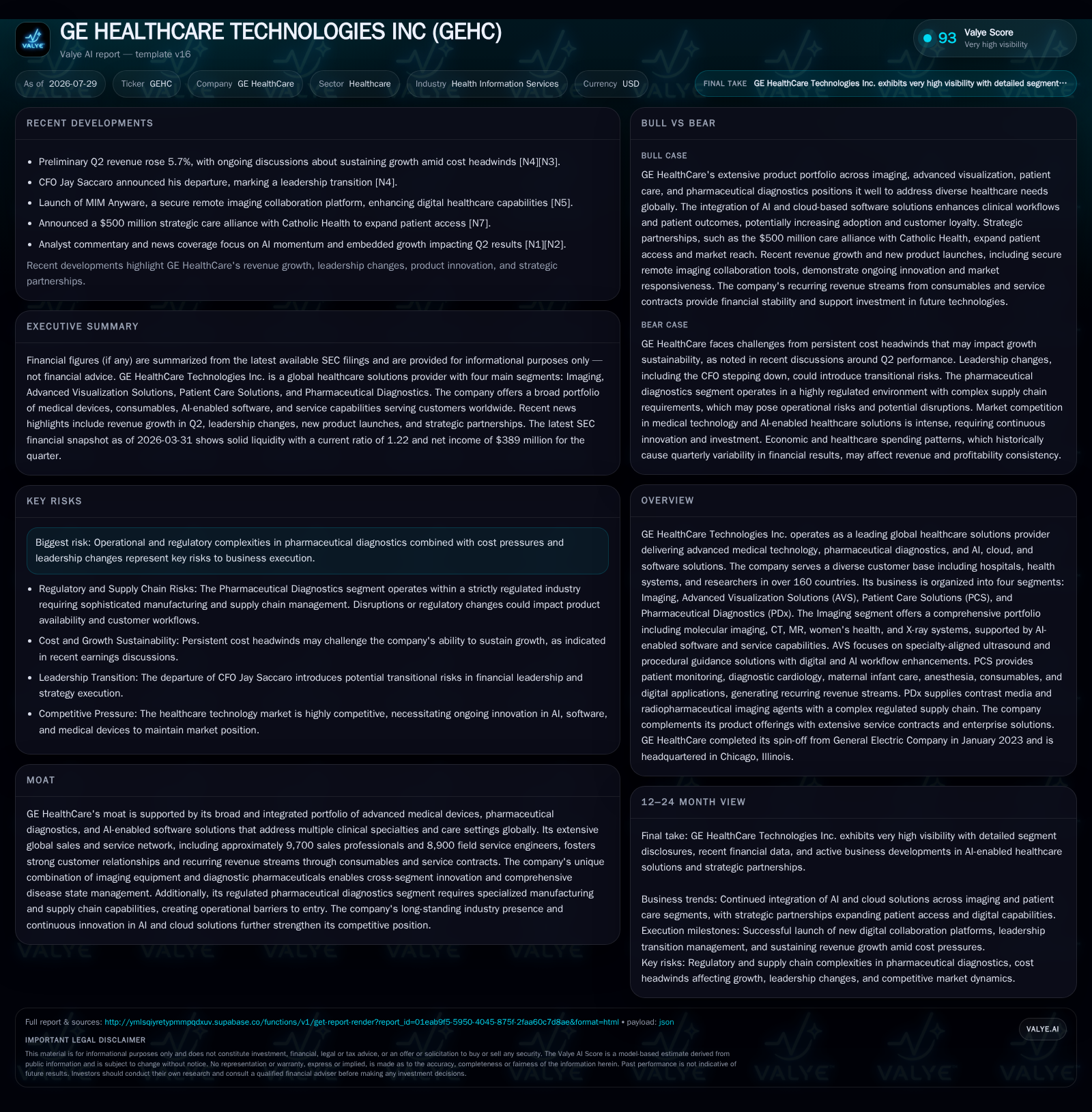
In Q2 2026, GE HealthCare Technologies Inc. reorganized its reporting segments by merging its Imaging and Advanced Visualization Solutions into a new Advanced Imaging Solutions (AIS) segment, aiming to streamline operations and accelerate innovation in diagnostic technologies [S2][S17]. The company reported 5.7% revenue growth driven by strength in imaging systems and AI-enabled software, reflecting ongoing demand from hospitals and health systems globally [N2][S12]. Despite positive top-line trends, cost headwinds and the CFO transition signal execution risks to watch [N8][S21]. The company’s integrated portfolio spanning medical devices, pharmaceutical diagnostics, and cloud-based AI platforms supports recurring service contracts and consumables streams that undergird financial stability [S1][S4]. Key risks include regulatory complexities in pharmaceutical diagnostics manufacturing and the need to maintain supply chain resilience amid global uncertainties [S24].
Recent Operating Update
GE HealthCare Technologies Inc. unveiled a major organizational change in the second quarter of 2026 by consolidating its previously separate Imaging and Advanced Visualization Solutions segments into a single Advanced Imaging Solutions (AIS) segment. This restructuring reflects an intent to unify related product lines—such as radiology, specialized ultrasound, and procedural guidance technologies—under one executive leadership to improve execution speed, innovation capacity, and operational efficiency [S17]. This realignment coincides with ongoing growth momentum highlighted by a reported preliminary Q2 revenue increase of approximately 5.7%, driven primarily by imaging systems sales buoyed by embedded AI software solutions [N2][S12].
The AIS segment spans a broad clinical spectrum including oncology, cardiology, neurology, orthopedics, women’s health, pediatrics, and surgery. Combining these formerly siloed sub-segments enables more integrated development of advanced imaging technologies such as molecular imaging (PET/SPECT), computed tomography (CT), MRI systems alongside AI-powered digital platforms that enhance workflow efficiency and diagnostic accuracy [S14][S17]. The company has emphasized leveraging AI-enabled cloud solutions increasingly for subscription-based digital health services alongside capital equipment sales.
Business Model Specifics
GE HealthCare operates as an end-to-end provider of medical technology solutions encompassing hardware (diagnostic imaging equipment), consumable pharmaceuticals (contrast agents and radiopharmaceuticals), patient monitoring devices, and increasingly software-based tools delivered through cloud platforms. Customers are predominantly hospitals, health systems, academic institutions, government agencies, and research organizations across more than 160 countries. Its commercial model employs roughly 9,700 sales representatives supported by around 8,900 field service engineers—underscoring a broad global footprint essential for sales penetration, installation support, maintenance contracts, upgrade programs, consumable replenishment, and digital subscription upselling [S4][S5]
Revenue is generated via several monetization streams: upfront capital equipment sales; recurring service contracts offering preventative maintenance to full-service biomedical engineering support; consumables linked to diagnostic equipment usage; and increasingly AI-enabled software-as-a-service (SaaS) subscriptions that provide workflow automation, image analysis tools, and interoperability features compatible with third-party systems. This combination creates multiple stickiness vectors ensuring high customer retention rates while smoothing revenue volatility intrinsic to capital device sales cycles. Consumables contribute steady margins given their necessity during diagnostic procedures.
The Pharmaceutical Diagnostics (PDx) unit supplies contrast media used in CT or MRI scans alongside sophisticated radiopharmaceuticals required for nuclear medicine imaging techniques. Management highlights PDx’s complex supply chain rigor demanding specialized manufacturing capabilities compliant with strict regulatory standards globally—a barrier that reduces entrant threat yet heightens operational risk exposure should unforeseen manufacturing disruptions or regulatory shifts occur [S4][S22][S24].
Industry Structure and Competitive Position
The healthcare technology industry servicing imaging diagnostics is intensely competitive with several large-scale diversified peers such as Siemens Healthineers, Philips Healthcare, Canon Medical Systems as well as specialized pharmaceutical diagnostic firms like Bayer. GE HealthCare distinguishes itself through an integrated portfolio spanning both medical hardware systems and complementary diagnostic pharmaceuticals—enabling synergistic innovation around disease management workflows. Further differentiation arises from investments in embedded AI capabilities enhancing clinical decision-making and expanding digital health footprints.
Other competitive moats emerge from the extensive global installed base supported by direct field service networks combined with indirect channel partnerships exceeding 5,000 third-party distributors that extend reach into emerging markets while reinforcing customer loyalty through responsive aftersales care [S5][S6]. Additionally, intellectual property protection sustained through patents on novel imaging techniques bolsters product exclusivity albeit no single patent dominates the portfolio’s value proposition.
A notable structural feature is the increasing amalgamation of software cloud solutions with traditional device offerings—a trend reshaping buying criteria toward integrated ecosystems capable of improving throughput efficiency at healthcare facilities. This transition challenges legacy sale models centered on one-time device purchases by emphasizing recurring revenue from software licenses alongside consumables and maintenance services.
Growth Drivers
Key growth stimuli for GE HealthCare include demographic shifts such as aging populations globally that escalate demand for both diagnostic imaging procedures and chronic disease monitoring using patient care devices. Concurrently, rising chronic disease prevalence fuels continuous need for nuanced diagnostics supported by more precise pharmaceutical agents.
Technological advancement in AI algorithms paired with cloud computing infrastructure fuels clinical workflow enhancements—from image acquisition through automated interpretation—attractive in resource-constrained settings where clinician availability limits throughput. Emerging markets expanding healthcare infrastructure present meaningful opportunities given lower historical penetration coupled with growing awareness around preventive care facilitating adoption of sophisticated diagnostics.
Outpatient care expansion also favors portable ultrasound systems within PCS targeting maternal-infant care or point-of-care diagnostics broadening total addressable market size beyond hospital confines. Strategic collaborations with providers like Mayo Clinic underscore validation efforts advancing cancer theranostics illustrating emphasis on precision medicine paradigms aligned with personalized treatment protocols [N13][S22].
Risks and Watchpoints
Despite growth headwinds stemming from currency fluctuations or macroeconomic instabilities appearing transient so far [N8], persistent cost inflation pressures challenge margin expansion efforts especially given substantial R&D investment commitments focused on AI/cloud platform development—a necessary but currently unprofitable endeavor risking delayed payoffs if adoption lags expectations [S24]. Leadership changes such as CFO Jay Saccaro’s departure mid-2026 introduce near-term execution uncertainty during transition periods until permanent appointments solidify financial stewardship [N2][S21].
Pharmaceutical Diagnostics presents unique operational risks given exposure to stringent regulatory scrutiny worldwide—with potential fallout from manufacturing interruptions impacting diagnostic agent availability causing workflow disruptions at customer sites—a material risk factor flagged repeatedly by management [S24]. Cybersecurity vulnerabilities inherent in connected medical devices add another layer of complexity requiring continuous investment.
Supply chain fragility remains notable amid global geopolitical tensions affecting components sourcing; the company leverages a global manufacturing footprint spanning over 44 sites in 17 countries attempting to mitigate but cannot fully immunize against disruptions affecting timely delivery or cost structure stability [S5][S24].
What to Watch Next
Investors tracking GE HealthCare should observe upcoming quarterly updates for indicators including service contract renewal rates reflecting installed base satisfaction; consumables revenue trends signaling procedure volume health; software subscription growth evidencing successful migration toward SaaS models; regulatory approval cycle times especially within PDx influencing product launch cadence; plus any announcements elucidating outcomes from ongoing leadership searches impacting financial strategy continuity.
Monitoring supply chain lead times through inventory disclosures may offer early warnings on potential cost surges or fulfillment delays. Progress in strategic alliances such as the $500 million Catholic Health Care Alliance may showcase tangible benefits beyond headline revenue figures if disclosed in future filings or press releases [N5][N11]. Furthermore, execution on integrating AIS segment operations will bear watching—as synergies realized could unlock margin improvement prospects.
Finally, developments regarding sustainability initiatives aligned with Environmental Health & Safety protocols will reflect responsiveness to long-term stakeholder expectations potentially influencing operational risk profiles over time [S4].
Financial Profile Discussion
Although detailed current quarter profitability metrics were not explicitly disclosed in the latest filings reviewed here beyond preliminary revenue increases for Q2 2026 (approximate +5.7%), balance-sheet data as of March 31, 2026 reveal $2.26 billion in cash & equivalents against total debt approximating $10.17 billion resulting in net debt near $7.91 billion—indicative of leverage levels consistent with capital-intensive industry peers reliant on continued cash flow generation to service liabilities efficiently [F1]. The information presented herein aims solely to contextualize GE Healthcare Technologies Inc.’s current operating posture within broader industry trends emphasizing operational dynamics shaping commercial performance.
Financial position in context
As of 2026-03-31, companyfacts shows $2.3bn in cash and equivalents and $10.2bn of total debt [F1]. The same snapshot implies net debt of roughly $7.9bn, keeping balance-sheet context relevant but secondary to the operating story [F1]. Current assets of $10.4bn and current liabilities of $8.5bn imply a current ratio near 1.22x for 2026-03-31 [F1].
Disclaimer: This is research-only, informational analysis and not investment advice. It may include AI-generated interpretation and general industry context. Always verify important details using primary sources.

Comments