
HDFC Bank’s Expanded Platform Drives Cross-Selling and Margin Resilience in Q2 2026
HDFC Bank leverages its 2024 merger to accelerate market penetration through diversified financial services and digital innovation, maintaining robust margins despite competitive pressures.
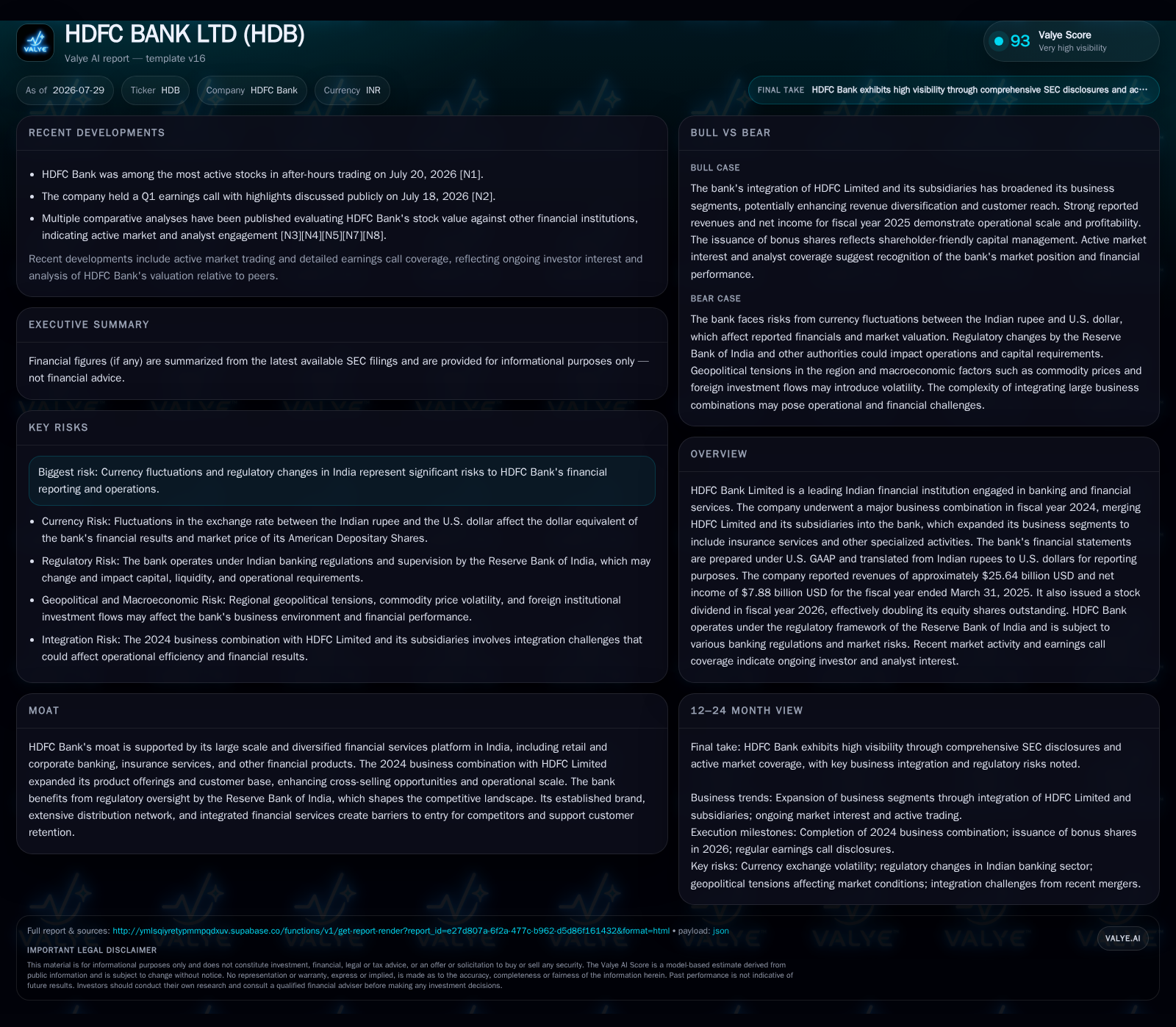
In Q2 2026, HDFC Bank showcased operational progress following its transformative 2024 merger with HDFC Limited. The combined entity benefits from a wider product suite spanning retail banking, corporate lending, insurance, and wealth management, fueling cross-selling revenue growth and reinforcing net interest margin resilience. Regulatory oversight by the Reserve Bank of India continues to shape capital adequacy and credit risk frameworks, underpinning stable asset quality. Growth catalysts include enhanced digital banking adoption and expanding customer reach into underserved rural areas. Key watchpoints involve managing non-performing assets amid macroeconomic fluctuations and adapting to evolving regulatory requirements.
Q2 2026 Operating Highlights Reflect Accelerated Post-Merger Integration
HDFC Bank’s Q2 2026 filings ([S2], [S3]) demonstrate significant operational progress following its transformative 2024 merger with HDFC Limited. This strategic combination broadened the bank’s franchise from core retail and corporate banking into insurance distribution and wealth management, creating a comprehensive financial services platform. The filings reveal enhanced cross-selling synergies as the bank leverages its expanded product suite to deepen customer engagement and diversify revenue streams.
The integration is evident in segment disclosures showing a rising contribution from fee income generated by insurance premiums and wealth management services alongside traditional net interest income. The enlarged physical branch network, combining both legacy entities’ footprints, is complemented by accelerated investments in digital banking infrastructure. This dual-channel approach supports customer acquisition and retention across India’s heterogeneous urban and rural markets, enhancing competitive scale and operational efficiency.
These developments occur amid intensifying competition in India’s financial sector, where large private banks and fintech firms vie for market share. Successfully managing the complexity of multiple business lines while maintaining service quality and operational discipline will be critical to sustaining growth momentum. Early quarterly data indicates improving unit economics, with fee income growth outpacing net interest income expansion, signaling effective execution of cross-segment integration strategies.
Revenue Diversification: Balancing Net Interest Margin and Fee Income Growth
HDFC Bank’s revenue model remains anchored in net interest margin (NIM), supported by a diversified loan book spanning retail segments—including home loans, personal loans, and credit cards—and corporate lending focused on infrastructure and commercial enterprises ([S1], [F1]). Post-merger, the bank has expanded fee-based income through insurance product distribution and wealth management services, which now constitute a growing share of total revenues. This diversification mitigates earnings volatility typically associated with interest rate fluctuations and deposit growth cycles.
The filings highlight NIM resilience driven by prudent loan pricing and disciplined credit risk management, balancing competitive pressures with asset quality preservation. Concurrently, fee income growth benefits from integrated customer data platforms enabling targeted cross-selling, which enhances wallet share and customer lifetime value. Maintaining a favorable cost-to-income ratio amid scaling operations further supports margin stability.
Key operating metrics to monitor include loan growth rates segmented by retail and corporate portfolios, fee income as a percentage of total income, and NIM trends relative to prevailing interest rate environments. These indicators will clarify the sustainability of revenue diversification and margin resilience in the evolving competitive landscape.
Competitive Positioning Underpinned by Scale, Regulatory Compliance, and Brand Equity
Operating within the Reserve Bank of India’s (RBI) regulatory framework, HDFC Bank maintains robust capital adequacy ratios (CAR) and liquidity coverage ratios (LCR), enabling measured loan growth while preserving capital buffers ([S1]). The bank’s extensive deposit base, nurtured through a broad physical branch network and growing digital channels, creates significant barriers to entry for regional banks and fintech competitors.
Efficient management of risk-weighted assets (RWA) supports aggressive yet prudent lending strategies without compromising regulatory capital requirements. The bank’s brand strength, built over decades, combined with a wide ATM and branch network, fosters customer loyalty, particularly in retail banking where trust and service quality are decisive.
While the bank’s diversified product offering and regulatory compliance enhance its competitive moat relative to other large private sector banks in India, ongoing regulatory risks require vigilance. Potential RBI policy changes affecting capital thresholds, provisioning norms, or lending caps could impact growth trajectories and capital allocation decisions.
Growth Drivers: Digital Banking Expansion and Cross-Selling Synergies
HDFC Bank’s growth strategy emphasizes digital banking innovation targeting India’s expanding mass market, including tier-2 and tier-3 cities, aligned with government financial inclusion initiatives ([S1], [N1]). Mobile and internet banking platforms integrated with backend systems improve customer acquisition efficiency and enable service delivery to previously underserved rural populations.
Cross-selling of insurance and wealth management products, integrated post-merger, leverages the bank’s existing customer relationships and distribution channels. This approach enhances fee income generation and deepens customer engagement beyond traditional deposit and lending products.
Operational KPIs such as digital transaction volumes, active digital user growth, fee income contribution from ancillary products, and customer retention rates will be critical to assessing the pace and effectiveness of digital adoption and cross-selling initiatives.
Risk Factors and Monitoring Points: Credit Quality, Regulatory Changes, and Macroeconomic Sensitivities
Credit risk remains a key focus area, with the bank’s non-performing asset (NPA) ratio closely monitored amid India’s cyclical economic environment ([S1], [F1]). Conservative underwriting standards post-merger aim to mitigate deterioration in asset quality during periods of macroeconomic stress.
Currency volatility poses translation risks given the bank’s exposure to foreign exchange through loan portfolios and investment holdings. Regulatory developments under RBI supervision, including potential increases in capital buffer requirements or tighter lending norms, could constrain near-term loan growth and profitability.
Macroeconomic headwinds such as slower GDP growth, inflationary pressures, or rising interest rates may reduce credit demand and increase delinquency rates. Quarterly tracking of asset quality metrics, provision coverage ratios, and loan growth segmentation will provide early warning signals of emerging risks.
Forward-Looking Execution Milestones
Key upcoming milestones include the phased rollout of enhanced digital banking services tailored for financial inclusion in smaller cities and rural areas ([S1], [N1]). The bank plans to continue launching bundled insurance products linked to retail deposits and credit cards to amplify cross-selling benefits.
Deposit growth aligned with retail savings mobilization remains a priority to support loan book expansion within regulatory lending limits. Additionally, regulatory approvals for new product lines or potential inorganic growth opportunities could further diversify revenue streams, contingent on maintaining operational risk discipline.
Monitoring deposit growth rates, loan-to-deposit ratios, digital platform adoption metrics, and regulatory developments will be essential to evaluating the bank’s execution progress and market share gains.
Financial Overview: Capital Strength, Profitability, and Asset Quality
The non-performing asset ratio remains within manageable levels, supported by conservative provisioning and credit risk management practices ([F1]). The bank’s cost-to-income ratio compares favorably to peer private banks, evidencing disciplined expense control that supports strong return on equity (ROE) metrics.
These financial metrics align with the bank’s strategic focus on diversified revenue streams, regulatory compliance, and operational efficiency, underpinning balance-sheet resilience post-merger.
This analysis is based exclusively on HDFC Bank’s latest SEC filings dated July 29, 2026 ([S1], [S2], [S3]) and recent earnings call insights ([N1]). It provides an evidence-based overview of the bank’s strategic positioning, operational progress, and financial profile without investment research views or speculative forecasts.
Disclaimer: This is a research-only informational analysis and does not constitute investment advice. Readers should verify details from primary sources.
Disclaimer: This is research-only, informational analysis and not investment advice. It may include AI-generated interpretation and general industry context. Always verify important details using primary sources.

Comments