
S&P Global’s Earnings Beat and Strategic Focus Post-Mobility Separation
Q2 2026 results highlight strong subscription growth and operational repositioning following the Mobility segment spin-off, reinforcing S&P Global’s durable competitive advantages amidst evolving technological and market dynamics.
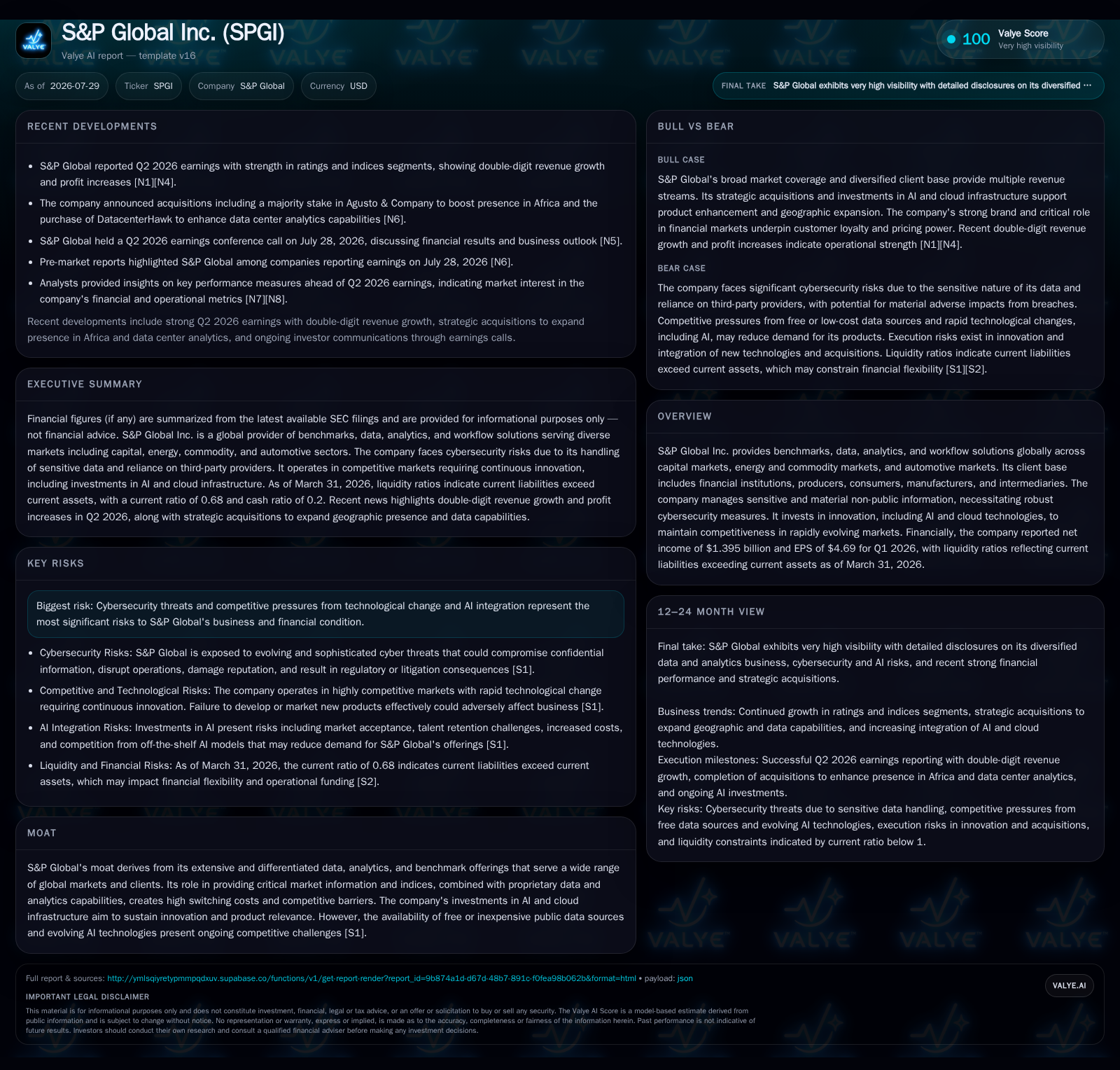
S&P Global reported solid Q2 2026 financial results marked by a net income of $1.395 billion in Q1 and significant operational shifts due to the July 1 separation of its Mobility Global unit [S2][N1]. The company’s core subscription revenue streams, underpinned by proprietary benchmarks, indices, and analytics platforms, continue to deliver durable, high-margin recurring revenue with strong client retention [S1][S2]. Strategic investments in AI and cloud infrastructure are enhancing product innovation and competitive positioning, while robust cybersecurity measures remain critical given the sensitive nature of data handled [S1]. However, risks from evolving cyber threats and competition from free or low-cost public data sources require ongoing vigilance. Near-term growth visibility benefits from industry diversification across capital markets, energy, and automotive sectors despite increased operational complexity post-separation.
Q2 Operating Performance and Mobility Separation Impact Drive Near-Term Outlook Shift
In Q2 2026, S&P Global reported net income figures reflecting sustained profitability with $1.395 billion achieved in Q1 as an anchor point for recent performance [S2]. These results notably incorporate the structural impact of the July 1 separation of Mobility Global Inc., which simplifies S&P’s operating footprint to focus on core benchmarks, credit ratings, data feeds, and analytics platforms serving global capital markets as well as energy/commodity and automotive sectors [S2][S3]. The divestiture recalibrates segment reporting and governance but sharpens strategic clarity around recurring revenue streams anchored in proprietary data assets. Importantly, quarterly earnings comfortably beat consensus estimates driven primarily by strength in ratings and indices businesses—highlighting resilient demand for high-quality market intelligence amid fluctuating macro environments [N1]. Cash flow also improved with operational efficiencies becoming more visible post-separation.
Subscription Revenue Dynamics Reveal Strength in Client Retention and Pricing Power
Leveraging Proprietary Benchmarks and Analytics Platforms to Sustain High Switching Costs
The company operates near the upstream end of the financial information value chain: aggregating raw transactional market data globally then applying proprietary analytics methodologies to produce differentiated benchmarks (indices), credit ratings assessments, risk analytics models, and workflow solutions that feed into clients’ investment strategies or operational risk frameworks [S1]. This portfolio is not easily replicable because it requires scale to capture comprehensive market intelligence combined with deep analytical expertise maintained through continuous innovation. Consequently, customers incur high costs if they replace these offerings with competing products that lack the same accuracy or regulatory recognition. As noted in guidance commentary this quarter, these features reinforce customer stickiness despite cyclical pressures across some end markets.
Strategic Integration of AI and Cloud Infrastructure Bolsters Product Innovation Pipeline
Reflecting broader industry trends among financial data providers like MSCI incorporating AI-driven analytics features into index construction or risk evaluation tools, S&P has prioritized investment in artificial intelligence technologies paired with cloud infrastructure upgrades [S1]. These enable automated real-time analysis at scale improving responsiveness to market moves while expanding product relevance beyond traditional static reports toward actionable insights embedded in client workflows. The company acknowledges exposure to increasingly sophisticated cyber threats ranging from ransomware campaigns to nation-state actors attempting unauthorized access. Ongoing investment focuses on robust network defenses across distributed third-party vendor ecosystems plus enhanced detection mechanisms minimizing incident impact. Maintaining longstanding client trust is essential as breaches could irreparably damage credibility leading customers to redirect spend elsewhere—a risk underscored repeatedly in recent filings.
Cross-Industry Diversification: Capital Markets, Energy, and Automotive Segment Analysis
Post-Mobility spin-off, S&P is sharpened around servicing three major verticals: capital markets (asset managers through ratings agencies), energy & commodity markets (producers/traders leveraging energy price forecasts including AI-powered short-term power price analytics purchased via acquisition), plus automotive markets (manufacturers/suppliers utilizing specialized market intelligence) [S1][S2]. This diversified vertical exposure smooths revenue cyclicality inherent within individual sectors yet increases operational complexity requiring tailored solutions for different client profiles. The divestiture of certain software portfolios within energy—such as geoscience applications intended for sale next year—is expected not to materially impair consolidated earnings but refocus this segment towards analytics-driven decision support rather than legacy software sales [S25].
Headwinds and Watchpoints: Competitive Pressures from Public Data & Technological Change
While the moat derives principally from exclusive data sets licensed under contract alongside sophisticated workflow integrations generating high switching costs, competitive pressures persist notably from abundant free or low-cost public financial datasets increasingly enriched by AI-enhanced analytic tools accessible broadly online [S1]. This external availability could erode parts of SPGI’s addressable market especially lower-tier customers seeking commoditized inputs supplanting pricier subscriptions. Additionally accelerating technological disruption through AI adoption threatens traditional human-intensive rating methodologies necessitating continual adaptation to preserve relevance. Regulatory frameworks governing index licensing rights may also tighten impacting licensing revenues if transparency or standardization increases external scrutiny.
What to Watch Next: Renewal Rates, AI Deployment Milestones, Regulatory Developments
Over upcoming quarters monitoring subscription renewal rates will offer crucial confirmation regarding underlying stickiness assumptions—particularly under conditions altered by technological advances post-Mobility separation [N1][S2]. Corporate disclosures tracking incremental adoption metrics related to AI-augmented analytic products or cloud migration footprints will provide insight into innovation pacing versus peers. Regulatory developments influencing permissible data usage or benchmark transparency standards represent another critical dimension potentially reshaping market dynamics across segments.
Financial Profile Discussion: Liquidity, Debt, Earnings Context Supporting Strategy
As of March 31, 2026, balance-sheet snapshots indicate current assets totaling approximately $6.32 billion against current liabilities near $9.34 billion producing a current ratio below 1 at 0.68—a liquidity position consistent with prior periods reflecting working capital management within a large-scale enterprise context [F1][S2]. Total debt stood near $13.32 billion partially offset by cash reserves approximating $1.81 billion yielding net debt around $11.5 billion; leverage ratios remain moderate facilitating ongoing investments in technology while supporting dividend payments ($0.97/share declared Q2) alongside share repurchase activities totaling over $500 million during Q2 alone indicating confidence in capital allocation flexibility [S2]. Operating income margins remain robust consistent with historical trends reflecting scalable cost structures typical for subscription-driven businesses concentrated on digital deliverables rather than capital-intensive assets.
This analysis synthesizes latest quarterly disclosures combined with strategic context framing inherent risks alongside emerging growth opportunities centered on innovation-led differentiation within financial data ecosystem. Continuing structural shifts including portfolio reshaping post-Mobility unit spin-off adapt the business model towards sharper focus on subscription revenue sustainability supplemented by targeted AI-cloud deployment designed to extend competitive moats over time.
This document is prepared solely for informational purposes based on available SEC filings and reputable news sources; it does not constitute investment advice.
Financial position in context
As of 2026-03-31, companyfacts shows $1.81 billion in cash and equivalents and $13.32 billion of total debt [F1]. The same snapshot implies net debt of roughly $11.5 billion, keeping balance-sheet context relevant but secondary to the operating story [F1]. Current assets of $6.32 billion and current liabilities of $9.34 billion imply a current ratio near 0.68x for 2026-03-31 [F1].
Disclaimer: This is research-only, informational analysis and not investment advice. It may include AI-generated interpretation and general industry context. Always verify important details using primary sources.

Comments