
Skyworks Solutions Strengthens Position with Q3 Revenue Beat Amid RF Semiconductor Industry Dynamics
Skyworks Solutions delivered better-than-expected Q3 2026 results, underscoring operational resilience in a complex RF semiconductor market amid its proposed merger with Qorvo.
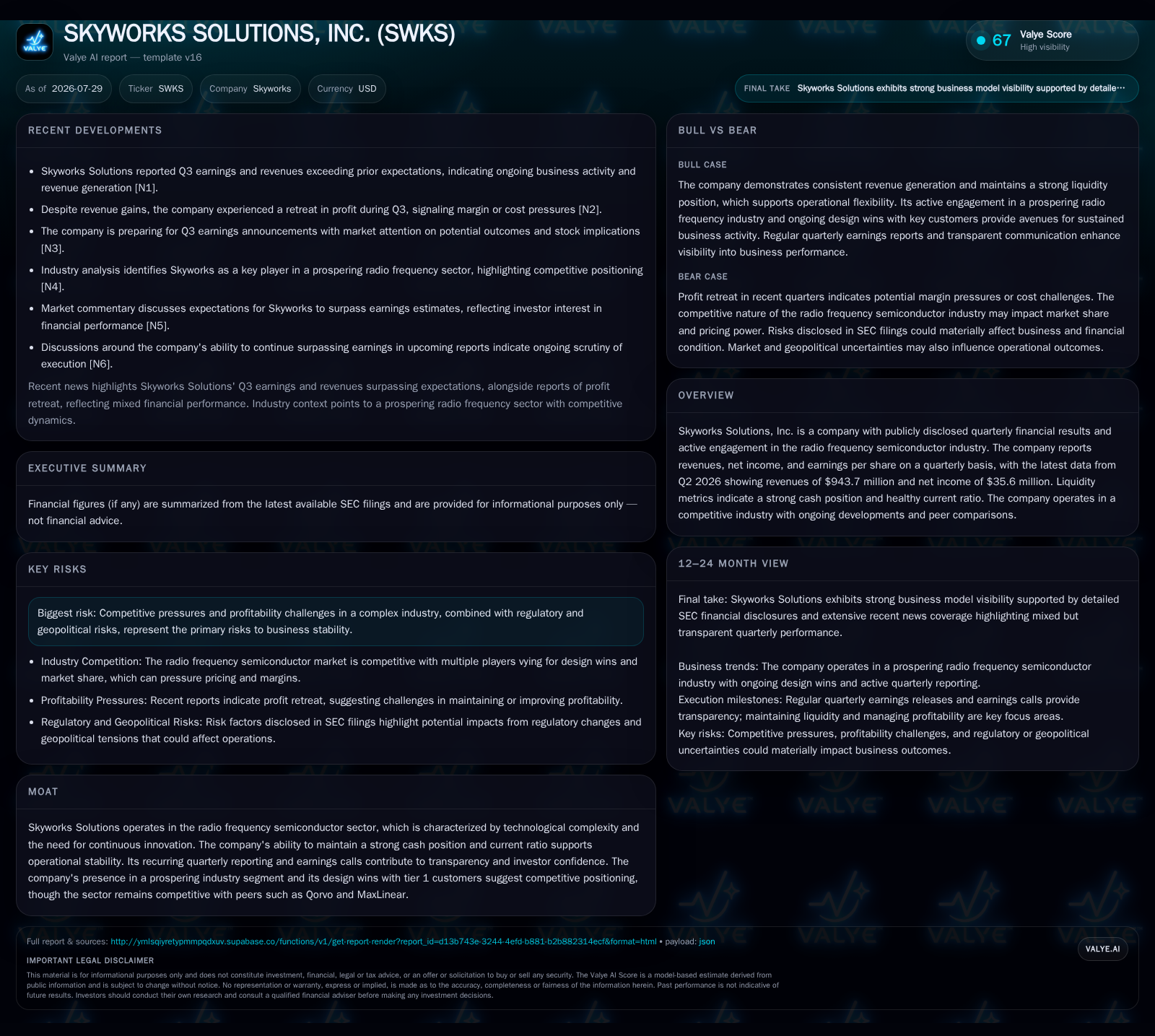
In its latest quarterly filing, Skyworks Solutions reported Q3 2026 revenues of $943.7 million, exceeding analyst estimates despite a net income decline to $35.6 million, signaling ongoing margin pressures. Operating within the specialized radio frequency semiconductor sector, Skyworks maintains a robust cash position and a strong current ratio of 2.38, supporting stability amid geopolitical risks and competitive pressures. The company’s business model centers on designing and manufacturing advanced RF front-end modules and integrated circuits primarily sold to tier 1 OEMs, with innovation-driven design wins continuing to shape growth prospects. Skyworks faces cyclical demand fluctuations and supply chain constraints common to the sector but benefits from ongoing 5G expansion and increasing IoT adoption. The pending merger with Qorvo represents a significant structural catalyst that could reshape competitive dynamics in this niche.
Recent Operating Update: Third Quarter Outperformance during Margin Challenges
Skyworks Solutions released its Q3 2026 results in late July showing revenues of approximately $943.7 million which beat consensus estimates reflecting solid product demand across its portfolio [S2], [N1]. However, net income declined to $35.6 million during the same period as increased input costs and pricing pressure compressed margins despite stable shipment volumes [S2]. This suggests that while end-market demand remains intact structurally driven by expanding wireless connectivity needs, macroeconomic factors keep profitability volatile.
This quarter's performance is especially relevant during Skyworks' public announcement of a pending merger with competitor Qorvo filed simultaneously in an SEC registration statement on July 28th [S3]. The merger aims to consolidate scale in the radio frequency (RF) semiconductor market segment catering predominantly to mobile device OEMs but introduces near-term integration uncertainty.
Business Model: Focused on Design-Win Driven RF Component Sales to Tier 1 OEMs
Skyworks operates distinctively as an integrated design and manufacturing supplier specializing in RF front-end modules—key building blocks enabling wireless communication in smartphones, infrastructure equipment, automotive systems, and IoT devices [S1]. Its revenue derives chiefly from selling these complex semiconductor components—including power amplifiers, low-noise amplifiers, switches, and filters—to original equipment manufacturers (OEMs) and original design manufacturers (ODMs).
The company’s monetization involves primarily product sales under multi-year supply agreements punctuated by periodic price negotiations linked to technology cycles. Design wins with leading tier 1 customers represent critical forward indicators because these contracts translate into high-volume shipments once products are qualified in end-devices. Skyworks invests heavily in research and development (R&D) to maintain cutting-edge technology leadership demanded by evolving wireless standards such as 5G and anticipated future protocols.
Given the industry's technological complexity and rapid innovation cycles requiring short time-to-market capabilities for new generation products, maintaining product relevance is equally driven by execution capabilities alongside design innovation.
Industry Structure and Competitive Positioning
The radio frequency semiconductor industry is highly specialized within the broader semiconductor market space characterized by analog/mixed-signal integrated circuits critical for enabling wireless data transmission. Skyworks competes alongside peer companies like Qorvo—its proposed merger partner—and MaxLinear which also serve mobile device OEMs but vary slightly by product focus breadth or geographic footprint.
Key competitive dynamics revolve around securing design wins with large OEM customers who dominate smartphone and infrastructure markets. Customers exhibit strong purchasing leverage given the concentrated nature of handset manufacturers.
Capital intensity is medium-high due to reliance on external foundries for wafer fabrication combined with proprietary design efforts internally; hence supply chain coordination is pivotal. Timing delays at foundries can adversely affect capacity utilization rates thus influencing cost structures. Broader industry exposure includes cyclical fluctuations tied to wireless device refresh cycles impacting volume demand.
Benchmarking R&D intensity reveals Skyworks commits significant expenditure relative to revenue—necessary to remain competitive—although detailed figures specific to the latest quarter are reserved for annual disclosures [S1]
Growth Drivers: Wireless Expansion Fuels Demand for Advanced RF Components
Structural growth foundations remain sound across multiple vectors: ongoing global deployment of 5G networks increases bandwidth requirements necessitating sophisticated RF front-end modules capable of handling higher frequencies effectively; simultaneous growth in IoT connected devices broadens addressable markets beyond smartphones into industrial applications; automotive electronics increasingly integrate advanced RF functions including radar sensing aligned with ADAS systems driving component demand.
Incremental product innovations focusing on lower power consumption without sacrificing performance align well with consumer device OEM priorities protecting battery life—an essential selling point mature vendors compete upon. Emerging markets also present thematic upside potential due to rising wireless infrastructure investment supporting device penetration growth.
From an operational KPI perspective vital metrics include maintenance or expansion of design win rates among top-tier customers as these correlate directly with future shipment volumes; average selling prices fluctuate based on contract terms but sustained pricing power supports margin leverage; measuring order backlog captures near-term visibility into shipment cadence.
Risks and Watchpoints: Margin Pressures Within Geopolitical Complexity
Skyworks faces pronounced risks typical of the RF semiconductor space but intensified by current global trade tensions impacting cross-border sales permitting regulatory export controls potentially restricting access to certain markets or technologies [S2]. Customer concentration poses vulnerability given dependency on few large OEM accounts where any volume shift or contract loss would materially impact revenues.
Competitive pressures contribute to pricing challenges limiting gross margin expansion despite operational cost efficiencies aimed through lean manufacturing practices. Supply chain disruptions or foundry capacity constraints due to elevated industry-wide demand fluctuations might curtail timely fulfillment of orders affecting client relations.
Intellectual property disputes present latent threats given high technology overlap among peers necessitating vigilance around patent portfolios.
Execution risks related to integrating the announced merger with Qorvo encompass technology platform harmonization costs alongside customer retention cohesion uncertainties.
What to Watch Next: Milestones Reflecting Integration Progress and Market Demand Evolution
Key upcoming milestones include monitoring quarterly earnings ahead of full fiscal year close for evidence of margin recovery or stabilization following recent contraction phases; evaluating developments regarding regulatory approvals or shareholder votes tied to the Qorvo deal will clarify strategic trajectory; tracking updates on major new product introductions or technology licensing agreements could strengthen competitive moats.
Operational indicators such as changes in R&D spend ratio vis-à-vis revenue can signal investment levels aimed at fostering innovation pipelines essential for sustaining long-term relevance within rapidly advancing wireless standards.
Order backlog evolution reported quarterly provides tangible insights into future volume trends supporting topline sustainability amidst broader economic cycles affecting device sell-through globally.
Financial Profile Discussion
Cash conversion efficiency links closely with receivables collection cycles synchronized against production shipments; prudent capital expenditures sustain capacity readiness especially considering foundry partners' lead times.
Skyworks’ capital structure thus supports its complex manufacturing supply chain demands combined with aggressive R&D investments necessary in this highly innovative sector.
Disclaimer: This analysis is based solely on publicly available information as of July 29, 2026, including SEC filings and credible news sources without any non-public insights or forward-looking projections. It does not constitute investment advice or research views.
Disclaimer: This is research-only, informational analysis and not investment advice. It may include AI-generated interpretation and general industry context. Always verify important details using primary sources.

Comments