
Kilroy Realty's Q2 2026 FFO Outperformance Highlights Growth and Capital Strategy Challenges
Kilroy Realty reported stronger-than-expected FFO in Q2 2026 despite profit pressures and evolving capital allocation dynamics.
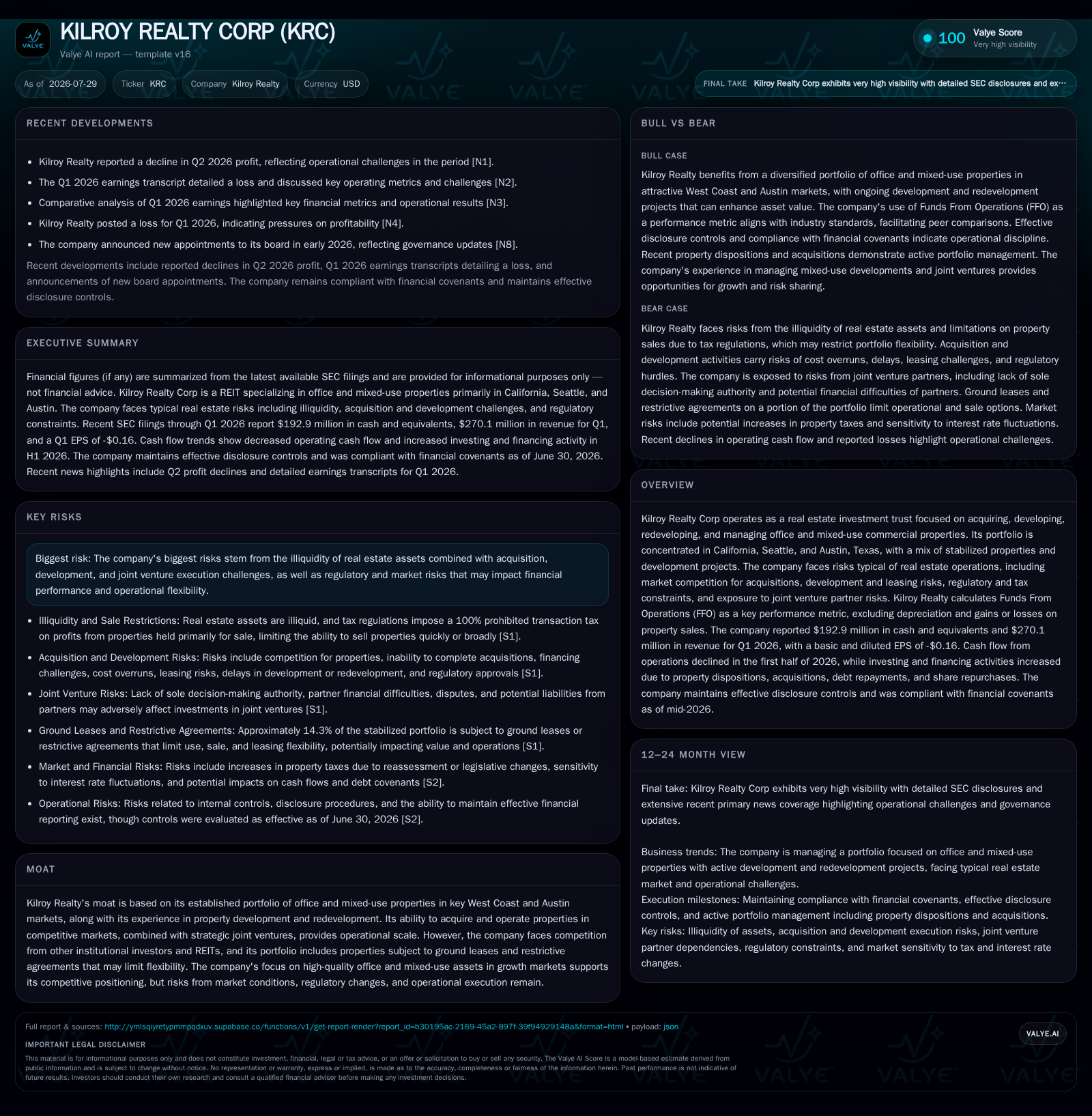
In the latest quarter, Kilroy Realty Corp delivered Funds From Operations (FFO) above market consensus, demonstrating resilience in its core office and mixed-use portfolio concentrated on the West Coast and Austin. Operating cash flow contracted due to portfolio churn and stabilized development projects, while investing activities reflected proceeds from property sales and a significant land acquisition for future development. The company maintains compliance with financial covenants but faces heightened exposure to interest rate sensitivity and geographic concentration risks. Ongoing redevelopment execution, leasing velocity in key markets, and disciplined capital structure management remain pivotal as Kilroy navigates competitive acquisition markets and broader macroeconomic fluctuations.
Recent Operating Update
Investing activities contrasted sharply with prior periods. Kilroy generated $134 million in net cash inflows versus a substantial $100.3 million outflow year-over-year primarily via net proceeds from the disposition of two operating properties and two residential assets, partially tempered by a $34.6 million payment tied to acquiring a 1.1-acre land parcel intended for future development [S24], [S26]. This shift underscores active capital recycling aimed at balancing portfolio optimization with pipeline expansion through acquisitions aligned with their strategic focus.
Financing activities evidenced increased cash deployment, expanding by 88.7% year-over-year to $288.4 million of net cash used driven largely by principal repayment on $50 million unsecured private placement senior notes alongside accelerated share repurchases under their 2024 Share Repurchase Program [S24], [S25]. This suggests an aggressive capital return stance while managing maturing debt obligations.
Business Model Analysis
Kilroy functions as a real estate investment trust specializing in acquiring, developing, redeveloping, and managing office plus mixed-use commercial real estate concentrated mainly in high-demand West Coast urban markets (Los Angeles, San Diego County, San Francisco Bay Area) along with Seattle and Austin metropolitan areas [S1]. Revenue generation hinges primarily on leasing activity—collecting rent payments from corporate tenants occupying office space or mixed-use developments featuring offices combined with retail or residential components.
Operating income derives from Net Operating Income (NOI), which reflects rental revenues less operating expenses including property management costs and maintenance. Funds From Operations (FFO) stand as the key profitability metric used internally and by investors; it excludes non-cash depreciation/amortization charges that distort GAAP earnings particularly in real estate assets.
Kilroy also pursues capital appreciation via development and redevelopment projects designed to reposition or modernize assets to command higher rents or attract premium tenants. These projects require upfront capital expenditures financed through a mix of equity contributions (including joint ventures) and debt financing secured against existing portfolio assets or through unsecured credit facilities.
The company's monocentric geographic focus heightens exposure to regional market cycles but allows depth of expertise managing diverse tenant requirements, zoning regulations, and local business climate nuances inherent to California’s complex regulatory environment as well as Seattle’s technology-driven economy and Austin’s rapid population growth [S1]. However, such concentration also heightens vulnerability to localized downturns or adverse regulatory changes.
Industry Structure and Competitive Position
Within the office/mixed-use REIT sector—which includes peers like Boston Properties focusing on office assets nationally or Alexandria Real Estate Equities emphasizing life sciences/office campus environments—Kilroy occupies a niche weighted heavily towards top-tier West Coast metros plus growth corridors such as Austin. Its competitive strength is predicated on established presence with scalable operations across these dense urban cores coupled with an active development pipeline adding long-term value beyond stabilized properties.
Competition arises chiefly from large institutional investors managing diversified portfolios across multiple regions including public REIT peers plus private equity real estate funds aggressively pursuing accretive acquisitions amid favorable economic growth trends in target markets. This competition inflates acquisition prices threatening yield compression particularly when bidding on premium assets or land suitable for new developments.
Joint ventures provide an important mechanism for sharing capital risk while leveraging external expertise but impose operational complexity requiring alignment among partners on project milestones, cost controls, leasing velocity targets, tenant retention efforts, and capital expenditure pacing.
Growth Drivers
Key engines for Kilroy’s future growth emanate from economic expansion in its current footprint which sustains demand for high-quality office space incorporating modern amenities that appeal to knowledge-sector tenants prioritizing location accessibility and environmental/sustainability credentials.
Development/redevelopment projects signify critical incremental sources of revenue uplift when successfully completed within budgeted timelines enabling rent escalations through repositioned product offerings demonstrating competitive differentiation [S1]
Strategic acquisitions remain vital as Kilroy selectively expands its footprint into high-growth submarkets demonstrating strong absorption rates fostering occupancy gains at stabilized holdings.
Leasing velocity improvements—reflected in higher occupancy rates or improved average rental rates per square foot—directly bolster recurring NOI streams contributing positively to FFO growth metrics.
Ongoing capital recycling via divestitures funds these reinvestment initiatives enhancing portfolio composition aimed at generating superior risk-adjusted returns relative to stagnant holdings.
Risks and Watchpoints
Several persistent risks bear watching closely:
- Interest rate fluctuations pose material threats given Kilroy’s exposure to variable-rate unsecured revolving credit facilities and looming maturities requiring refinancing under potentially elevated costs impacting profitability and liquidity flexibility [S1], [S27].
- Geographic concentration risk increases susceptibility to region-specific economic downturns or heightened regulatory/tax burdens prevalent especially in California’s litigious environment which may depress office space demand [S1].
- Development/redevelopment execution risks including construction cost inflation driven by labor/material shortages may impair projected yields or delay rental commencement affecting near-term cash flow outlooks [S1].
- Tenant credit risk compounded by lease renewal uncertainty could exert pressure on occupancy rates undermining stable cash flow generation essential to meeting fixed financial obligations.
- Illiquidity of real estate assets limits ability to divest swiftly should market dynamics necessitate portfolio adjustments reducing financial maneuverability during volatile periods.
- Dependence on joint venture partners introduces additional coordination complexity wherein differing strategic priorities might impair timely project delivery or optimal asset management outcomes.
What to Watch Next
Upcoming milestones include monitoring completion status of ongoing development projects where timely delivery will validate investment thesis underpinning incremental NOI contribution [S2].
Tracking leasing metrics such as occupancy rates at newly stabilized buildings along with renewal pricing benchmarks provides insight into underlying demand strength amidst evolving workplace preferences post-pandemic.
Refinancing activity related to maturing term loans especially given impending October 2026 maturity date circa $200 million term loan facility requires attention regarding achievable terms reflecting prevailing interest rate environment [S5], [S11], [S12].
Capital allocation decisions around continued share repurchases relative to dividend sustainability highlight management’s assessment of valuation opportunities balanced against liquidity preservation needs [S25]
Compliance status with financial covenants amid fluctuating cash flows due to market cycles remains critical gauge impacting access to credit lines supporting ongoing acquisition/development strategies [S27]
Financial Profile Discussion
The company maintains an unsecured revolving credit facility with significant borrowing capacity, providing flexible funding access for general corporate purposes including development spending or potential acquisitions without immediate liquidity strain observed in Q2 results documents [S7], [S22].
Cash flow patterns reflect operational pressures combined with strategic investing/divesting cycle typical among office-focused REITs actively managing their asset base for cyclical best value returns [S24]
Overall, Kilroy's financial profile balances growth ambitions via development alongside disciplined capital management albeit masked by short-term volatility linked mainly to portfolio turnover effects rather than systemic operational deterioration.
This analysis synthesizes filed quarterly data augmented by recent event disclosures offering insight into Kilroy Realty's evolving business dynamics within an increasingly complex commercial real estate landscape focused on office/mixed-use sectors in key U.S. markets. All figures cited are traceable directly to SEC filings unless otherwise noted from public market news coverage.
Disclaimer: This is research-only, informational analysis and not investment advice. It may include AI-generated interpretation and general industry context. Always verify important details using primary sources.

Comments