
Rogers Corporation’s Q2 Setback Highlights Innovation and Cost Pressure Risks
A notable Q2 earnings miss underscores Rogers Corp's margin vulnerabilities amid pricing pressures, while innovation and leadership changes shape its competitive outlook.
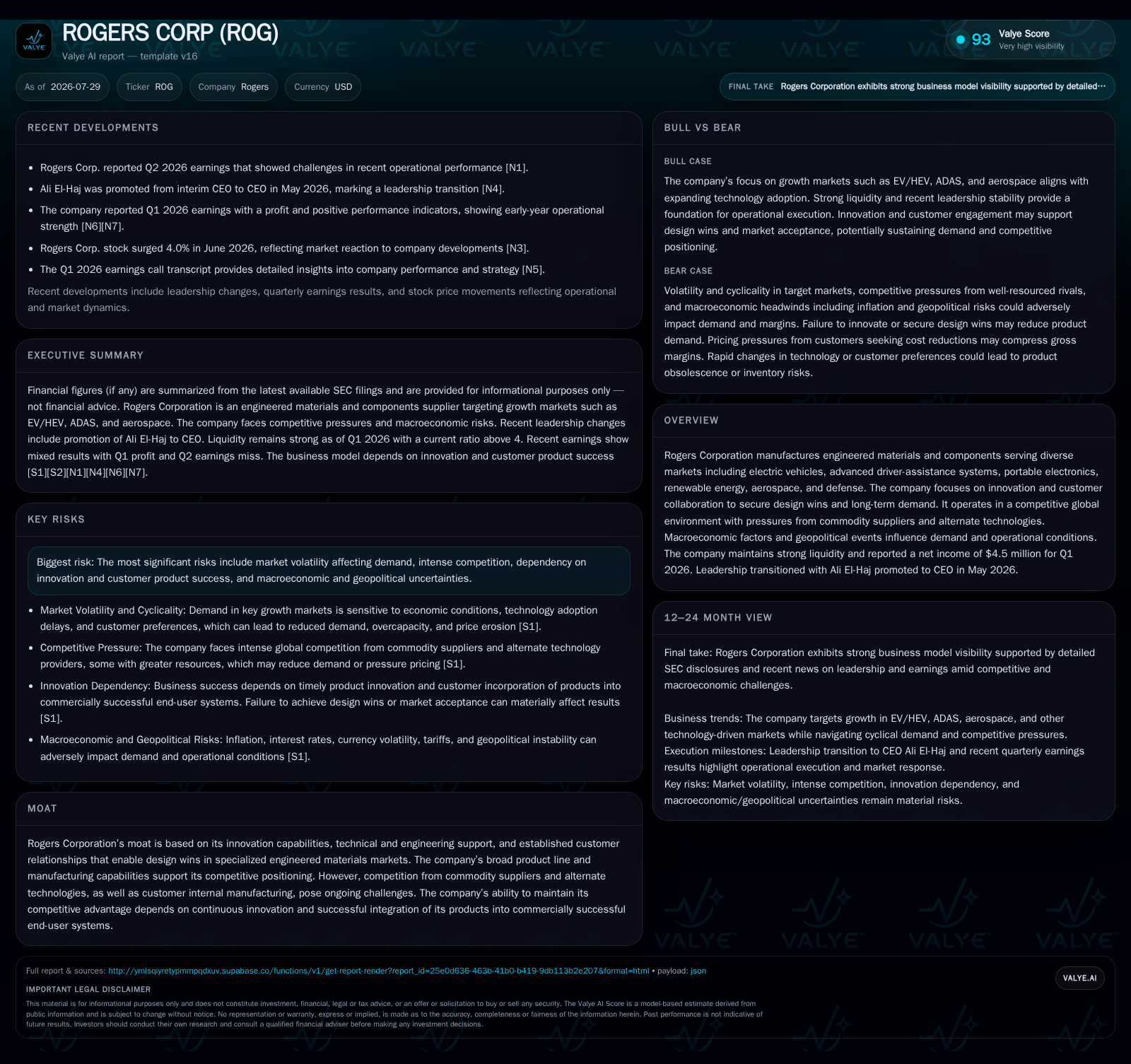
Rogers Corporation reported a disappointing second quarter in 2026 marked by net income erosion and margin pressure from competitive pricing dynamics and cost inflation [S2][N1]. The company’s core business relies on securing design wins through innovative engineered materials tailored for OEMs and Tier 1 suppliers, but recent results reflect intensifying competition from commodity substitutes and alternate technologies [S1]. Leadership turnover with CEO Ali El-Haj's recent promotion frames a strategic inflection point amid persistent macroeconomic and supply chain challenges. Long-term growth prospects hinge on the successful deployment of new product innovations aligned with expanding markets such as EVs, renewable energy, and advanced electronics.
Q2 Earnings Miss Reveals Margin Pressure Vulnerabilities
Rogers Corporation’s second quarter of 2026 presented a clear setback, revealing acute pressures on profitability. The company reported a modest net income of $4.5 million for the quarter—a disappointment relative to expectations—highlighting stretched margins due primarily to adverse pricing dynamics amidst intense competition and cost inflation challenges [S2][N1]. This outcome aligns with prior disclosures cautioning about customer demands for price concessions as OEMs push cost reductions down their supply chains, particularly in electronics and automotive sectors where Rogers is heavily exposed [S1]. These margin pressures signpost immediate risks in sustaining operating leverage given the sensitivity of Rogers’ business model to ASP erosion, heightened competition from both commodity material suppliers and alternative technology providers, as well as ongoing inflationary input costs.
While volume trends were not explicitly detailed in public filings, the firm’s ability to maintain production capacity utilization amid fluctuating demand volumes will be a critical operational bellwether. Order backlog—or lack thereof—serves as another forward-looking indicator for revenue stability but was not recently emphasized by management. Taken together, this Q2 performance flags potential short-term operating risk amplifying already elevated market uncertainty.
Innovation and Collaboration: Cornerstones of the Rogers Business Model
Rogers operates in a midstream position within the engineered materials value chain, focusing predominantly on producing differentiated materials customized to exacting specifications demanded by OEMs and Tier 1 suppliers across numerous end markets including electric vehicles, advanced driver-assistance systems (ADAS), renewable energy infrastructure, aerospace, defense, and portable electronics [S1]. The company's revenue generation largely hinges on securing design wins through deep technical collaboration—applying engineering services alongside product innovation to embed their materials into customers' final assemblies. Such design wins are often hard-won over lengthy development cycles but confer recurring revenue streams when end products achieve commercial success.
This model necessitates sustained investments in R&D to keep cycle times competitive for new product introductions while maintaining high product reliability and technical support quality—factors critical in defending against substitutes or encroachment by competitors who either compete on price or disruptive technologies [S1]. Rogers’ broad manufacturing capabilities further underpin its strategic strength by enabling flexible scale-up once design wins convert into volume production. However, these capabilities also imply capital intensity where misalignment with demand ramp-ups can pressure margins.
Competitive Dynamics Tighten on Pricing and Product Differentiation Fronts
The competitive landscape Rogers faces is multifaceted. On one side are commodity materials suppliers offering cost-driven substitutions that exacerbate ASP erosion risk. On the other side lie providers of alternate technologies that threaten disintermediation by rendering incumbent solutions obsolete or redundant via technological leaps [S1]. Further complicating this is the trend toward customer internal manufacturing which can shrink external supplier TAM.
Additionally, macroeconomic factors such as rising input costs compounded by global supply chain disruptions feed into increased cost structures often difficult to pass fully onto demanding customers seeking price concessions [S1][S18]. Geographic exposure also matters; approximately 41% of sales emanate from Asia (notably China), a marketplace impacted by escalating trade conflicts that could constrain future growth or create logistical bottlenecks [S15]. Rogers must therefore continue differentiating through innovation while managing pricing tactically amid these fragmented pressures.
Growth Catalysts: EV Adoption, Renewable Energy, and OEM Outsourcing Demand
Despite cyclical headwinds, structural growth drivers underpin medium- to long-term demand expansion for Rogers’ specialized materials. The accelerating adoption of electric vehicles (EV) and associated advanced driver-assistance systems (ADAS) necessitates materials capable of meeting stringent electrical performance, thermal management, weight reduction, and durability criteria. Similarly, the expansion of renewable energy installations—such as solar panels and energy storage—requires sophisticated engineered substrates integral to efficiency gains [S1].
Further tailwinds arise from portable electronics proliferation spurring demand for miniaturized high-performance components that rely on precisely engineered material inputs. Additionally, aerospace & defense spending revivals depending on geopolitical conditions provide incremental market opportunities.
OEMs outsourcing engineered material components rather than vertically integrating manufacture further broadens addressable market potential if Rogers can maintain its design win momentum. This interlinks intimately with their order backlog health—a KPI signaling near-term revenue visibility—and product introduction cycle times affecting ability to capture evolving requirements rapidly.
Risks in Technology Shifts, Internal Manufacturing Trends, and Supply Chains
The core risks shaping Rogers’ near-term outlook are industry endemic yet pronounced in this cycle. Technology shifts pose obsolescence threats; rapid product lifecycle evolution can render inventory obsolete quickly if new materials supplant existing offerings [S1][S4]. Customer internal manufacturing incorporates an additional layer of demand uncertainty as OEMs potentially reduce third-party spend.
Supply chain risk remains prevalent due to sole or limited source raw material dependencies combined with lean inventory strategies raising vulnerability to disruptions causing delayed deliveries or cost inflation that cannot be passed on fully [S18]. Macroeconomic volatility linked to inflationary pressures, interest rate fluctuations, trade wars (notably U.S.-China tensions), currency swings, and logistic hurdles all compound execution risks.
On regulatory fronts, evolving environmental compliance such as EU carbon reduction mandates may impose increased operating costs or capital expenditure burdens impacting profitability curves over time [S9][S11]. Meanwhile legacy litigation risks related to historic asbestos claims persist but have not materially escalated recently.
"What Comes Next" — Key Indicators for Market and Operational Rebound
Looking ahead, execution validation rests on several critical KPIs consistent with sector operating norms: improvement in design win rates indicating sustained pipeline strength; firming or growth in order backlogs providing revenue visibility; stabilization or expansion of average selling prices reflecting better pricing power; along with ramped production capacity utilization signaling efficient scaling without margin dilution.
The recent CEO succession with Ali El-Haj’s appointment introduces a strategic inflection point possibly emphasizing operational efficiency enhancements or innovation pipeline acceleration [S3]. Monitoring early moves under his leadership regarding capital allocation toward R&D versus capacity expansions will inform expectations around sustaining competitive moats despite cost headwinds.
Quarterly updates will also elucidate management’s ability to navigate pricing pressures tactically while safeguarding gross margins through product mix improvements or procurement optimizations.
Financial Profile Discussion — Liquidity Cushion Amid Profitability Challenges
On the financial front, Rogers maintains a robust liquidity position evidenced by $195.8 million in cash & equivalents recorded at quarter-end March 2026 combined with a strong current ratio of approximately 4.0—signaling ample short-term working capital coverage conducive for funding operational needs and strategic initiatives without immediate refinancing concerns [F1][S2]
However, while liquidity provides flexibility buffers, the pressure on profitability reflected in declining net income accentuates importance of margin restoration going forward. Capital expenditures linked to capacity scaling or compliance investments must be judiciously managed given uncertain cadence of demand recovery amid macro volatility.
Disclaimer: This analysis is intended solely for informational purposes based on publicly available data as of July 29, 2026. It does not constitute investment advice or research views regarding securities issued by Rogers Corporation.
Financial position in context
As of 2026-03-31, companyfacts shows $196mm in cash and equivalents [F1]. Current assets of $511mm and current liabilities of $127mm imply a current ratio near 4.02x for 2026-03-31 [F1].
Disclaimer: This is research-only, informational analysis and not investment advice. It may include AI-generated interpretation and general industry context. Always verify important details using primary sources.

Comments