
Garmin’s Integration and Subscription Push Bolster Resilience Across Diverse Markets
Garmin's Q2 2026 results underscore how its vertically integrated GPS device portfolio and growing subscription services sustain diversified growth despite ongoing supply chain uncertainties.
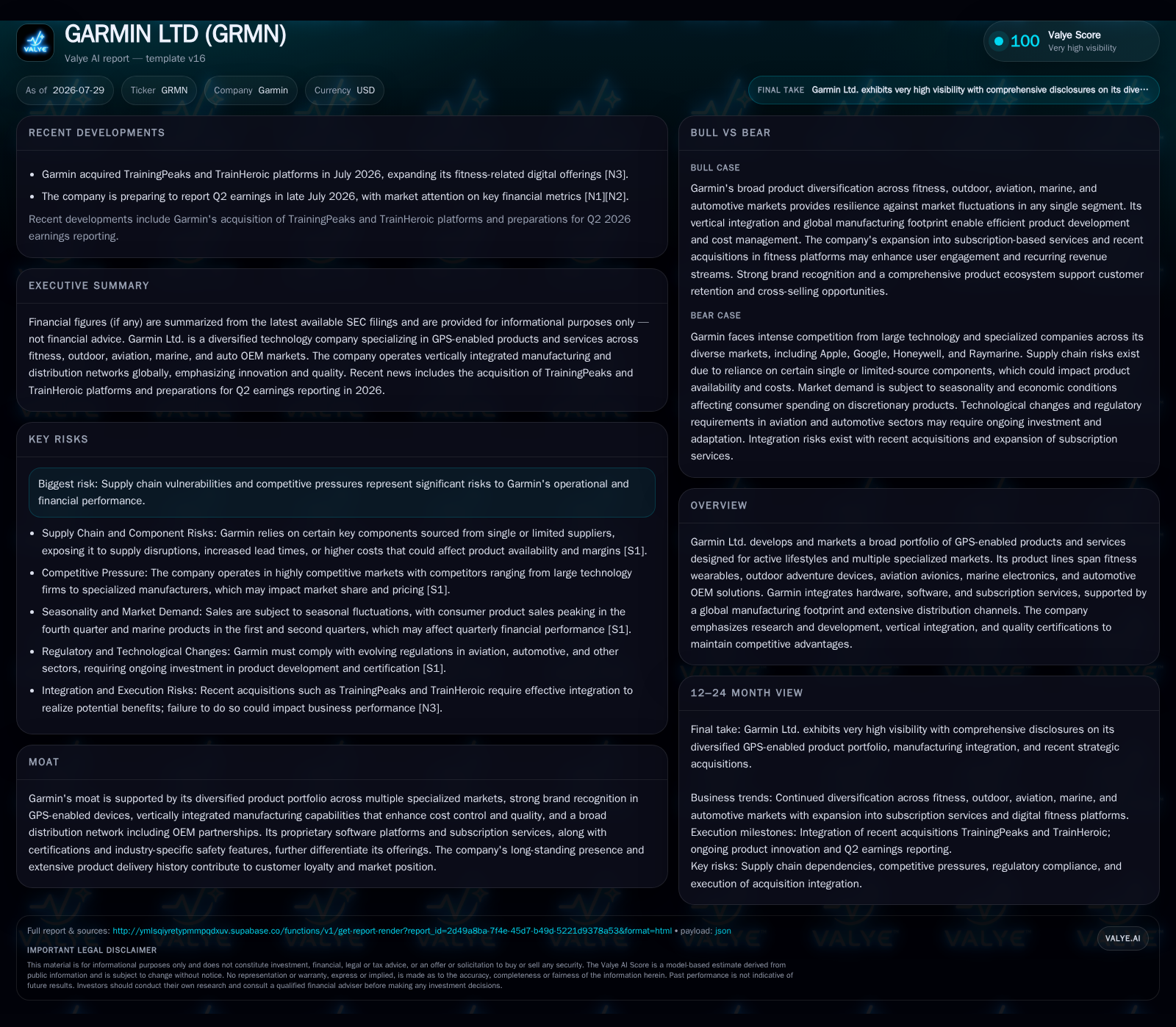
In Q2 2026, Garmin demonstrated operational resilience with increased profitability amid persistent component sourcing challenges. The company's broad GPS-enabled product mix spanning fitness, outdoor, aviation, marine, and automotive segments underpins steady revenue streams. Notably, the expansion of subscription services through recent acquisitions supports recurring revenue growth and deeper customer engagement. Vertical integration in manufacturing continues to provide Garmin with cost and quality advantages relative to peers navigating similar supply constraints.
Q2 2026 Results Confirm Subscription Growth Amid Supply Constraints
Garmin’s second-quarter report issued July 29, 2026, indicates an uptick in operating income compared to previous quarters despite ongoing global component shortages constraining unit availability [S2][S3][N3]. This improvement signals effective execution within the company’s vertically integrated manufacturing model, which partly mitigates the risks from single-source key components currently challenging the industry. Alongside hardware sales resilience, Garmin highlights accelerating momentum in its subscription service attachment rates — a critical metric that reflects growing recurring revenue streams from digital offerings linked to its GPS-enabled devices [S2].
Multi-Segment Hardware Portfolio Drives Diversified Revenue Streams
Garmin’s product architecture spans five primary market segments: fitness wearables; outdoor recreation devices; aviation avionics; marine electronics; and auto original equipment manufacturer (OEM) platforms [S1]. This breadth delivers strategic insulation against cyclical pressures or seasonal dips particular to any one segment—fitness wearables face consumer fashion trends and holiday seasonality, while marine electronics align with boating seasons. Aviation and automotive OEM products exhibit less seasonality but depend on certification timings and vehicle production schedules [S7]. Utilizing multiple global navigation satellite systems (GNSS), including GPS, GLONASS, Galileo, BeiDou, and regional augmentations, Garmin embeds high-precision geolocation capabilities into differentiated products targeting specialized user needs. The company’s ability to manage average selling prices (ASPs) via product mixing is key to sustaining margins amid fluctuating component costs.
Vertical Integration Enhances Manufacturing Flexibility and Cost Control
Central to Garmin's competitive model is its vertical integration across manufacturing facilities distributed in Taiwan, the U.S., China, Europe (Netherlands, Poland), and the U.K. This ownership enables close coordination between design engineers and manufacturing process engineers to optimize cost structures while maintaining strict quality certifications such as ISO 9001, IATF 16949 for automotive suppliers, and AS9100 for aviation [S6][S25]. Such integration provides flexibility to rapidly prototype new designs or adjust production volumes in response to volatile supply conditions—advantages not easily replicable by competitors reliant on extensive outsourcing. Additionally, streamlined communication between development and operations teams facilitates compressed product development cycle times that enhance time-to-market metrics critical in the fast-evolving consumer electronics sector.
Subscription Services Expand Recurring Revenue Base and Customer Engagement
A notable strategic initiative highlighted this quarter is Garmin's acquisition of digital training platforms TrainingPeaks and TrainHeroic [N4], expanding its footprint into software-based fitness coaching. This complements its existing subscription offerings that deliver value-added mapping content, weather data feeds through satellite networks, safety communication features, and enhanced application ecosystems surrounding hardware products [S1][S3]. Subscription attachment rate—a KPI tracking the percentage of hardware users subscribed to ongoing services—is rising, signaling improved customer retention potential alongside more stable margin profiles from recurring software revenue versus discrete device sales. This hybrid business model reduces dependency on hardware cycles while fostering brand loyalty through software ecosystem lock-in.
Competitive Positioning Supported by OEM Partnerships Across Specialties
Garmin competes within distinct competitive landscapes aligned with each segment: Apple dominates consumer fitness wearables emphasizing platform ecosystems; Honeywell Aerospace and Collins Aerospace lead advanced avionics solutions; marine electronics contend with Furuno and Raymarine; automotive OEM collaborations rival suppliers like Bosch or Harman [S6]. Garmin’s embedded technology reach benefits from established OEM relationships providing tier-one supplier status for domain controllers and infotainment units in global auto manufacturing [S22]. These partnerships extend distribution breadth beyond direct retail or online channels enabling scale economies and embedding Garmin platforms within vehicle infotainment architectures—an increasingly important vector as connected car adoption rises.
Growth Drivers: Fitness Demand, Sporting Expansion, Automotive Infotainment, Avionics Safety Features
Industry tailwinds support Garmin’s growth trajectory across multiple fronts. Rising health consciousness drives continuous adoption of wearable fitness and health monitoring devices worldwide. Outdoor adventure activities continue growing in popularity fueling demand for rugged GPS units with advanced mapping features. In automotive markets, increasing integration of advanced driver assistance systems (ADAS) and infotainment connectivity expands Garmin's opportunities as an embedded systems supplier. Aviation markets seek enhanced safety-critical avionics conforming to stringent global regulations—a space where Garmin leverages certified designs [S1]. Technological innovations including multi-GNSS chipsets integration improve positional accuracy fostering richer user experiences that underpin deeper ecosystem engagement.
Risks Centered on Component Sourcing Constraints and Market Competition Pressures
Despite diversification advantages, Garmin faces ongoing supply chain vulnerabilities primarily from key components sourced from single or limited suppliers without immediate alternatives [S1][S16]. This exposes the company to potential disruptions or escalating costs during periods of semiconductor shortages impacting inventory turnover rates. Intense competition exerts pricing pressure especially in consumer-facing segments where well-financed players continuously update product portfolios [S6]. Legal risk also remains — patent litigations typical within tech industries could arise although management currently expects no material adverse impact [S4]. Finally, seasonality effects challenge working capital management requiring careful inventory planning aligned with peak sales periods.
What to Watch: Deployment of New Product Cycles, Subscription Penetration Metrics, Supply Chain Pulse
Future catalysts include timing and reception of new product introductions across all major segments extending hardware innovation pipelines—critical given the importance of continual feature refreshes impacting ASPs [N1][S2]. Monitoring updates on subscription service attachment rates will provide insight into sustainability of recurring income streams supporting improved lifetime customer value. Lastly, metrics reflecting supply chain normalization such as component lead times or inventory levels will offer clues on operability improvements post-current global shortages [S3]. Investor focus should also track announcements relating to further strategic acquisitions enhancing digital platform offerings or deepening OEM integrations.
Financial Profile Discussion
Garmin maintains a robust liquidity position adequate to navigate supply uncertainties while funding R&D initiatives central to technology leadership. As of March 28, 2026 quarter-end, cash and equivalents stood at approximately $2.29 billion with current assets totaling nearly $6 billion against current liabilities around $1.38 billion — yielding a strong current ratio above 4x indicative of ample short-term financial flexibility [F1]. The balance sheet strength supports continued capital investment in vertical manufacturing capabilities alongside funded acquisitions enabling subscription service expansion. Operating cash flow trends remain a critical monitor for ongoing reinvestment capacity during periods of external turbulence.
This analysis synthesizes public disclosures without offering investment advice or price targets. It aims solely to elucidate Garmin Ltd.’s recent results within its industry context for informed internal discussion based on cited SEC filings [S1–S29], news sources [N1–N4], and financial snapshots [F1].
Financial position in context
As of 2026-03-28, companyfacts shows $2.3bn in cash and equivalents [F1]. Current assets of $6.0bn and current liabilities of $1375mm imply a current ratio near 4.36x for 2026-03-28 [F1].
Disclaimer: This is research-only, informational analysis and not investment advice. It may include AI-generated interpretation and general industry context. Always verify important details using primary sources.

Comments