
Meridian Holdings Analyzes Tri-Regional Gaming Operations Amid Platform Risks
Latest quarterly report uncovers Meridian Holdings’ operational scale and technology dependencies while spotlighting liquidity and regulatory challenges.
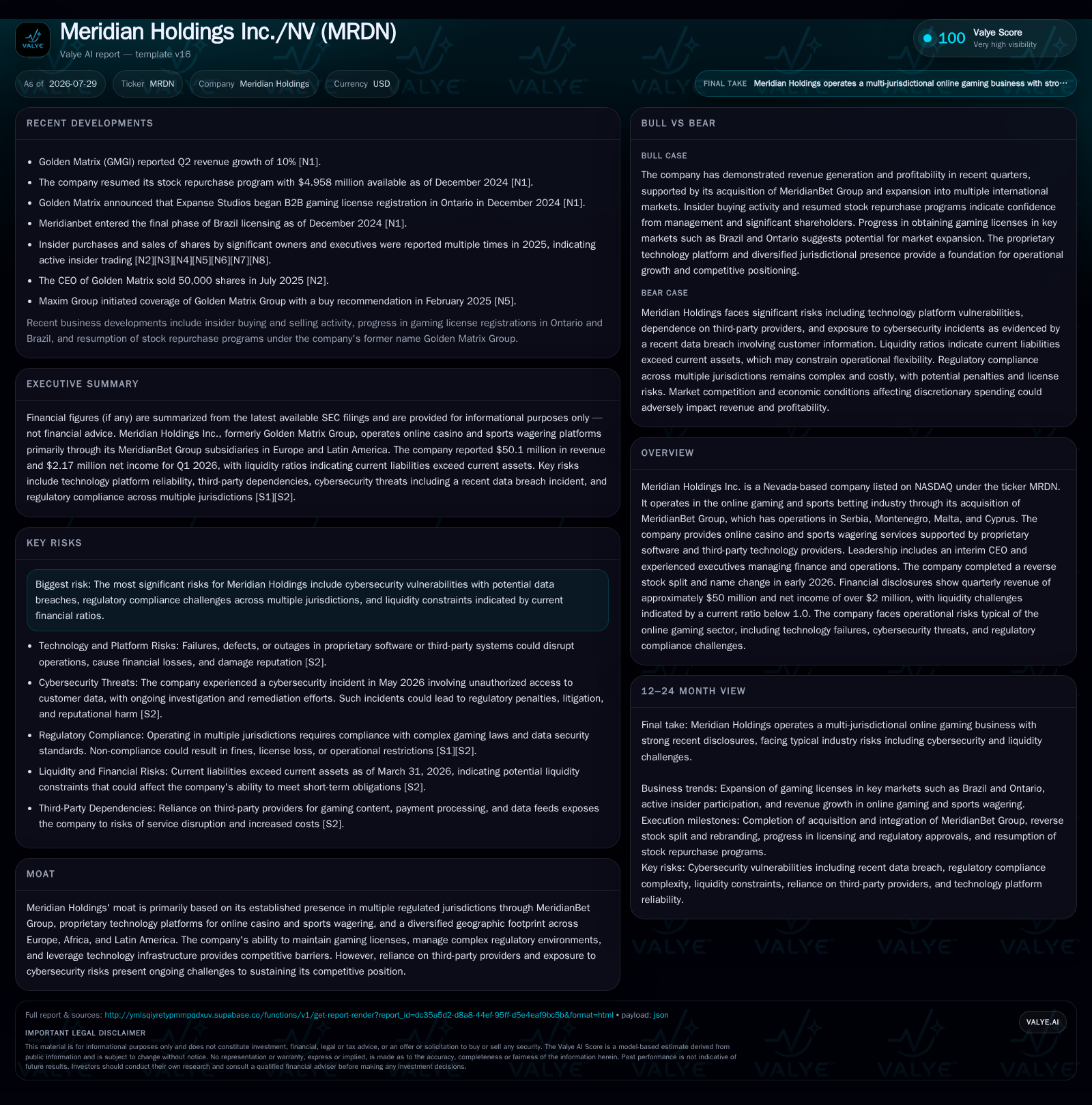
Meridian Holdings Inc. continues to operate its online casino and sports wagering services across Europe, Africa, and Latin America, leveraging its MeridianBet Group acquisition. The Q2 2026 filing reveals roughly $50 million in quarterly revenue and net income modestly above $2 million, though liquidity remains constrained with a current ratio below 1.0, signaling financial tightness. The company’s business model depends heavily on maintaining multi-jurisdictional gaming licenses and proprietary software augmented by third-party content and payment infrastructure, exposing it to platform risks and regulatory complexity that could influence growth prospects. Near-term success hinges on managing technology platform stability, renewing licenses, enhancing payment processing efficacy, and addressing cybersecurity threats.
Q2 Operational Metrics Highlight Combined Platform Challenges and Market Reach
Geographically, Meridian’s footprint spans Serbia, Montenegro, Malta, and Cyprus through MeridianBet subsidiaries established by early 2024 acquisitions that added regulated-market licenses essential for legal online gaming offerings in these jurisdictions [S1],. This tri-regional presence supports diversified revenue streams but inherently requires rigorous compliance with varying local regulatory frameworks.
Managing Complex Licensing Across Tri-Regional Markets: A Strategic Moat Under Pressure
A core competitive moat for Meridian derives from its multi-jurisdictional gaming license portfolio facilitating legitimate market access across Europe alongside African and Latin American expansions within MeridianBet Group’s operations. Such licensing acts as a significant entry barrier against less-compliant operators while enabling tailored product offerings adapted to region-specific regulations including geolocation verification mandates and responsible gaming requirements [S1]. However, the regulatory burden introduces recurring costs related to compliance monitoring, license renewals, governmental fees, reporting obligations, and occasional enforcement risks detailed in risk disclosures.
Maintaining this mosaic of licenses entails navigating both stable mature European markets like Malta—a recognized online gambling hub—and emerging regions where political or economic volatility may prompt sudden changes in regulation or enforcement intensity. The dual-edge nature of this licensing regime thus simultaneously underpins geographic diversification benefits but constrains scaling speed due to high administrative overheads and potential non-renewal consequences.
Technology Infrastructure Exposure: Proprietary Software Dependence Meets Third-Party Risk
Meridian’s core product delivery relies on internally developed proprietary platforms enabling real-time sports wagering and digital casino gameplay supported by backend infrastructure involving cloud hosting environments, databases, payment processors, identity-verification vendors, and content suppliers [S2]. Integration with third-party content providers enhances player experience breadth but introduces dependencies that can affect platform uptime and betting accuracy.
Operational risk manifests notably when software bugs or outages occur during peak betting windows such as major sporting events: errors in bet settlement or payout calculations can trigger customer dissatisfaction or regulatory scrutiny with direct negative impact on key KPIs like churn rate and ARPU (average revenue per user) [S2],. Furthermore, recent cybersecurity incidents evidencing unauthorized access through ex-employee credentials have exposed vulnerabilities requiring ongoing investigations alongside bolstered security measures—highlighting direct reputational risk tied to data privacy breaches [S13], [S16]. Persistent fragility in cybersecurity posture represents a critical watchpoint given increasing sophistication of attacks targeting sensitive player information.
Competition and Peer Benchmarking: Where Meridian Holds Up and Falls Short
Compared against leading multi-brand operators such as Flutter Entertainment plc or Bet365 Group Ltd., Meridian’s scale remains more modest both in financial resources and global market penetration. While these peers benefit from extensive capital bases enabling aggressive marketing spend balanced by optimized CAC (customer acquisition cost) metrics and diverse product ecosystems including sportsbook partnerships with major leagues—they also face similar regulatory complexities.
Technology providers like Everi Holdings Inc., specializing in gaming hardware and software solutions for casino operators globally, demonstrate stronger technological robustness though serving different value chain roles than Meridian’s platform-centric operation. Meridian’s hybrid reliance on proprietary development mixed with third-party integrations places it at higher operational continuity risk relative to vertically integrated peers.
The comparative smaller scale may limit bargaining power with third-party content vendors influencing cost structures; similarly capital constraints might slow investment cycles needed for continuous platform upgrades—factors critical for user retention amid industry churn rates.
Key Growth Levers: Jurisdictional Expansion, Content Innovation, and Payment Optimization
Meridian targets growth primarily through selective expansion into newly regulated markets within Africa and Latin America beyond existing European strongholds leveraging acquired license rights secured via MeridianBet Group acquisition completed in early 2024 [S1]. Regulatory liberalization trends globally remain a structural tailwind allowing entry opportunities subject to licensing approval processes.
Content innovation also features prominently as cross-selling casino games alongside sports wagers diversifies user engagement points enhancing overall handle (total amount wagered) which translates proportionally into net gaming revenue (NGR) post payouts. Improvements in interactive features like real-time betting interfaces integrated with geolocation verification systems improve player conversion rates thereby positively influencing ARPU.
Another growth vector lies in refining payment processing success rates via partnerships with advanced banking providers ensuring smoother deposits/withdrawals which historically reduce drop-off at transaction stages—directly supporting retention curves which are critical given elevated marketing expense ratios relative to revenues noted historically by the company [S1],.
Risk Factors Intensified: Cybersecurity Threats and Regulatory Fragility
Recent filings reiterate heightened cybersecurity threats as central within operational risk profiles; specifically the May 26th 2026 incident involving alleged unauthorized access emphasizes ongoing susceptibility despite remedial controls introduced post-event [S16], [S27]. Consequences of realized breaches extend beyond immediate remediation costs—they potentially inflict sustained reputational damage yielding lower active user counts coupled with regulatory fines or enforced operational curtailments adversely affecting margin sustainability.
Regulatory risks maintain prominence given the multi-jurisdictional operating model; license revocations or restrictions not only precipitate direct revenue interruptions but also increase compliance expenditures constraining free cash flow. Adverse rulings or policy shifts within core markets could amplify capital allocation conflicts between growth initiatives versus defensive legal/regulatory responses.
Moreover, systemic risks related to software failures impacting bet settlement integrity or payment delays risk breaching service-level agreements undermining consumer trust critical for repeat patronage amid fierce competition.
Investor Watchpoints: Upcoming Regulatory Milestones and Platform Stability Indicators
Investors should closely monitor several near-term execution markers pertinent to Meridian’s outlook. Foremost among these are scheduled renewals of key gaming licenses within Serbia, Montenegro, Malta, and Cyprus where delays or unfavorable terms could materially impair operating continuity coupled with unforeseen costs impacting profitability metrics revealed each quarter [S3].
Platform uptime performance during marquee sporting seasons should be tracked since persistent outages negatively impact handle volumes directly measurable through periodic reports—coupled with metrics around payment processing success rates which influence transactional throughput efficiency vital for revenue consistency.
Marketing spend vis-à-vis CAC trends relative to ARPU shifts provide insight into the company’s ability to sustainably grow its player base without eroding margin profiles. Early signs of elevated churn rate or increasing subsidy-driven promotions indicate competitive stress points warranting strategic recalibrations.
Broadly speaking any updates regarding cybersecurity threat remediation progress or emergent incidents remain key to assessing hidden liabilities or potential escalations leading to litigation or regulatory sanctions.
Financial Profile Discussion: Liquidity Constraints Amid Revenue Growth
This financial milieu necessitates strategic emphasis on preserving cash flows possibly limiting discretionary spending including capex on platform enhancements or marketing budgets crucial for growth execution. The capacity to secure additional external funding at reasonable terms remains a critical variable shaping operational resilience amid ongoing competitive pressure.
In sum, Meridian Holdings demonstrates active commercial momentum leveraging its multi-regional online gaming licenses combined with proprietary technology platforms buttressed by a complex network of third-party partners. Nonetheless liquidity constraints alongside tech-driven operational risks such as cybersecurity exposures impose material execution challenges amid a dynamic regulatory environment necessitating vigilant oversight by management going forward.
Disclaimer: This is research-only, informational analysis and not investment advice. It may include AI-generated interpretation and general industry context. Always verify important details using primary sources.

Comments