
Curbline Properties Advances Rent Resets and Acquisition Strategy to Sustain Growth
In Q2 2026, Curbline Properties reinforced its strategy of leveraging short-term leases and targeted acquisitions to drive growth in the retail convenience center sector amid inflationary and competitive pressures.
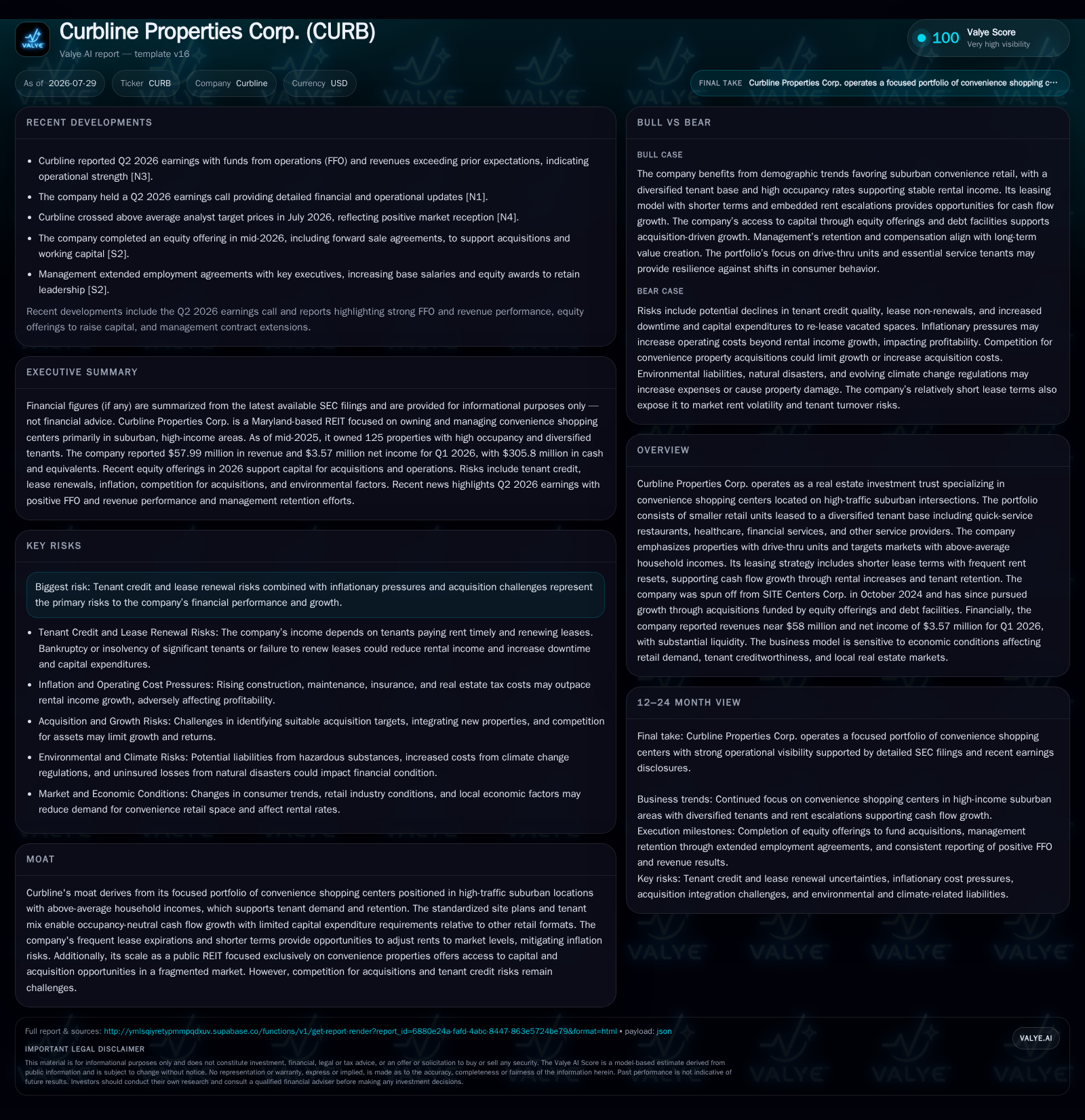
Curbline Properties’ latest quarterly filing highlights the effectiveness of its leasing model centered on shorter average lease terms, facilitating more frequent rent resets that help sustain net operating income growth despite inflation-driven cost pressures. The company’s diversified tenant mix, including a significant portion of properties with drive-thru units, supports strong occupancy and rental rate escalations. Recent equity offerings and credit facilities provide capital for acquisitions focused on suburban convenience centers in fragmented markets. While tenant credit risk and competitive acquisition pricing remain watchpoints, Curbline’s conservative leverage and substantial liquidity position underpin financial flexibility to execute its growth initiatives.
Q2 Operating Update Highlights Leasing Flexibility Driving NOI Growth
Curbline Properties’ Q2 2026 Form 10-Q underscores how its leasing portfolio is structured around shorter average lease terms that facilitate frequent rent resets in response to evolving market rents [S2][S3]. Approximately 10% of leased gross leasable area (GLA) was scheduled for expiration in 2026, offering multiple rent escalation opportunities within a single year. This approach contrasts with peers anchored by longer-term leases, allowing Curbline to adjust rental rates more responsively amid inflationary environments without incurring significant capital expenditures for tenant improvements or repositioning. The company’s ability to sustain net operating income (NOI) growth will hinge on maintaining lease renewal rates above expirations and achieving rental rate increases that outpace inflation [S1][S2].
Tenant Mix and Drive-Thru Features Support Occupancy Stability
The company’s portfolio emphasizes retail convenience centers anchored by essential service tenants including quick-service restaurants, healthcare providers, and financial services—a tenant composition that enhances resilience against economic cycles [S1]. Around half the portfolio incorporates drive-thru units which improve tenant appeal by enabling convenient customer access and higher customer throughput. This feature contributes to consistent occupancy rates above 93%, a key operational metric since the spin-off from SITE Centers [N1][S1]. While this focused tenant mix aligns with operational consistency, it also exposes Curbline more directly to retail sector-specific credit risks compared to more diversified retail REITs like Kimco Realty or Regency Centers.
Acquisition Strategy Targets Fragmented Convenience Center Markets
Curbline’s growth strategy relies heavily on accretive acquisitions funded via recent equity offerings—including a $400 million ATM agreement—and existing debt facilities such as revolving credit and term loans [S3][S21][S20]. The fragmented nature of convenience shopping center ownership creates opportunities for scale consolidation by a specialized public REIT like Curbline. The recent forward stock offerings closed in early Q3 2026 enhance liquidity available for property purchases consistent with stated capital deployment priorities [S15][N1]. However, competition among buyers has elevated acquisition multiples and compressed cap rates relative to initial valuations post-spin-off. Maintaining disciplined underwriting standards will be critical to ensuring acquisitions contribute positively to funds from operations (FFO) growth.
Inflation Impact Balanced by Rental Escalations
Operating costs such as property taxes, insurance, utilities, and maintenance are subject to inflationary pressures that could erode margins if not matched by rental income growth [S1][S2]. Curbline’s shorter-lease structure allows for more frequent contract resets embedding rent escalators that align lessors’ revenues closer to inflation trends. The filings note ongoing cost increases but affirm that rental rate adjustments through lease renewals have largely kept pace through mid-2026 [S2]. Continued margin stability will depend on managing expense volatility amid labor or materials cost fluctuations.
Managing Tenant Credit Risk Amid Leasing Challenges
Retail tenant bankruptcy or non-renewal risks represent notable operational challenges given the concentrated retail nature of the portfolio [S1][S2]. While tenant diversification dampens aggregate exposure, vacancies resulting from bankruptcies or non-renewals can introduce downtime and require capital expenditures that depress near-term cash flows. The company prioritizes retention of core tenants alongside proactive re-leasing efforts supported by local demand for convenience retail space. Given industry dynamics where some quick-service operators consolidate footprints or adjust concepts due to shifting consumer preferences, maintaining credit quality vigilance is essential [N1]. Similar challenges are characteristic across retail-focused REIT peers.
Growth Risks: Acquisition Pricing Pressure and Lease Renewal Timing
Despite strong liquidity supported by equity raises and moderate leverage levels, competitive pressures within fragmented suburban convenience center markets challenge acquisition pricing discipline and deal execution pace [S2][S3]. Elevated property valuations compress yield spreads vital for sustaining FFO growth relative to capital costs. On the leasing front, clustered lease expirations could cause temporary occupancy dips if replacements lag or require inducements [S1]. These factors present headwinds against otherwise solid operational momentum.
Forward-Looking Milestones: Renewals, Acquisitions, and Market Dynamics
Investor focus over coming quarters should center on renewal rates surpassing expirations signaling revenue momentum; effective use of proceeds from forward stock sales into accretive acquisitions sustaining scale expansion; and occupancy trends revealing portfolio resilience amid evolving suburban consumer patterns post-pandemic [N1][N2][S3]. Upcoming earnings calls may provide further insight into pipeline health amidst competitive acquisition markets.
Financial Profile Discussion: Strong Liquidity Underpins Strategic Flexibility
As of March 31, 2026, Curbline reported roughly $306 million in cash against total debt near $428 million at December 31, 2025—yielding an estimated net debt position around $122 million—which reflects a conservative leverage stance supporting growth initiatives funded through prudent borrowing strategies [F1][S2]. This liquidity buffer combined with access to committed revolving credit facilities offers flexibility in capital deployment even amid tightening market conditions. Compliance with debt covenants concerning leverage ratios further supports confidence in financial stability enabling uninterrupted operational execution.
This analysis integrates insights from Curbline Properties’ SEC filings through July 29, 2026 alongside sector context pertinent to retail convenience center-focused REITs. It emphasizes documented operating developments without extrapolating undisclosed guidance or assumptions.
Disclaimer: This is research-only, informational analysis and not investment advice. It may include AI-generated interpretation and general industry context. Always verify important details using primary sources.

Comments