
Royal Caribbean’s Q2 Surge Reflects Fleet Innovation and Market Expansion
Robust Q2 results and raised full-year guidance highlight Royal Caribbean’s operational momentum driven by fleet modernization and diversified brand reach.
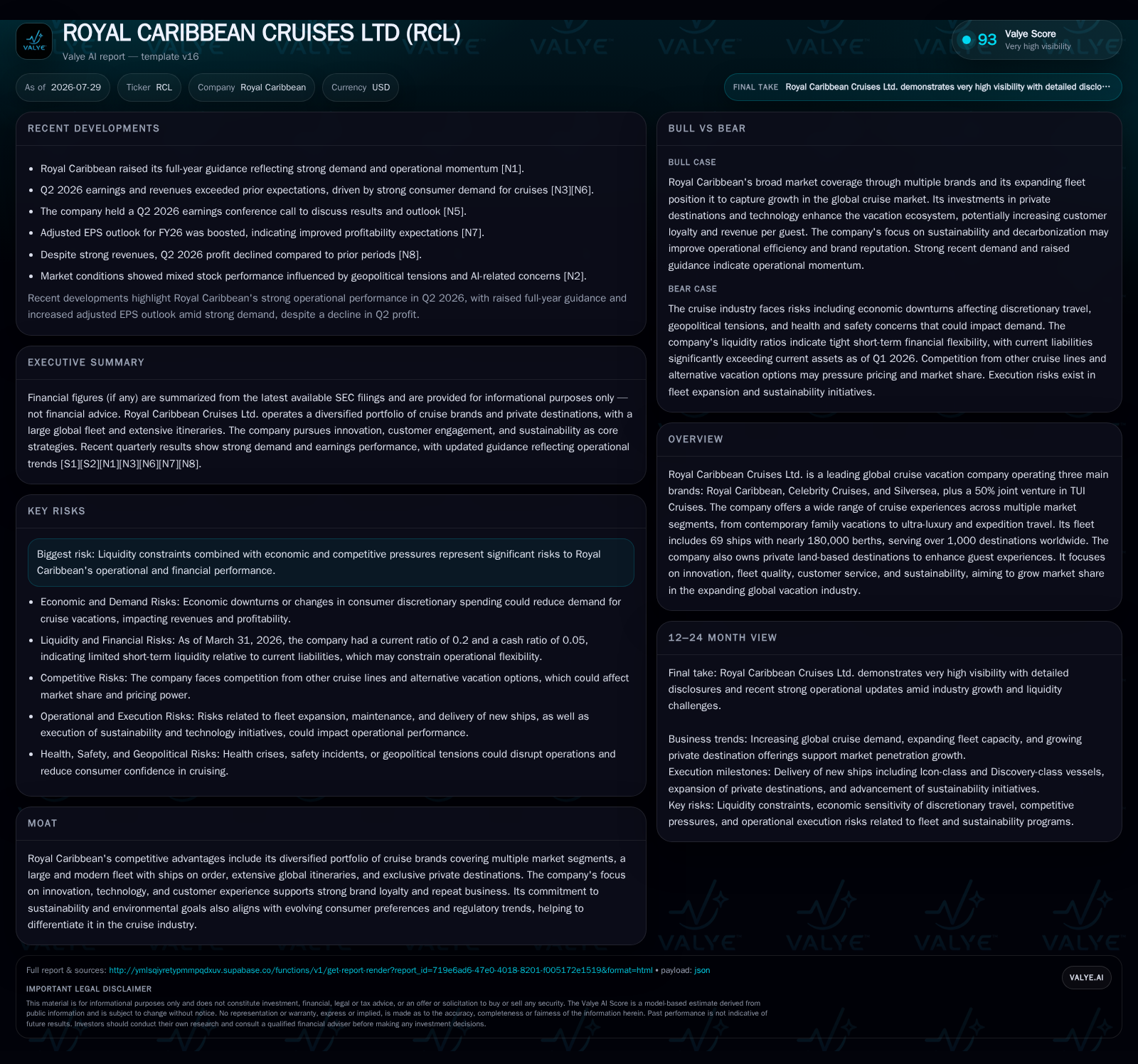
Royal Caribbean Cruises Ltd. reported stronger-than-expected Q2 2026 performance, prompting an upward revision to its full-year outlook. Revenue growth was fueled by improved occupancy rates, higher average daily rates (ADR), and solid onboard spending across its diverse brand portfolio. The company’s sustained investment in fleet quality, innovative itineraries, and exclusive private destinations supports competitive positioning despite the capital-intensive nature of the cruise industry. Near-term risks include liquidity pressures from elevated leverage and challenges posed by fluctuating fuel costs and regulatory requirements.
Q2 Operating Momentum Drives Raised Full-Year Outlook
The increased occupancy rate points to more efficient utilization of the fleet’s berth capacity— a critical metric translating directly into RevPABD (Revenue per Available Berth Day). Meanwhile, raised ADR reflects effective yield management amidst resilient consumer willingness to pay for differentiated cruise experiences rather than discounting—a sign that Royal Caribbean’s product positioning remains compelling in a competitive leisure travel environment.
Diverse Brand Portfolio Fuels Broad Market Coverage
Royal Caribbean’s business model centers on a multi-brand structure comprising three global brands—Royal Caribbean, Celebrity Cruises, Silversea—and a 50% equity investment in TUI Cruises [S1]. This segmentation provides strategic breadth across market tiers ranging from mass-market family vacations to ultra-luxury and expedition cruises.
The flagship Royal Caribbean brand blends casual ambiance with broad appeal to families and couples via an extensive set of itineraries spanning Alaska to Asia—including popular Caribbean routes—with cruise durations typically between three to 14 nights [S1], [S29]. Celebrity Cruises targets premium travelers seeking sophisticated dining, accommodations, and immersive destinations like the Galapagos Islands or South America [S1]. Silversea serves the ultra-luxury segment offering smaller ships focused on exclusivity and high-end service.
This brand stratification enhances pricing power by tailoring offerings to distinct demographic cohorts and preserving yield integrity across segments. The blend also reduces volatility linked to regional economic fluctuations or segment-specific downturns because growth can be compensated across brands serving different geographies or traveler profiles.
Fleet Modernization Enhances Competitive Positioning Amidst Capex Rigors
Royal Caribbean operates one of the world’s largest fleets with approximately 69 ships totaling around 180,000 berths as of end-2025 [S1], reflecting significant scale relative to peers like Carnival Corporation or Norwegian Cruise Line Holdings. Maintaining this fleet involves ongoing drydock cycles every 30-60 months for mandatory maintenance tied to Class certification—critical for safety compliance and operational reliability [S1].
Depreciation assumptions are based on ship useful lives averaging 30-35 years with residual values factoring environmental regulations and technological obsolescence [S1]. The company capitalizes major improvements compliant with evolving emission standards or guest experience upgrades while expensing routine repairs.
Fleet renewal includes investments in newbuild ships featuring advanced amenities designed to attract repeat customers and expand itinerary options. This modernization underpins Royal Caribbean’s moat but also imposes heavy capital expenditures impacting free cash flows due to shipbuilding costs and docking fees. Effective capex planning and drydock scheduling are thus essential levers for sustaining long-term competitiveness without overextending leverage.
Private Destinations Strengthen Customer Loyalty and Onboard Revenue Mix
A key differentiator is Royal Caribbean’s ownership of private land-based resorts branded under "Perfect Day" experiences and Royal Beach Club collections [S1]. These exclusive destinations augment cruise packages by providing curated shore experiences unavailable on standard itineraries.
Private destinations foster higher passenger yields by enabling premium pricing on voyage packages including access fees for amenities such as watersports, dining venues, or cultural activities tailored exclusively for guests. They also create switching costs by enhancing customer lifetime value through brand loyalty incentives linked to these proprietary offerings.
This strategic vertical integration diversifies revenue streams beyond basic fares into premium onboard and onshore spending—both higher-margin components that improve overall profitability margins when well managed.
Cost Structure & Capital Intensity Demand Operational Discipline
Royal Caribbean faces a highly fixed cost base stemming from crew salaries, ship depreciation, fuel consumption variability, port fees, insurance premiums, and technological system maintenance [S2], [F1]. Fuel price volatility remains particularly impactful given the magnitude of energy required for global voyages.
The company reported $512 million in cash against current liabilities exceeding $11 billion at quarter-end March 2026 displaying a low current ratio near 0.2 [F1]. This signals tight near-term liquidity requiring active management of working capital alongside disciplined expense control commitment highlighted in recent disclosures [S2].
Deferred drydocking costs capitalization aids margin smoothing; however unplanned repair expenses or regulatory retrofits could quickly increase operating costs. Crew utilization—the balance between maintaining adequate staffing levels for service excellence versus labor cost efficiency—is another variable requiring fine-tuning given labor market tightness globally.
Macro & Regulatory Risks Temper Growth Prospects
No new material risks emerged in the latest quarterly filing compared with the annual report but previously disclosed concerns remain salient [S2], [S19]. Economic cycles continue to influence discretionary leisure travel spending; any downturn pressures occupancy rates or ADRs negatively. Fuel prices pose cost unpredictability fluctuations affecting voyage economics; hedging policies mitigate but cannot eliminate this exposure fully.
Environmental regulations are increasingly stringent internationally covering emissions standards (e.g., sulfur oxides) or port access restrictions that necessitate ongoing fleet upgrades—either technologically complex retrofits or gradual replacement—adding capex burdens [S1]. Geopolitical events or health crises similar but less severe than prior pandemics also represent latent risks affecting global itinerary scheduling flexibility.
What’s Next – Key Milestones to Monitor Through Late-2026
Stakeholders should track upcoming quarterly bookings data that signal continued consumer confidence post-pandemic along with load factor variations by region indicative of shifting demand patterns [S2], [N1]. Scheduled drydock completions will affect available vessel capacity; delays could restrict peak season deployment meaningfully.
Any announcements concerning delivery schedules for newbuild ships would impact medium-term capacity expansion capabilities. Progress on sustainability goals including emission reductions will be monitored closely given regulatory scrutiny intensifies.
Financial Profile Discussion - Balancing Growth With Leverage
As of March 31, 2026, Royal Caribbean reported approximately $19.7 billion in total debt and $512 million in cash and equivalents, resulting in net debt near $19.2 billion [F1]. Current assets stood at $2.2 billion against current liabilities of $11.1 billion, yielding a current ratio of about 0.2x [F1]. This reflects a leveraged balance sheet with tight near-term liquidity.
The company’s ability to generate operating income supported by improved Q2 results underpins debt servicing capacity while managing working capital tightly mitigates liquidity stress points [S2]. Refinancing efforts earlier this year through senior note issuances have extended maturities which reduces near-term refinancing risk [S20].
Continued margin preservation and efficient capex execution will be essential to free cash flow generation necessary for gradual deleveraging without curtailing growth initiatives tied to fleet enhancements or destination development.
This document is intended solely for informational purposes without any investment advice or research views regarding securities transactions.
Financial position in context
As of 2026-03-31, companyfacts shows $512mm in cash and equivalents and $19.7bn of total debt [F1]. The same snapshot implies net debt of roughly $19.2bn, keeping balance-sheet context relevant but secondary to the operating story [F1]. Current assets of $2.2bn and current liabilities of $11.1bn imply a current ratio near 0.2x for 2026-03-31 [F1].
Disclaimer: This is research-only, informational analysis and not investment advice. It may include AI-generated interpretation and general industry context. Always verify important details using primary sources.

Comments