
MGP Ingredients’ Q2 Shows Liquidity Strength but Profitability Challenges Persist
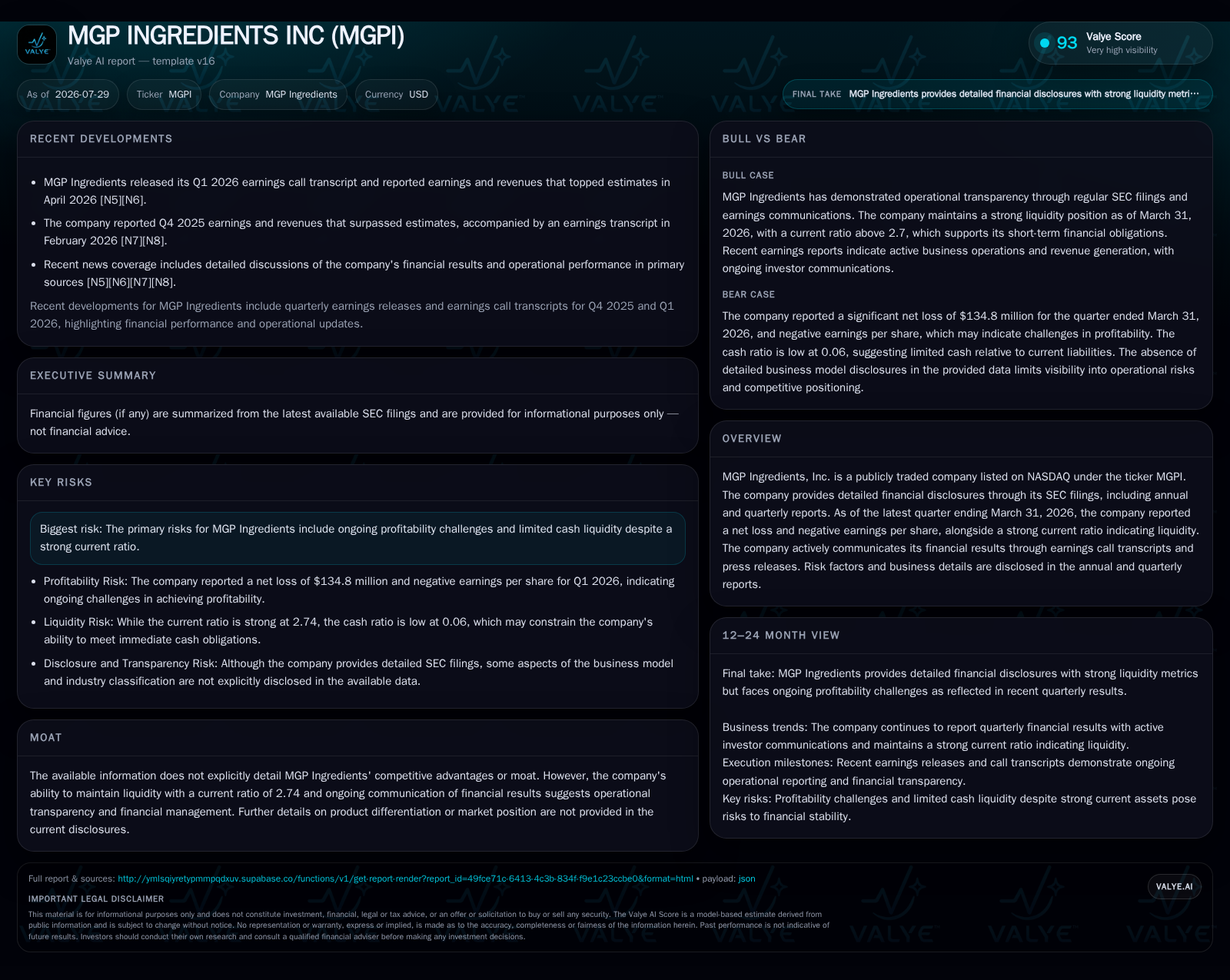
MGP Ingredients reported stronger liquidity metrics in Q2 2026 despite continued net losses, reflecting operational pressures from raw material costs and demand softness in specialty ingredients and distilled spirits.
In its latest quarterly filing ending June 30, 2026, MGP Ingredients maintained a strong current ratio of 2.74, underscoring solid short-term liquidity, while recording a net loss that reflects ongoing margin pressure. The company's integrated midstream business model — producing distilled spirits, specialty proteins, and starches from agricultural commodities — faces headwinds from volatile raw material costs and limited pricing power. Although niche growth drivers such as specialty protein demand and premium spirits markets offer upside potential, capacity utilization challenges and regulatory risks remain relevant. Comparisons against specialty ingredient peers highlight MGPI’s constrained operating leverage amidst cyclical demand and commodity-driven margin compression.
Q2 Operating Snapshot: Liquidity Strength Amid Profitability Pressures
Despite this liquidity strength, MGP Ingredients continued to report net losses in the quarter, driven primarily by margin compression linked to elevated raw material costs and subdued demand in certain end markets [S2], [S3]. The company’s integrated midstream business model, which converts agricultural commodities into distilled spirits, specialty wheat proteins, and starches, remains sensitive to fluctuations in input costs and capacity utilization dynamics.
Integrated Midstream Manufacturing: Product Portfolio and Market Exposure
MGP Ingredients operates a vertically integrated production platform focused on transforming grains such as corn and wheat into value-added products. Its portfolio includes distilled spirits—such as bourbon and other premium liquors—specialty wheat proteins used in functional food formulations, and starches that serve as bulk ingredients in food manufacturing [S1]. The company primarily monetizes its products through bulk ingredient sales and contract manufacturing agreements with food and beverage formulators, distillers, and industrial customers.
This midstream positioning requires adherence to stringent food safety compliance, ingredient purity standards, and supply chain traceability protocols, especially given the regulatory environment surrounding alcohol production and nutritional ingredient manufacturing [S6]. The fermentation process, central to spirits production, is capital intensive and demands high capacity utilization rates to optimize fixed cost absorption and improve operating leverage [S17]. Recent operational adjustments, including temporary idling of some distillation capacity earlier in 2026, reflect efforts to align production with demand fluctuations but also highlight sensitivity to market volatility.
Raw Material Cost Inflation and Pricing Dynamics
A key headwind for MGPI’s profitability is the inflationary pressure on agricultural feedstocks, notably corn and wheat, which constitute the foundational raw materials for both distilled spirits and specialty protein production [S25]. These commodity price increases have been industry-wide, affecting all grain-dependent producers, but MGPI faces particular challenges due to limited pricing power relative to bulk commodity suppliers.
The company’s pricing flexibility is constrained by competitive pressures from lower-cost bulk ingredient providers, limiting its ability to pass through higher input costs fully without risking volume declines or customer attrition. This dynamic results in margin compression, especially in the absence of offsetting volume growth or operational efficiency improvements. Consequently, capacity utilization rates become a critical lever for enhancing profitability, as higher throughput spreads fixed costs over greater production volumes, improving gross margins.
Competitive Landscape and Peer Positioning
Within the specialty food ingredients and distilled spirits sectors, MGP Ingredients occupies a nuanced competitive position. It bridges the gap between large-scale specialty starch suppliers like Ingredion Incorporated, which focus on starches for food applications, and fermentation-centric peers such as Alto Ingredients, known for sustainability-driven capacity expansions and innovation in fermentation-based ingredients [N5], [N7].
Unlike branded distilled spirits producers such as Brown-Forman Corporation, which emphasize consumer marketing and premium brand positioning, MGPI’s business model centers on bulk ingredient sales and contract manufacturing, exposing it more directly to commodity price volatility but with lower marketing overhead. This hybrid model creates a unique operating leverage profile, with profitability closely tied to capacity utilization and raw material cost management.
Peers with fermentation-focused growth strategies have recently attracted investor interest due to innovation investments that enhance margin profiles and sustainability credentials [N5]. MGPI’s challenge lies in improving capacity utilization amid cyclical demand patterns to capture similar operating efficiencies and margin expansion.
Growth Drivers: Specialty Proteins and Premium Spirits Markets
MGP Ingredients’ growth prospects are anchored in expanding demand for specialty proteins driven by consumer trends favoring plant-based nutrition, clean-label formulations, and functional food ingredients [S1]. The company’s specialty wheat proteins cater to these health-conscious segments, offering potential for volume growth and product innovation.
Simultaneously, the premium and craft distilled spirits markets represent incremental growth avenues aligned with MGPI’s fermentation expertise. Growth in these segments is supported by rising consumer interest in craft and premium beverage experiences, although cyclicality in alcohol consumption and economic sensitivities in discretionary spending temper near-term visibility.
Key operational indicators to monitor include production volume trends across protein and starch segments, capacity utilization rates in distillation facilities, order backlog developments, and the establishment of new contract manufacturing partnerships. Geographic expansion into emerging markets, contingent on regulatory approvals, could also provide incremental growth opportunities.
Risks and Operational Constraints
MGP Ingredients faces several risks that could impact its operating and financial performance. Commodity price volatility remains a primary concern, with fluctuations in corn and wheat prices directly affecting input costs and margin stability [S25]. Regulatory compliance burdens related to food safety and alcohol production impose ongoing operational costs and complexity.
Supply chain disruptions, including feedstock availability and transportation logistics, can increase inventory holding costs and delay customer deliveries [S17]. Capacity utilization is a critical operational KPI; recent idling of distillation capacity indicates challenges in maintaining optimal throughput, which depresses fixed cost absorption and operating margins.
Additional risks include potential product quality control issues that could undermine customer formulations reliant on ingredient purity and consistency, particularly in health-sensitive specialty protein applications.
Key Metrics and Monitoring Post-Q2
Following the Q2 2026 results, several metrics warrant close attention to assess MGPI’s operational trajectory:
- Capacity Utilization: Changes in distillery and ingredient production utilization rates will indicate demand recovery or further softness.
- Production Volumes: Trends in gallons of distilled spirits produced and tons of specialty proteins and starches will signal market acceptance and operational efficiency.
- Order Backlog and Contract Wins: Growth in backlog and new contract manufacturing agreements would support revenue stability and diversification.
- Pricing Trends: Ability to improve selling prices relative to raw material cost inflation will be critical for margin recovery.
- On-Time Delivery and Quality Metrics: Operational execution indicators will reflect supply chain resilience and customer satisfaction.
Financial Position and Liquidity Overview
The elevated leverage underscores the importance of operational cash flow generation and margin improvement to maintain financial flexibility. Capital expenditures and investments in capacity optimization will also be key variables influencing future leverage and profitability profiles.
Disclaimer: This analysis is for informational purposes only and does not constitute investment advice. It incorporates data from MGP Ingredients’ SEC filings and publicly available sources as of July 29, 2026. Readers should verify details independently.
Disclaimer: This is research-only, informational analysis and not investment advice. It may include AI-generated interpretation and general industry context. Always verify important details using primary sources.

Comments