GENCOR Industries: A Fortress of Liquidity Amidst a Revenue Blackout
An in-depth analysis of GENCOR INDUSTRIES INC's solid financial liquidity contrasted with opaque revenue reporting and limited business disclosure.
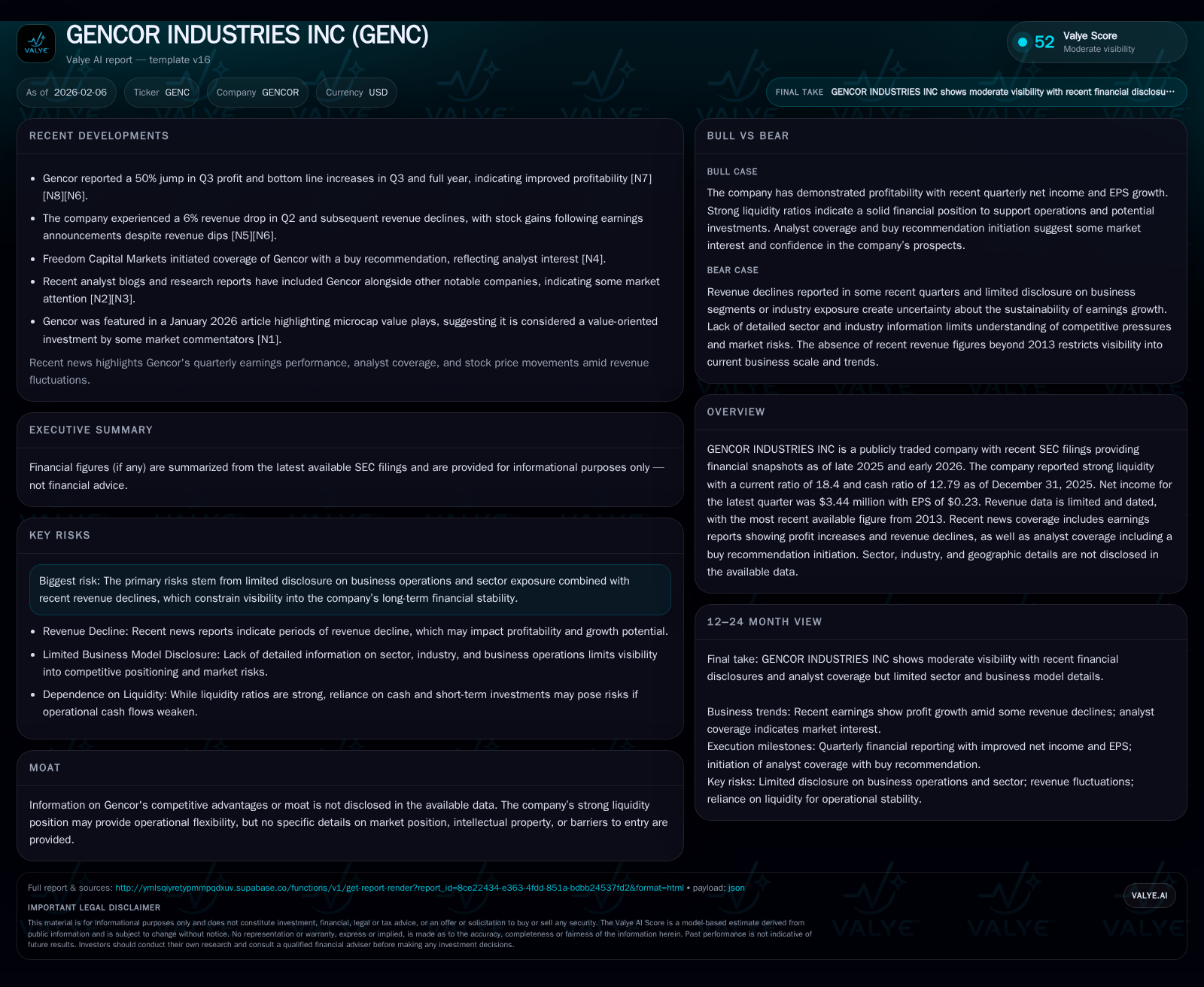
GENCOR Industries stands out with exceptionally strong liquidity ratios uncommon for microcap entities, boasting a current ratio of 18.4 and a cash ratio of 12.79 as of year-end 2025. However, the company’s last reported revenue figure dates back to 2013, raising questions about growth trajectory and operational transparency. Recent quarters show an intriguing paradox: net income improving despite declining revenues, suggesting effective cost management or alternative profit drivers. Analyst coverage, including a fresh buy rating, emphasizes financial health over business clarity, reflecting cautious optimism amid significant disclosure gaps.
Casting Light on the Financial Fortress: Gencor’s Exceptional Liquidity
Among microcap firms where financial fragility is often the norm, GENCOR INDUSTRIES INC presents a striking outlier: a fortress-like liquidity profile unparalleled in its peer group. As of December 31, 2025, the company's current assets stand at approximately $212.5 million against modest current liabilities of $11.5 million, translating to an eye-opening current ratio of 18.4. Furthermore, cash and cash equivalents alone account for $36.7 million—yielding a cash ratio near 12.79.
Such elevated liquidity ratios far exceed typical benchmarks even among financially healthy mid-sized firms. This surplus cushion signals not only robust short-term solvency but also implies considerable flexibility to pursue strategic investments or weather unforeseen disruptions without immediate funding constraints. The presence of ample liquid securities (like corporate bonds and equity mutual funds per SEC disclosures [S1],[S2]) likely contributes to this strength.
While this liquidity abundance is commendable, it must be noted that overcapitalization could potentially indicate underutilized resources—a hypothesis requiring further insight into how these assets translate into growth or shareholder returns.
The Revenue Enigma: What Does 13 Years of Data Silence Mean?
Contrasting sharply with its transparent balance sheet is GENCOR's puzzling silence on updated revenue reporting. The latest available top-line figure harks back to September 30, 2013—$48.9 million according to SEC companyfacts [F1]. Beyond this point, there are no publicly disclosed figures detailing revenue trends for more than a decade.
This prolonged blackout hampers any meaningful analysis of business scale evolution, market expansion, or competitive dynamics. Without current sales data or segment breakouts—information usually fundamental for valuation—stakeholders confront an opaque growth story where longevity substitutes for momentum.
The absence of sector identifiers or geographic footprints exacerbates the challenge by stripping contextual clues that could otherwise guide inference about economic cyclicality or industry-specific drivers shaping performance.
Profit Gains vs. Sales Decline: Examining the Recent Earnings Paradox
Adding complexity to the financial narrative are recent earnings results filed in early 2026 [S2] showing net income of $3.44 million (EPS $0.23 for Q1 FY2026) amid reported revenue declines noted in contemporaneous news reports [N1], [N4]. While declining sales generally erode profit bases, GENCOR bucks this trend with improved profitability.
One plausible explanation lies in stringent cost management reducing operating expenses faster than sales contract—a margin-focused strategy sustaining earnings power despite lower turnover. Alternatively, gains may stem from non-operating sources such as investment income generated by the sizeable liquid asset portfolio reflected on the balance sheet.
Absent detailed segment or expense disclosures in filings, pinpointing exact drivers remains speculative but underlines an unusual earnings paradox worth close monitoring as it diverges from conventional growth–profit linkages.
The Analyst Spotlight: A Fresh Buy Recommendation and Market Reception
In early January 2026, Freedom Capital Markets initiated coverage on GENCOR with a buy recommendation [N4], framing the investment thesis around robust financial health metrics rather than traditional product or sector catalysts.
This approach likely reflects the scant visibility into underlying operations but recognizes balance sheet strength as a temporary anchor amid uncertainty—especially attractive given the microcap value context discussed in broader market commentary [N1], [N2]. Analysts acknowledge that valuations must factor in informational asymmetry; hence confidence hinges on hard asset-backed liquidity rather than forecasted revenue growth.
While optimistic signals from research reports bolster sentiment marginally [N3], they underscore reliance on proxy indicators rather than clear fundamental momentum.
The Unseen Battle: Risks of Operating Behind a Curtain of Disclosure
GENCOR’s guarded disclosure stance poses considerable analytical challenges and risk implications. Lack of clarity on business lines, customers, geographic markets, or competitive positioning restricts stakeholder ability to evaluate sustainability or resilience through economic cycles.
Without documented moats such as patents, brand equity, or regulatory protections cited [Valye Report Excerpt], investors face exposure to sector shifts or market entry threats unnoticed until realized. Further complicating confidence is the outdated revenue data undermining long-term visibility.
This fog obliges reliance on balance sheet proxies as stand-ins for operational viability—an imperfect substitute rendering valuation intrinsically more uncertain and speculative.
Historical Context and Recent News Pulse: Framing Investor Sentiment
GENCOR’s narrative resonates within niche microcap value investing circles highlighted recently by Nasdaq articles spotlighting it alongside other undervalued small caps [N1]. These narratives paint GENCOR as an off-the-radar candidate offering deep value based primarily on asset quality rather than dynamic growth stories.
Investor discourse oscillates between intrigue over cash-rich status and skepticism fueled by limited disclosures—the duality lending itself to a watchful yet opportunistic stance among certain market participants [N2], [N3]. Potential catalysts remain ambiguous but may hinge on future clarifications around business revitalization or monetization strategies for idle assets.
Asset Composition and Lease Commitments: Anchors of Stability or Red Flags?
Delving into SEC filings reveals GENCOR holds varied asset types including equipment, buildings & improvements, land—all captured under property plant & equipment (PP&E) categories—with lease obligations newly recognized as per updated accounting standards [S1],[S2].
The lease contractual terms categorize some agreements as new leases effective through late 2025 periods reflecting refreshment or expansion efforts but appear well-contained relative to liquidity buffers.
Investment-grade securities such as corporate bonds and treasury instruments populate the portfolio contributing steady mark-to-market values consistent with conservative asset management conducive to preserving capital preservation objectives amidst volatile operating results.
Overall, asset quality supports observed liquidity grandeur while lease commitments do not materially threaten solvency given scale disparities.
Strategic Impressions: What We Can Infer and What Remains Unknown
Synthesizing available evidence depicts GENCOR INDUSTRIES as an intriguing financial outlier anchored by exceptional liquidity at odds with opaque operational footprints. Its profitability upticks amidst declining revenues suggest disciplined expense control or alternative profit mechanisms potentially linked to investment income or legacy contracts.
Analyst enthusiasm hinges constructively on these balance sheet strengths amid acknowledged knowledge gaps—an endorsement more reflective of cautious optimism than conviction fueled by transparent fundamentals.
Absent clarity on sector participation or moat characteristics leaves critical questions unanswered about sustainable competitive advantage or growth capability beyond financial resilience alone.
Investors should weigh GENCOR’s fortress-like capital position favorably but remain circumspect given persistent information deficiencies constraining comprehensive risk-return assessment.
This report is based solely on publicly available data up to February 6, 2026. It does not constitute investment advice but aims to unpack financial complexities surrounding GENCOR INDUSTRIES INC through rigorous analysis while acknowledging material unknowns.
Disclaimer: This is research-only, informational analysis and not investment advice. It may include AI-generated interpretation and general industry context. Always verify important details using primary sources.

Comments