
GenFlat Holdings Advances Sustainable Shipping with Collapsible Container Innovation
GenFlat moves from R&D stage to initial commercial lease revenue, leveraging patented collapsible containers to target cost and carbon reductions in intermodal shipping.
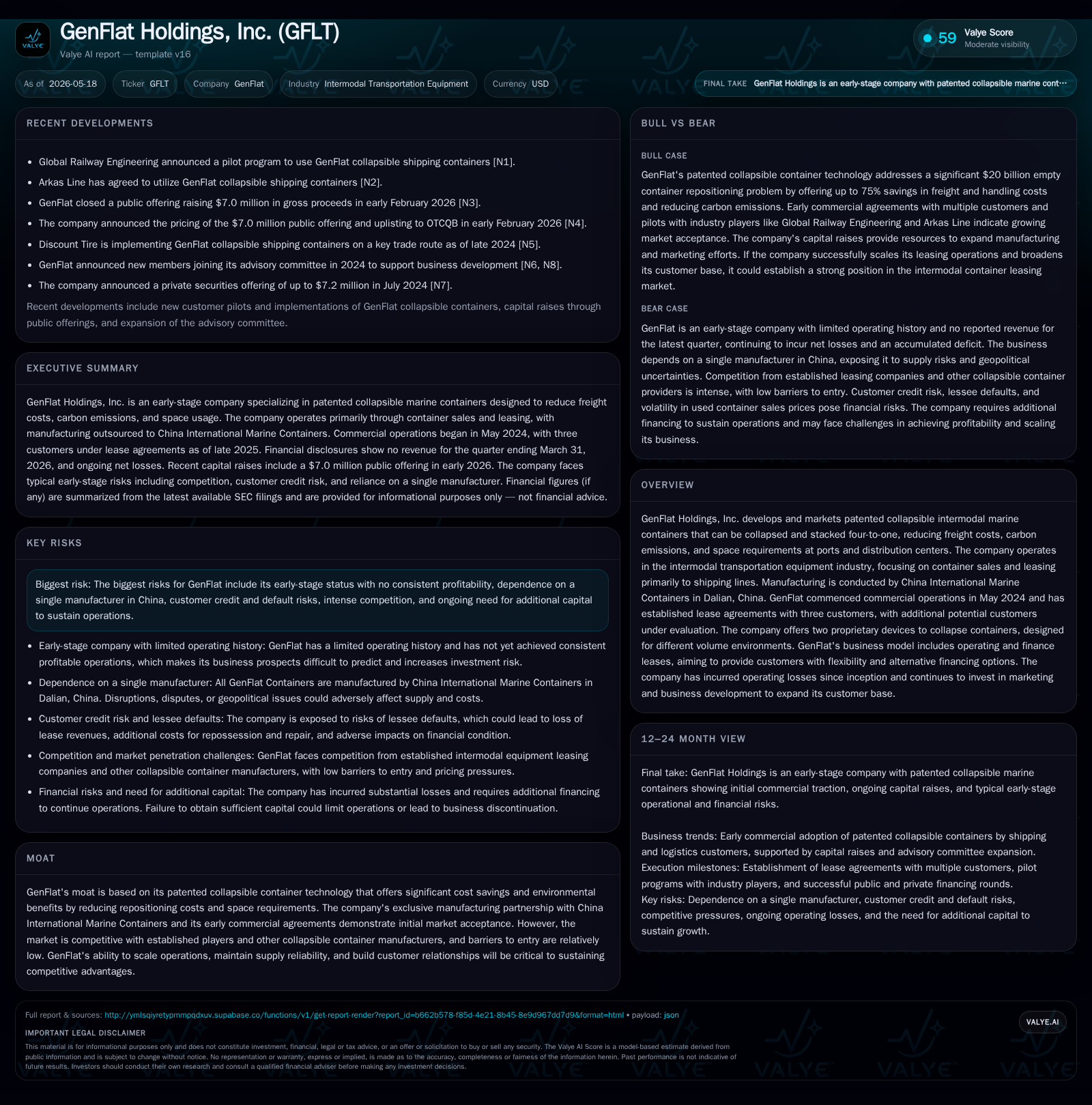
GenFlat Holdings, an early-stage developer of patented collapsible intermodal marine containers, reported its latest quarterly filing showing incremental lease revenue from three customers since commencing commercial operations in May 2024. The company’s innovation enables stacking four collapsed containers in the space of one, offering substantial freight and carbon emission savings. Manufacturing is conducted through a partnership with China International Marine Containers (CIMC) in China. While GenFlat faces significant risks including operating losses, customer concentration, and competition from established players, its technology provides a tangible value proposition aligned with growing logistics sustainability concerns. Future growth hinges on scaling leases beyond initial customers and securing additional capital.
Latest Quarterly Operating Highlights and Commercial Traction
GenFlat Holdings’ latest quarterly filing dated May 15, 2026 ([S2]) confirms the company’s progression from a development-stage entity toward nascent commercial operations. Since launching manufacturing in September 2023 and starting commercial activity in May 2024 ([S1]), GenFlat has secured three container leasing agreements: one rental agreement active since mid-2024 and two equipment leases finalized during the third quarter of fiscal 2025 (August and September). These contracts underscore initial market acceptance of GenFlat’s novel collapsible container products.
Revenue recognition remains minimal at roughly $7,894 for the year ended June 30, 2025 ([F1]), reflecting the very early adoption phase. Operating losses continue to burden finances with a net loss exceeding $4.6 million for the same period ([F1]). Despite this, the existence of signed leases indicates foundational traction beyond pure R&D.
Liquidity metrics as of March 31, 2026 show current assets over $5.2 million against liabilities near $231K, supporting a strong current ratio of approximately 22.59 ([F1]). Total debt sits near $100K with a net debt position around $87K after accounting for minimal cash reserves ([F1]). This reflects necessary leveraging to maintain operations amid ongoing investment burn but suggests runway supported by current asset buffers.
Business Model Overview and Proprietary Product Innovation
At its core, GenFlat holds patents on collapsible marine containers engineered to collapse into one-quarter their conventional volume—stacking four empty units in the space normally occupied by one standard marine container ([S1],[S9]). Constructed primarily from mild steel and Corten materials meeting or exceeding industry structural standards, these units aim to significantly reduce repositioning costs inherent to global container logistics.
Cost efficiencies stem from reduced freight legs (fewer deadhead container moves), compressed space needs at terminals and yards, and lower handling fees—projected up to 75% savings cumulatively across these vectors ([S9]). Environmental impact reduction is also a cornerstone benefit through cutting carbon emissions associated with transport modes that handle empty containers.
GenFlat’s revenue streams are split between container sales and leasing services primarily targeting ocean shipping lines ([S9]). Leasing agreements take two forms: operating leases offering flexible short-to-medium-term rentals to manage fluctuating cargo volumes and fleet composition; and finance leases providing customers structured ownership alternatives typically tied to longer terms with purchase options ([S22]).
The company outsources manufacturing exclusively to China International Marine Containers (CIMC) based in Dalian, China—one of the world’s largest container producers—which allows GenFlat potential manufacturing scale albeit raising supplier concentration risk ([S1],[S28]).
Competitive Dynamics in Collapsible Container Leasing
Within the intermodal transportation equipment industry sector focusing on containers for maritime logistics, GenFlat operates amid several emerging competitors specializing in collapsible solutions—firms such as 4Fold, Spectainer, Staxxon among others ([S6],[S27]). However, unlike its peers mostly confined to niche non-containerized equipment or smaller market segments, GenFlat touts itself as among the few pursuing full integration into standard containerized shipping fleets.
The broader intermodal container leasing market is highly competitive with established industry players holding vast customer relationships backed by financial resources and distribution reach ([S6]). Barriers to entry remain moderate given standard engineering requirements allow rival designs; thus differentiation pivots largely around patented technology reliability and operational cost benefits.
No competitor has fully breached significant penetration within ocean shipping line customers so far—GenFlat’s initial lease signings potentially position it as an early mover if it can capitalize on this foothold ([S6]). However, competitor financing power and brand relationships represent ongoing challenges needing strategic management.
Growth Drivers: Market Adoption and Scaling Opportunities
Demand for more sustainable logistics solutions is intensifying due to heightened regulation around carbon emissions coupled with port congestion driving terminal densification efforts globally. GenFlat’s product offering directly addresses these trends by enabling more compact container storage and fewer repositioning moves—key cost drivers for shipping lines trying to manage volatile cargo flows ([S1],[N/A-analysis]).
The company is actively engaging multiple verticals including international shipping companies, retailers, logistics providers as well as government entities such as the U.S. military currently evaluating use cases ([S1]). This diversification strategy aims to broaden customer base beyond initial three elite lessees.
Marketing initiatives have been scaled cautiously given capital limitations but include digital campaigns targeting industry stakeholders alongside trade show participation intended to raise awareness about GenFlat’s value proposition ([S9],[N/A-analysis]).
Future growth will rely heavily on converting evaluated prospects into paying customers while ramping production efficiently via CIMC partnerships. Lease expansions tied to managing seasonal trade fluctuations provide recurrent revenue potential supported by lease structure flexibility allowing operating adjustment without ownership burdens for users ([S22],[N/A-analysis]).
Risks and Constraints: Capital Needs, Customer Concentration, and Competition
As disclosed in both annual and quarterly filings ([S1],[S2]), GenFlat faces substantial risks typical for an early-stage industrial innovator:
- The company continues unprofitable operations marked by sizable net losses (~$4.7M FY25) with auditor-issued going concern opinions questioning viability absent additional funding or meaningful revenue growth.
- Dependence on a single Chinese manufacturer (CIMC) introduces supply chain vulnerabilities potentially exacerbated by geopolitical tensions or production issues.
- Revenue currently derives from only three leasing/rental customers creating high client concentration risk; default or non-renewal would materially impair results.
- Competitive pressures stem not only from specialized collapsible container startups but also entrenched multi-product lessors wielding broader balance sheets to leverage pricing power or customer loyalty.
- The company must secure further equity or debt financing amid uncertain capital markets conditions or face operational curtailments impacting growth execution timelines.
Key Milestones and What to Watch Next
Stakeholders should monitor key forward indicators including: - Pace of new leasing contracts signed post-Q1 2026 beyond the current customer count of three, - Production scale-up progress through CIMC with attention to order backlogs or delays, - Marketing expenditure shifts reflecting capital raise successes intended to drive top-line acceleration, - Operating cash flow trajectory signaling movement toward breakeven, - Debt service capacity considering current net debt levels around $87K against asset liquidity buffers, - Any update from management regarding amendments in customer credit assessments or diversification efforts addressing concentration risks [S2][S1]
These milestones serve as actionable touchpoints revealing whether GenFlat can translate technological promise into substantive commercial scale within the intermodal container leasing ecosystem.
Financial Position and Cash Flow Analysis
Supporting the narrative above, GenFlat’s financial snapshot through Q3 FY25 summarizes an early-stage industrial startup profile characterized by heavy investment outlays offsetting modest income inflows. Reported revenue remains negligible relative to scale required for viability ($7.9K reported revenue)[F1]. The operating loss surpassed $4.6 million highlighting significant R&D plus selling/administrative expenditures necessary for product innovation deployment.[F1]
Balance sheet health measured by current ratio approximating 22.59 reflects strong short-term solvency driven by relatively high current assets versus low current liabilities.[F1] Yet total debt stands at around $100K partially offset by limited cash holdings translating into net debt exposure near $87K[F1]. Maintaining liquidity will depend on continued capital infusions timed aptly alongside incoming revenues as operations mature.[F1]
This financial positioning underscores a typical capital-intensive innovation lifecycle where upfront losses precede scalable offsetting sales—a dynamic requiring vigilant cash management given limited historical profitability.[N/A-analysis].
This analysis reflects information available as of May 18, 2026 based on SEC filings [S1],[S2] and company factual data [F1]. It does not represent investment advice but aims to provide an informed perspective on GenFlat Holdings’ business progress amidst industry context.
Disclaimer: This is research-only, informational analysis and not investment advice. It may include AI-generated interpretation and general industry context. Always verify important details using primary sources.

Comments