
Generation Income Properties Charts Path to Nasdaq Compliance with Strategic Asset Sales
GIPR leverages targeted property dispositions and governance changes to address Nasdaq listing deficiencies amid ongoing operational challenges.
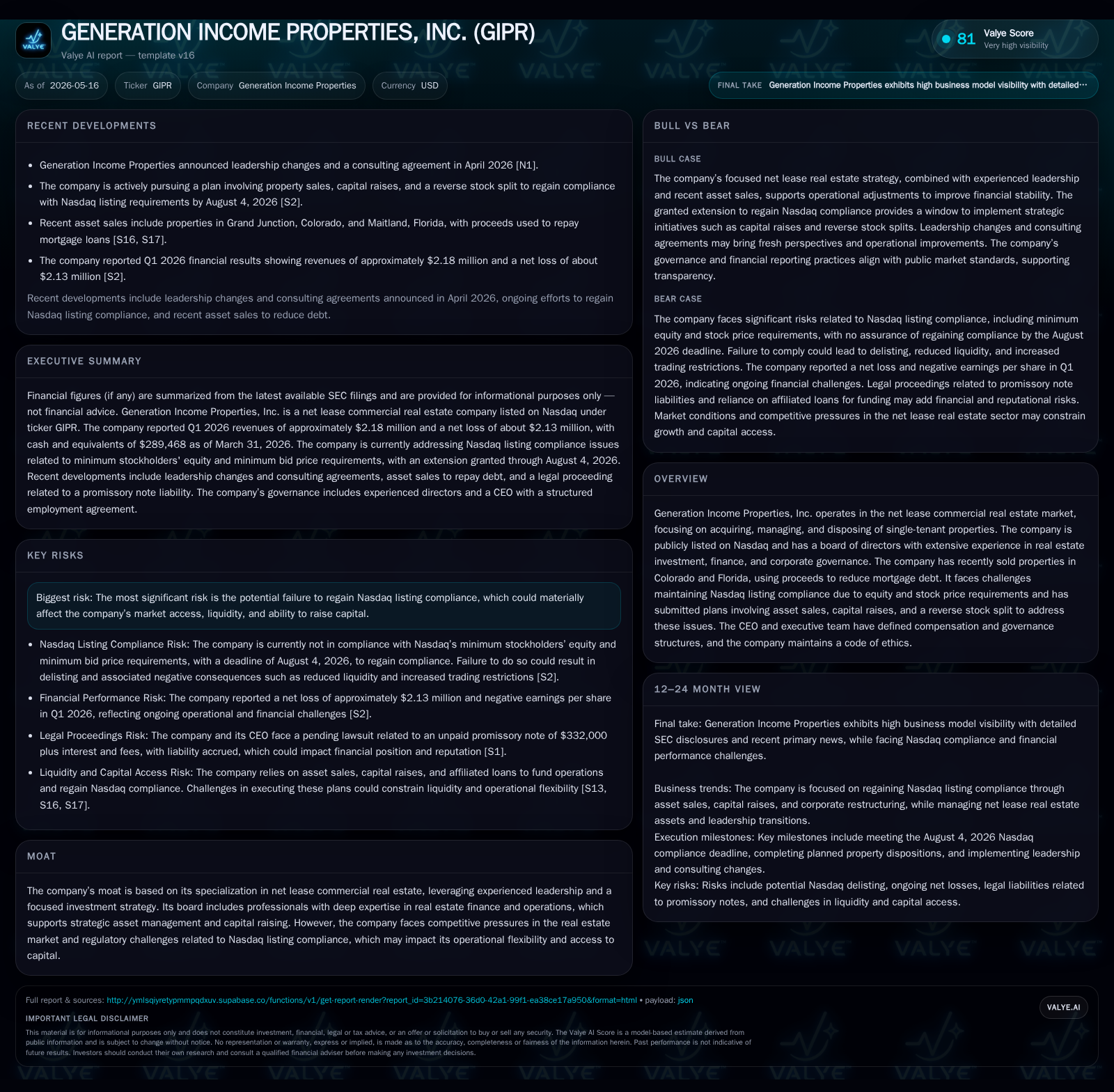
In its latest quarterly filing, Generation Income Properties, Inc. (GIPR) outlined significant developments aimed at regaining compliance with Nasdaq’s listing standards, chiefly via strategic asset sales, capital restructuring, and board refreshment. The company’s focused net lease real estate business faces stiff regulatory and market pressures, driving an operational pivot toward simplifying the portfolio and reducing leverage. While recent property disposals in Colorado and Florida have supplied liquidity to trim mortgage debt, the firm confronts continued risks around equity thresholds and stock price minimums mandated by Nasdaq, placing a tight timeline on execution. Governance updates reflecting boardmember resignations further underscore challenges during this turnaround phase.
Q1 2026 Operational Update and Listing Compliance Focus
Generation Income Properties’ latest quarterly report filed May 15, 2026 ([S2]) highlights the company's current struggle to meet Nasdaq’s quantitative listing standards. The core issue remains GIPR's failure to maintain the minimum stockholders' equity threshold of $2.5 million as required under Nasdaq Listing Rule 5550(b)(1). Despite submitting a comprehensive remediation plan involving property sales, equity capital raises, and a reverse stock split, the company has not yet restored full compliance. The Nasdaq Hearings Panel granted an extension through August 4, 2026 — the final respite allowed — emphasizing that failure to comply would trigger delisting processes.
Concurrently, GIPR faces pressure from the Minimum Bid Requirement Rule (Nasdaq Listing Rule 5550(a)(2)), necessitating the stock price averaging at least $1.00 per share for ten consecutive business days by July 27, 2026. Management has indicated readiness to implement a reverse stock split if needed to meet this standard.
Strategically important is GIPR's recent divestiture activity: it sold two key assets — a retail property leased to Best Buy in Grand Junction, Colorado for approximately $5 million ([S28]), and an office building in Maitland, Florida for about $6.7 million ([S22]). Proceeds from these sales were primarily applied toward retiring approximately $5.3 million in mortgage debt associated with these properties. This deleveraging effort reduces financial strain while providing much-needed liquidity.
Leadership dynamics also shifted recently. On May 7, three directors—Benjamin Adams, Gena Cheng, and Patrick Quilty—resigned without any disagreements concerning corporate strategy or operations ([S3]), marking a notable board refresh in what remains a challenging juncture for corporate governance.
Business Model: Specialized Net Lease Real Estate Investments
Generation Income Properties operates as a net lease REIT specializing exclusively in single-tenant commercial properties leased out under long-term contracts backed by tenant-held leases. This model generates stable rental income streams with limited landlord responsibilities beyond structural maintenance.
The company's income is driven primarily by rents paid under net leases where tenants assume most operating costs including taxes and insurance. This structure typically creates predictable cash flows attractive to investors seeking yield and reduced operating risk.
The firm’s niche focus requires extensive sector expertise to identify accretive acquisition targets while strategically rotating assets that no longer fit portfolio objectives or have reached value maturity thresholds. GIPR's strategic decisions around asset disposition reflect management’s intent to maintain a high-credit-quality tenant roster while managing leverage prudently ([S1], Valye Report Excerpt).
Competitive Environment and Regulatory Challenges
In the competitive landscape of net lease commercial real estate investing, companies like GIPR must navigate fluctuating tenant credit conditions alongside cap rate compression trends driven by broader interest rate cycles.
Pricing power for net leases depends strongly on tenant strength and location quality; given escalating rates recently observed across real estate sectors nationally, demands on debt servicing costs have heightened.
Simultaneously, as a publicly listed entity on Nasdaq’s Capital Market tier specialized listing standards impose unique administrative burdens. Non-compliance risks include trading suspensions or delisting which severely reduce market liquidity and equity financing options—a critical challenge for mid-sized focused REITs competing against larger access-capital peers ([S2], Valye Report Excerpt).
Growth Catalysts: Asset Optimization and Capital Restructuring
The company’s growth trajectory currently hinges less on expansion than on prudent portfolio optimization aligned with restoring financial stability.
Completion of the announced sale transactions in late 2025 has helped reduce debt service burdens while improving overall balance sheet flexibility ([S22], [S29]). Further planned capital raises aim to boost equity levels above Nasdaq minimums enabling longer-term operational continuity.
Management also contemplates executing a reverse stock split ahead of the July deadline as leverage against persistent sub-$1 share prices—an often necessary but delicate maneuver fraught with investor perception risks.
Together these strategic moves work to reposition GIPR financially so it can regain public listing privileges thereby restoring access to liquid capital markets vital for future asset acquisitions or refinancing activities.
Key Risks: Nasdaq Compliance Deadline and Market Headwinds
Failure to regain compliance with Nasdaq’s requirements represents perhaps the largest existential risk; delisting would challenge liquidity severely complicating future financing needs ([S2]).
Legal exposure stemming from recently disclosed litigation involving CEO personal guarantees on promissory notes related to unpaid brokerage commissions adds financial uncertainty ([S1]).
Board turnover amid turn-around pressures may unsettle investor confidence even as resignations were stated not related to company disagreements ([S3]).
Lastly, net lease market competition alongside macroeconomic volatility could constrain pricing premiums or tenant renewals making revenue streams less predictable than historical norms suggest.
Upcoming Milestones to Monitor
Attention centers on several imminent events:
- August 4, 2026: Deadline imposed by Nasdaq Hearings Panel for meeting stockholders' equity requirements.
- July 27, 2026: Minimum bid price compliance period ends; potential date for reverse stock split initiation if required.
- Execution timing of pending capital raises or further asset dispositions critical for bolstering equity buffers.
- Legal proceedings related developments concerning brokerage commission lawsuits impacting contingent liabilities.
These milestones represent clear checkpoints dictating whether operational remediation transitions into restored market standing or intensifies regulatory consequences.
Latest Financial Snapshot
Latest financial snapshot
| Metric | Value | Period |
|---|---|---|
| Cash & equivalents | $289468 | |
| 2026-03-31 | ||
| Total debt | $55mm | |
| 2026-03-31 | ||
| Net debt | $55mm | |
| 2026-03-31 |
Source: SEC companyfacts cache [F1].
| Metric | Amount (USD) | Date |
|---|---|---|
| Cash & Equivalents | 289,468 | |
| 2026-03-31 | ||
| Total Debt | 55,008,722 | |
| 2026-03-31 | ||
| Net Debt | 54,719,254 | |
| 2026-03-31 |
This snapshot underscores tight liquidity relative to substantial leverage carried through mortgages largely associated with operating properties ([F1]). The narrow cash cushion imposes urgency on asset sales converting property holdings into cash inflows usable for debt amortization or working capital needs.
This analysis is based solely on public SEC filings up to May 16, 2026. It does not constitute investment advice or recommendations.
Disclaimer: This is research-only, informational analysis and not investment advice. It may include AI-generated interpretation and general industry context. Always verify important details using primary sources.

Comments