
Income Certainty in STRATS SM Trust for United States Cellular Corporation Securities
STRATS SM Trust acts as a pass-through vehicle providing investors with periodic income derived solely from United States Cellular Corporation securities.
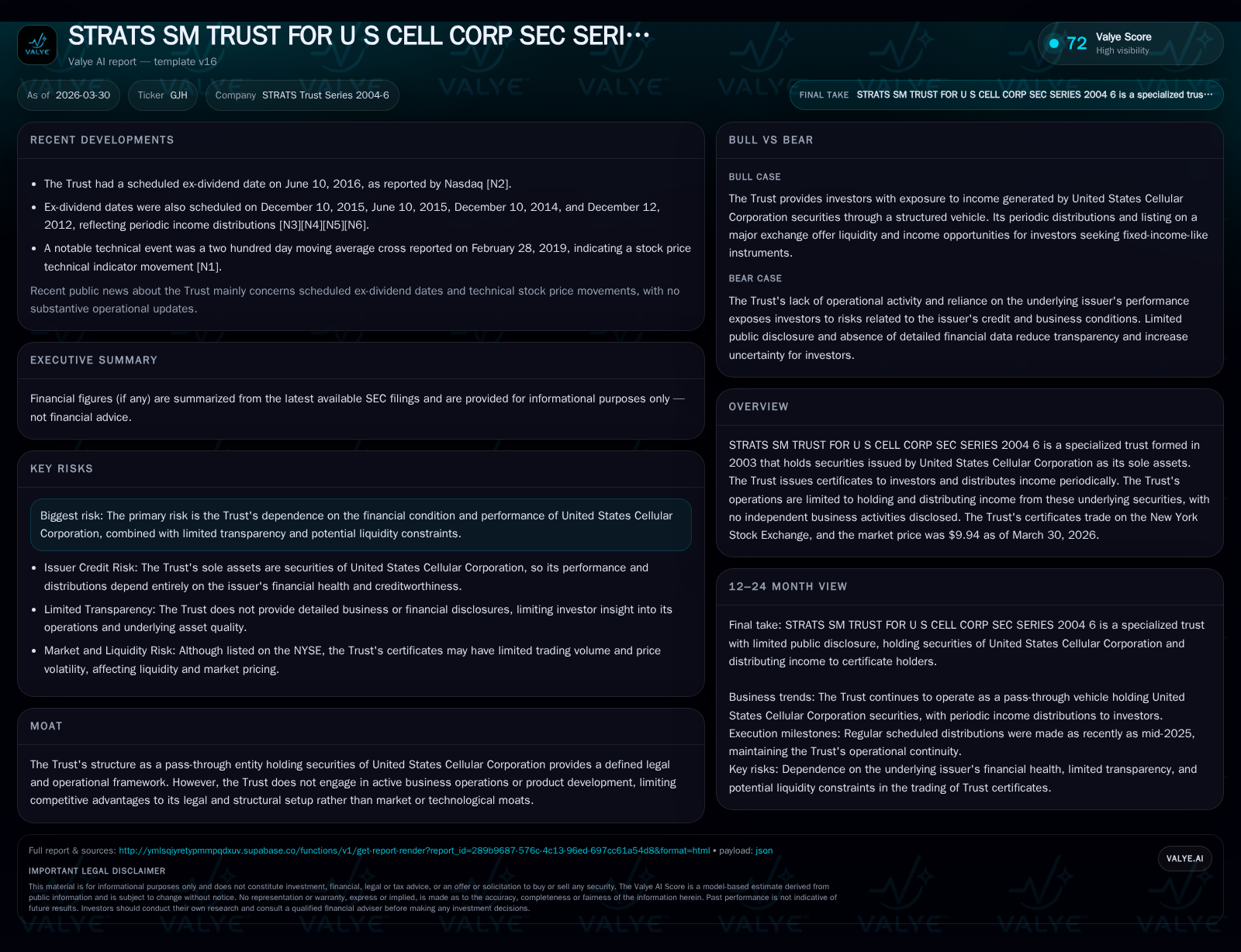
STRATS SM Trust for United States Cellular Corporation Securities, Series 2004-6, is a specialized legal entity formed to hold and distribute income generated exclusively by US Cellular-issued securities. Without independent operations or revenues, its financial performance tracks the cash flows from the underlying issuer. Recent trustee filings indicate stable distribution patterns reflective of US Cellular’s payment activity. Risks center largely on the credit and liquidity profile of the underlying corporation, with limited transparency or capital reinvestment flexibility inherent in the trust’s structure.
Historical Income Distribution Patterns and Trust Performance
The STRATS SM Trust for United States Cellular Corporation Securities, Series 2004-6 ("the Trust") operates as a conduit delivering income generated solely by its underlying assets: securities issued by United States Cellular Corporation (US Cellular). The Trust does not engage in independent business operations; rather, it exists purely to receive cash distributions from these securities and transfer them to certificate holders [S6], [S9], [S11].
Analysis of trustee distribution statements filed as exhibits to various Form 8-Ks illustrates stable and punctual payment patterns through 2025. Distributions were made on dates including June 16, 2025, and December 15, 2025, consistently reflecting contractual payout terms without reported shortfalls or deferments [S6], [S9], [S11]. These distributions underline the quasi-fixed-income nature of the certificates: investors receive predictable cash flows akin to bond coupon payments.
Given the lack of other revenue sources or active management operations, fluctuations in distributions closely mirror changes in cash flow availability from US Cellular itself. No indications suggest operational volatility within the Trust that would disrupt these income streams.
Legal Structure and Operational Framework of the Trust
Formed under a Base Trust Agreement dated September 26, 2003, between Synthetic Fixed-Income Securities, Inc. as depositor and U.S. Bank Trust National Association as trustee and securities intermediary, the Trust is structurally designed as a pass-through vehicle [S6]. Supplemental documentation via a series supplement dated April 21, 2004 further defines the terms applicable to this particular issuance.
By design, the Trust holds no assets other than US Cellular-issued securities. It does not conduct any business activities such as product development or asset management. The trustee's role is custodial—managing distributions per governing documents—but it maintains no discretion over investment decisions. This legal framework provides clarity regarding operational limits; all financial outcomes depend solely on the performance of the issuer's securities.
Dependence on United States Cellular Corporation: Assessing Underlying Asset Dynamics
The entirety of the Trust's asset base comprises securities issued by US Cellular (SEC file no. 001-09712), rendering it deeply dependent on this single entity's financial health [S6]. There is no independent reporting entity for the Trust itself; hence, performance assessment requires referencing US Cellular's publicly filed financials.
This concentration creates pronounced credit exposure risk — deterioration in US Cellular’s cash flow generation could directly affect distribution capability. Conversely, it allows focused analysis of underlying security performance without diversification complexities common in broader fixed-income funds.
In sector terminology, this manifests as high "issuer concentration risk" balanced by simplified "credit exposure monitoring." For certificate holders, understanding US Cellular’s operating metrics, debt profile, and sector positioning becomes paramount.
Capital Allocation: Distribution Policies and Investor Returns
Distribution policies reflect standard pass-through trust mechanics: income received from US Cellular securities is transferred periodically to certificate holders. Frequency appears semiannual based on June and December payout filings; amounts remain consistent with prior periods absent new issuances or capital events [S6], [S9], [S11].
There is no evidence of capital return approaches beyond these scheduled distributions—no share buybacks or reinvestment programs exist within trust guidelines or filings. As such, investor return profiles focus exclusively on yield generated from underlying coupons or dividends.
The absence of reinvestment flexibility aligns with typical securitized debt instruments prioritizing predictable yield profiles over growth strategies.
Liquidity and Debt Position: Recent Developments and Implications
Recent disclosure filings from mid-2025 through year-end confirm that the Trust maintains adequate liquidity to meet distribution obligations without resorting to debt issuance or refinancing maneuvers [S6]–[S11]. No new liabilities are recorded beyond outstanding certificate obligations.
This liquidity profile supports continuity in income delivery despite broader market shifts.
Risks Linked to Underlying Asset Performance and Transparency Limits
Formal risk factor disclosures within recent annual filings explicitly state that risks specific to the Trust itself are "not applicable" reflecting its passive structure [S1], [S3], [S4]. Instead, all material investment risks stem from US Cellular’s operational performance and credit quality.
Primary risks include concentrated credit exposure — any adverse event impacting US Cellular can reduce distributions materially. Additionally, absent independent decision-making authority or diversification options limits mitigation strategies available at trust level.
Transparency constraints arise since neither Synthetic Fixed-Income Securities nor the Trustee verifies underlying issuer disclosures independently, leaving investors reliant on public filings without further due diligence assurances [S6], [S7].
Liquidity constraints may manifest if sudden issuer distress curtails cash flow availability. Hence, certificates behave akin to fixed-income instruments with embedded issuer default risk rather than equity stakes.
What Investors Should Monitor Going Forward
Absent explicit guidance or trust-specific forecasts in recent disclosures, prospective income stability depends heavily on tracking several key indicators centered around US Cellular:
- Ongoing review of US Cellular's quarterly and annual SEC reports for financial health trends (via EDGAR access under file number 001-09712) will provide principal insight into cash flow sustainability.
- Regular trustee distribution statements remain primary signals for short-term performance shifts indicating potential changes in payout patterns [S6], [S9], [S11].
- Market pricing dynamics around certificate trading offer real-time sentiment clues about yield adequacy versus prevailing interest rates.
- Regulatory updates affecting pass-through security structures or telecommunications sector developments influencing US Cellular's creditworthiness also merit attention.
From an analytical standpoint, assessing "distribution coverage" ratios calculated by relating issuer earnings/cash flow to debt servicing obligations could forecast future distribution reliability.
Given structural rigidity and lack of operational control within the Trust itself, investors effectively hold a fixed-income-like instrument where capital appreciation prospects are minimal relative to scheduled cashflows.
Historical Distribution Summary Table
| Distribution Date | Notes |
|---|---|
| December 15, 2024 | Distribution details not publicly disclosed |
| June 16, 2025 | Distribution made; see Exhibit 99.1 filing [S10], [S11] |
| December 15, 2025 | Distribution made; see Exhibit 99.1 filing [S6], [S9] |
| Distribution amounts are detailed within trustee filings but aggregated data is not publicly disclosed. |
Disclaimer: This analysis presents factual company information supported by regulatory filings related to STRATS SM Trust for United States Cellular Corporation Securities Series 2004-6 without offering investment recommendations. Investors should consider external factors beyond disclosed data when evaluating such fixed-income pass-through entities whose returns hinge entirely on underlying issuer performance.
Disclaimer: This is research-only, informational analysis and not investment advice. It may include AI-generated interpretation and general industry context. Always verify important details using primary sources.

Comments