
Global AI Accelerates Growth Through Agentic Platform and Strategic M&A
The latest quarterly SEC filing highlights Global AI’s early-stage platform traction, strategic acquisitions, and financial challenges.
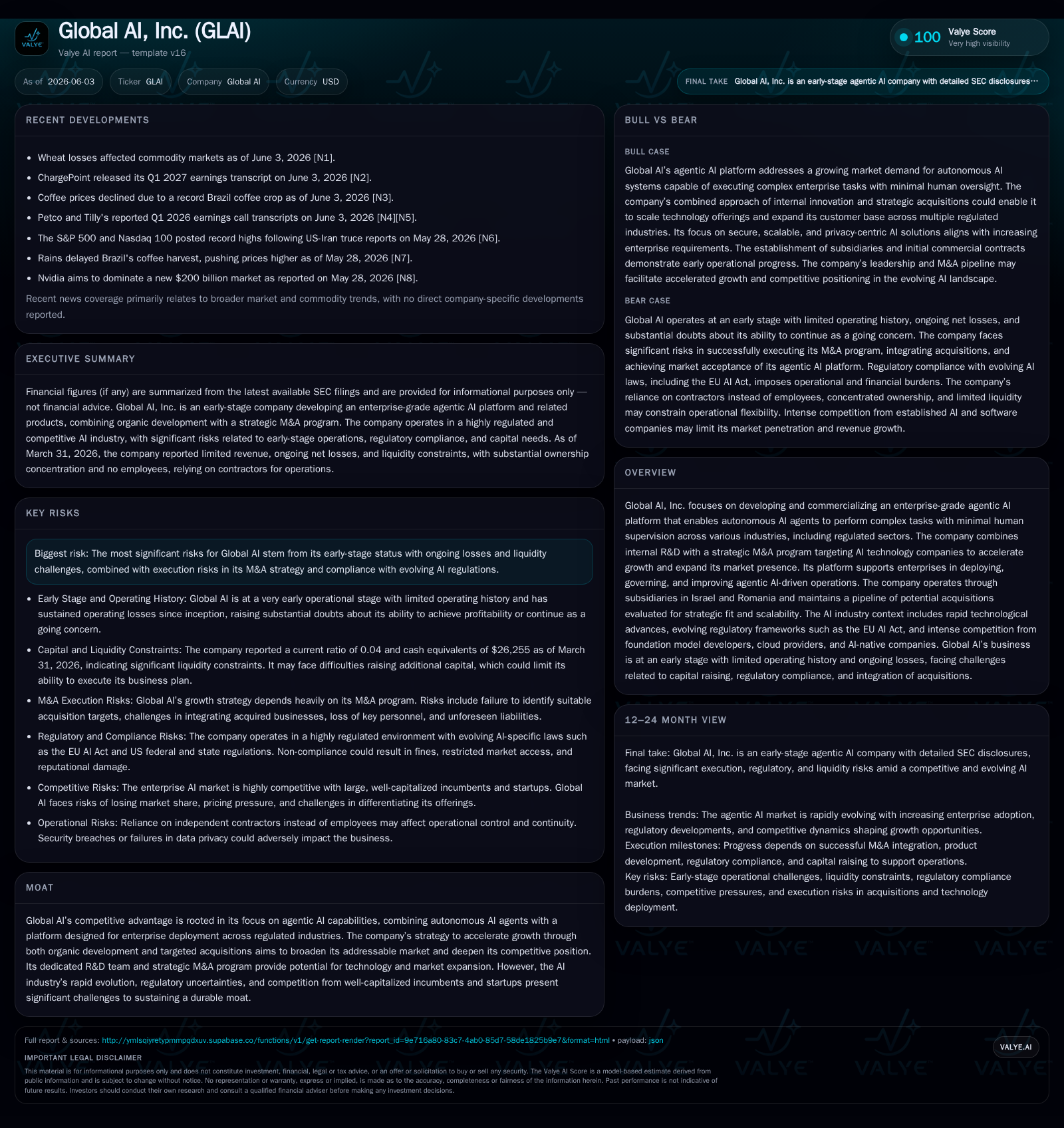
Global AI, Inc.'s 2026 Q1 filing underscores tangible progress with its enterprise-grade agentic AI platform and the advancement of a strategic mergers and acquisitions program aimed at expanding its footprint in regulated industries. The company's first commercial contract via its Israel subsidiary marks a milestone despite persistent liquidity constraints. Navigating an evolving regulatory landscape and integration risks, Global AI seeks to differentiate through autonomous AI agents tailored for compliance-heavy sectors. Execution risks and a precarious financial position define the near-term outlook as management targets growth through a hybrid of organic innovation and M&A.
Quarterly Update Highlights: Progress amid Financial Tightening
Global AI's latest quarterly report filed on June 3, 2026, reveals a company advancing foundational steps toward commercialization. The company has executed a key commercial contract via its Israeli subsidiary (GL AI Ltd.), established less than two years prior, marking one of its first revenue-generating engagements [S2][S6]. This progress complements recent board approval of a Global Equity Incentive Plan reserving 15 million shares for employee and director compensation, linked notably to stock price thresholds that incentivize delivery against market-cap milestones between $18.75 million and $37.5 million in restricted stock units (RSUs) [S3].
Agentic AI Platform: Innovation Serving Regulated Enterprises
At the core of Global AI's business model is its enterprise-grade Agentic AI Platform—an advanced software environment enabling autonomous AI agents to perform complex multi-step tasks across domains requiring rigorous governance. Unlike typical conversational or assistive AI implementations, agentic systems drive autonomous reasoning, planning, execution, and tool usage with minimal human oversight. The platform targets heavily regulated verticals such as banking, insurance, healthcare, and life sciences where compliance mandates around data privacy, accuracy, auditability, and responsible automation are stringent [S1][S6]. By designing capabilities that allow enterprises to deploy, monitor, and continuously improve these autonomous agents within controlled boundaries, Global AI aims to fulfill unmet market needs inaccessible to generalized foundation models or narrowly focused task automation tools.
The platform offers SaaS-like recurring revenue potential by embedding security-centric design choices while supporting privacy requirements under regimes like GDPR and CCPA. Its product relevance hinges on delivering robust autonomy balanced by governance features compliant with the EU AI Act’s upcoming enforcement phases targeting "high-risk" systems [S14][S25]. This positioning attempts to carve out differentiation vis-à-vis larger cloud providers offering more generic API access to foundation models lacking tailored controls for regulated customers.
Strategic M&A Program: Expansion and Integration Challenges
A notable pillar of Global AI’s growth strategy is its active M&A pipeline targeting startups and mid-sized entities complementing or enhancing the Agentic AI Platform. This program applies stringent acquisition criteria emphasizing technology scalability aligned with Global AI’s roadmap, strong recurring revenue streams that bolster SaaS retention metrics, customer base quality indicating predictable renewal rates, and leadership teams capable of smooth integration [S1][S6]. Such inorganic growth avenues intend to accelerate market penetration quicker than organic R&D alone could achieve.
However, this strategy entails execution risks amplified by heightened regulatory scrutiny at the Federal Trade Commission (FTC) and Department of Justice (DOJ) level under the Hart-Scott-Rodino Act clearance process. Given industry concerns over "killer acquisitions" aimed at neutralizing emerging competitors or consolidating data moats in the rapidly evolving AI ecosystem, delays or blocking orders may impede transaction completion timelines or necessitate divestitures [S1][S8]. Additionally, operational hurdles remain significant—including harmonizing disparate architectures across acquired technologies, retaining key technical talent essential for maintaining developmental momentum post-deal, and avoiding unforeseen liabilities embedded within acquired assets that could derail cost synergies.
Industry Competitive Dynamics: Differentiation through Agentic AI
Global AI operates amid an intensely competitive landscape involving major foundation model developers such as OpenAI-competitors alongside hyperscale cloud platforms providing managed model services (e.g., AWS SageMaker). These incumbents benefit from deep pockets enabling investments in compute infrastructure optimization—critical given rising costs of training large models—and extensive distribution ecosystems spanning global enterprise software markets [S5][S10]. At the same time, specialized startups develop narrowly defined vertical applications leveraging foundation model APIs.
Global AI's value proposition centers on specialized agentic autonomy—AI systems that do not merely augment but actively undertake decision-making workflows autonomously within controllable parameters suited for high-compliance settings. The company’s approach addresses sector demands often underserved by generic foundation models that struggle to satisfy auditability or liability standards required for regulated enterprise use cases. Furthermore, this niche focus aligns with trends towards outcome-based pricing rather than simple per-seat subscriptions prevalent in SaaS licensing models—reflecting shifting consumption patterns where clients pay for effective task execution rather than mere access [S5][N2]
Yet barriers persist as evolving intellectual property disputes around training datasets raise uncertainty around long-term cost structures; compute capacity remains constrained by semiconductor supply chains; regulatory frameworks impose ongoing certification burdens; and trustworthiness issues such as hallucination risks require continuous safety research investment.
Growth Drivers: Addressable Market, Customer Adoption, and Tech Development
Global AI's growth opportunities hinge on expanding enterprise adoption within regulated segments increasingly open to automating complex workflows previously reliant on manual human execution due to compliance concerns. Regulatory developments such as the EU AI Act’s phased enforcement schedule provide both a mandate for trustworthy agentic systems and create barriers favoring specialized vendors capable of compliance support over broad public cloud providers struggling with governance consistency [S14][S25].
Early indicators from contractual wins like the initial Israel subsidiary deal provide proof points validating product-market fit in government-related or healthcare sectors where such solutions generate tangible efficiency gains while maintaining rigorous oversight. International expansion including the establishment of a Romanian subsidiary further extends reach into European markets facing harmonized GDPR-type regimes [S1][S6].
Continued internal R&D led by an experienced team focused on security-centric innovation alongside M&A-driven technology infusions contribute synergistically to platform evolution—potentially supporting improved net retention rates if existing customers expand utilization or renew long term. Sector KPIs relevant here would include tracking annual recurring revenue (ARR), churn reduction linked to regulatory lock-in effects, and billings tied directly to consumption-based pricing mechanisms indicating deeper platform engagement.
Risks and Constraints: Early-Stage Execution, Regulatory Scrutiny, and Liquidity Stress
Despite significant conceptual advances, Global AI faces hurdles typical for an early-stage enterprise software vendor attempting market penetration in a capital-intensive domain. Operating history remains limited with accumulated deficits exceeding $5.4 million as of late 2025 reflecting unprofitable R&D-heavy operations without proven large-scale client adoption yet [F1][S1]
Cash burn is acute relative to available liquid assets; reported cash holdings are roughly $26,255 as of March 31, 2026, while current liabilities exceed $6.74 million at quarter-end, resulting in a current ratio near 0.04—indicating a significant working capital mismatch that may require urgent recapitalization or operational adjustments to sustain near-term operations [F1]. Moreover:
- The M&A approach increases complexity—with transaction timing uncertain given government antitrust oversight amid increased sector consolidation vigilance.
- Regulatory environments remain fluid globally resulting in compliance cost uncertainties impacting product features rollout or restricting addressable markets.
- Autonomous agentic systems inherently carry legal liability concerns depending on outcomes caused by algorithmic decisions possibly requiring costly indemnities or insurance coverage expansions.
- Dependence on contractor services reflects lean staffing but risks knowledge continuity and execution scalability.
Such risks underscore the speculative nature at this stage—failure either operationally or financially could significantly affect sustainability absent new capital inflows or partnership agreements.
Looking Ahead: Upcoming Milestones and Market Catalysts
Key forthcoming events warrant close observation including:
- Material acquisition closings subject to regulatory clearances that would test integration capabilities while potentially bolstering recurring revenues.
- Enterprise contract announcements beyond initial multi-industry pilot phases indicating broader customer acceptance across subsidiaries.
- Achievement of targeted market capitalization thresholds unlocking sizeable RSU grants valued up to $37.5 million aligning management incentives directly with shareholder returns conditional on sustained share-price appreciation post-liquidity event milestones [S3].
- Developments in regulatory frameworks impacting go-to-market strategies notably compliance adaptations required under expanded EU provisions slated for enforcement beginning August 2026.
- Progression in R&D outcomes strengthening platform robustness against emergent threats such as hallucination mitigation techniques or enhanced explainability modules increasing buyer confidence.
Collectively these milestones will signal whether Global AI can transition effectively from early-stage development into scalable commercial operations amid intensifying competition.
Financial Overview: Supporting Current Operations Despite Losses
Management signals awareness via structured equity incentives fostering alignment but implicit need for immediate recapitalization looms given sparse internal cash flow generation confirming that growth ambitions rest squarely dependent on access to external financing sources or transformative M&A synergies achieving accelerated profitability pathway [S3][F1]
This analysis synthesizes disclosures from Global AI’s latest filings combined with industry context without expressing investment research views or forecasts.
Disclaimer: This is research-only, informational analysis and not investment advice. It may include AI-generated interpretation and general industry context. Always verify important details using primary sources.

Comments