
Netskope’s Q1 Update Highlights Challenges in Scaling Cloud Security Platform
The latest quarter reflects robust subscription growth yet underscores persistent losses and operational complexities amid competitive pressures.
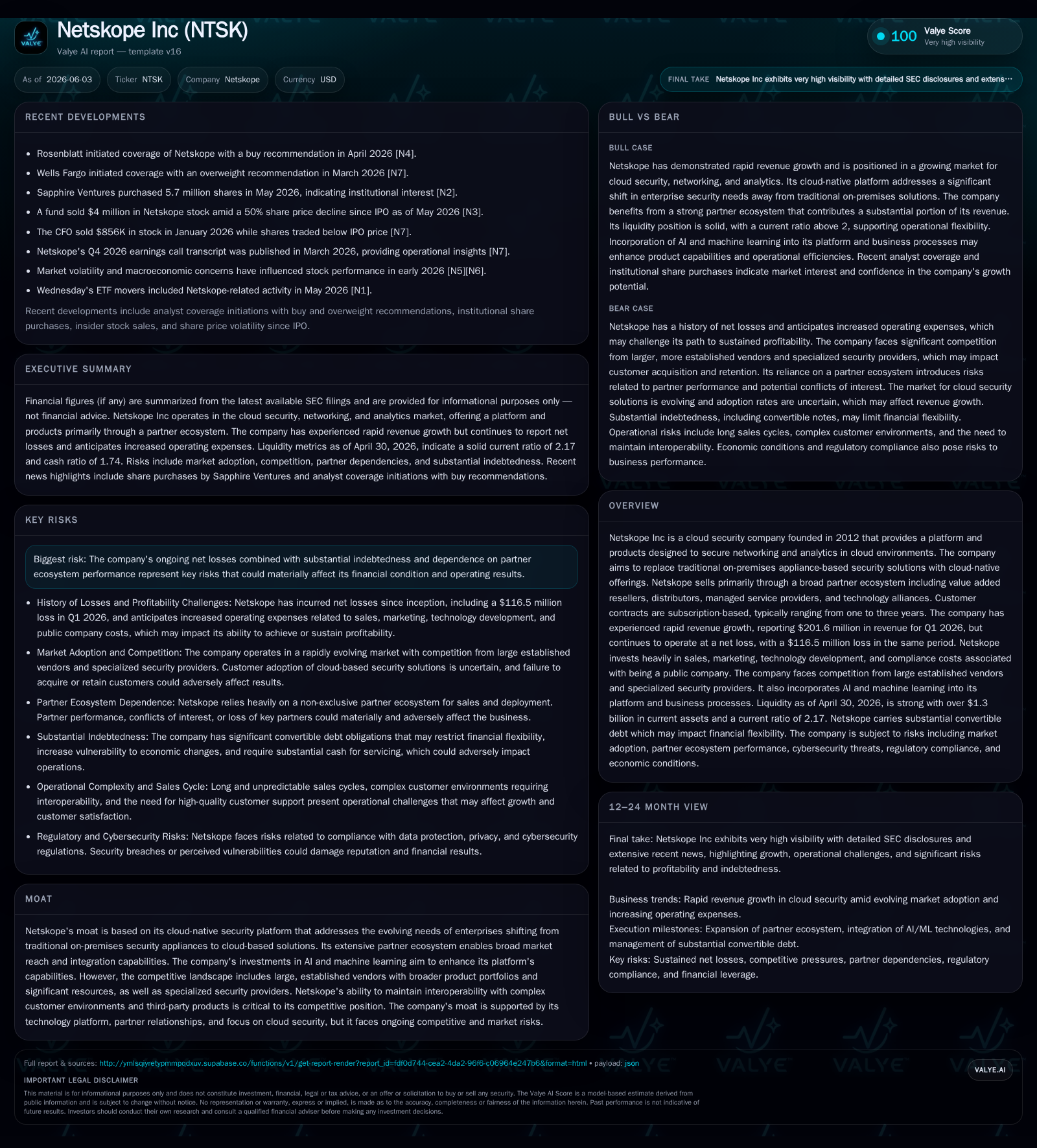
Netskope reported revenue of $201.6 million for Q1 fiscal 2027, fueled by expanding cloud-native security subscriptions sold largely through an extensive partner network. Despite this, the company posted a net loss of $116.5 million, highlighting ongoing profitability challenges driven by sizeable investments in sales, R&D, and compliance. The firm’s growth relies heavily on its platform’s differentiation in rapidly evolving enterprise cloud security needs, but long sales cycles, reliance on partner channels, and stiff competition from large incumbents constrain near-term margin improvement prospects.
Q1 Fiscal 2027 Operating Highlights Update
Netskope’s latest SEC filing for the quarter ended April 30, 2026, reveals continued momentum in subscription revenue, reporting $201.6 million for Q1 fiscal 2027 [S2]. This reflects sustained demand for its cloud-native security platform, which combines networking and analytics to support enterprise cloud adoption trends. Customer contracts remain subscription-based with typical durations of one to three years, facilitated primarily through an extensive partner ecosystem encompassing value-added resellers (VARs), managed service providers (MSPs), distributors, and technology alliances [S1].
Despite these top-line gains, Netskope posted a net loss of $116.5 million in the same period [S2]. Operating losses continue as the company invests heavily across multiple fronts: expanding its direct sales force to accelerate customer acquisition; intensifying marketing to bolster pipeline development; enhancing AI-driven platform capabilities; and shouldering public company compliance costs. The departure announcement of CFO Andrew Del Matto during the quarter suggests a potential shift in financial stewardship that may impact near-term cost management strategies [S6].
Persistent Losses Despite Revenue Growth: A Profitability Bottleneck
Netskope exemplifies a SaaS-scale growth model under pressure to balance rapid customer acquisition against mounting operating expenses. While recurring subscriptions drive predictable ARR growth momentum, the sales cycle remains long and unpredictable—lengthening customer onboarding and elevating overall cost per acquisition [S2]
Operating expenses reflect investment not only in go-to-market activities but also sophisticated regulatory compliance requirements such as FedRAMP authorizations needed to serve government entities, adding further cost layers [S24]. Additionally, significant research and development spend fuels continuous enhancements integrating AI/ML technologies within its platform’s security analytics module—essential for maintaining product relevance yet costly in the near term.
The accumulated deficit of approximately $2.7 billion underscores entrenched unprofitability despite impressive revenue scale [S23]. Margin expansion hinges on improving sales efficiency, contract renewals at higher net retention rates, and scaling partner-driven volume without proportional increases in marketing or support costs.
Cloud-Native Security Platform: Differentiation and Customer Value
Founded in 2012, Netskope built a cloud-native architecture designed to supplant traditional on-premises security appliances with scalable SaaS alternatives offering granular visibility into cloud traffic and data flows [S1]. Its unified platform integrates secure web gateway (SWG), cloud access security broker (CASB), zero trust network access (ZTNA), and data loss prevention (DLP) functionalities alongside rich analytics powered by machine learning algorithms.
This technology positioning aligns closely with enterprises transitioning workloads to public clouds where legacy appliance models struggle with distributed access points, encrypted traffic inspection, and hybrid multi-cloud environments [S1]. Netskope’s emphasis on AI enhances threat detection accuracy while reducing false positives, critical for end-user acceptance and operational efficiency.
However, customer adoption involves intricate integration challenges requiring seamless interoperability with existing endpoint security controls, identity providers, and third-party threat intelligence feeds. Building this ecosystem compatibility is both a technical differentiator and ongoing development commitment.
Partner Ecosystem as a Dual-Edged Sword: Reach vs Dependency
Netskope’s channel strategy extends market reach beyond direct sales by leveraging collaborations with VARs, distributors, MSPs, and technology partners that facilitate wider geographic penetration and sector vertical coverage [S1]. This model supports subscription renewals and upsell opportunities across multinational accounts.
Yet dependence on partner execution introduces variability in pipeline predictability, sales cycle velocity, and brand control [S2]. Any misalignment or underperformance within the channel could negatively impact new bookings or renewals. Effective partner enablement programs including certification paths, joint marketing initiatives, and incentive alignment remain pivotal for sustained growth.
Competitive Dynamics and Integration Challenges in Cloud Security
The broader cloud security industry features intense competition with large established players like Palo Alto Networks or Cisco offering holistic but legacy-rooted portfolios encompassing hardware appliances transitioning towards cloud services. Netskope competes by emphasizing cloud-native architectures optimized for modern enterprise networks but must continuously innovate to keep pace with feature breadth offered by incumbents [S1].
Moreover, competing niche vendors focused solely on specific product areas create fragmentation risks for buyers seeking integrated platforms. Netskope’s ability to maintain interoperability—and evolve APIs supporting multi-vendor orchestration—is critical to preventing customer churn amid complex IT environments.
Growth Drivers: ARR Expansion, AI/ML Integration, and Market Adoption
The primary engine behind Netskope’s growth is expanding Annual Recurring Revenue driven by new customer acquisitions plus expansion bookings within existing clients via seat increases or feature add-ons [S2]. Application of artificial intelligence enhances product stickiness by improving security efficacy while automating policy enforcement.
Market adoption accelerates as enterprises wrestle with increasing cyber risk vectors tied to remote workforces and hybrid clouds—conditions favoring advanced security analytics platforms over legacy tooling [S1]. Despite lengthy sales cycles typical of high-touch enterprise SaaS deals compounded by regulated verticals like finance or healthcare requiring tailored compliance features [S19], the company expects ongoing ARR progression.
Risks and Operational Watchpoints for Scaling Profitably
Despite promising demand signals, risks loom large. The company’s indebtedness includes convertible notes exceeding $533 million principal plus accrued interest—a liability that commands significant cash flow allocation potentially limiting operational flexibility [S11][S12]. Dependency on third-party partners raises execution risks; weak pipeline conversion or contract renewal performance could derail growth projections [S2]. Long sales cycles increase forecasting difficulty while geopolitical complications impacting international operations introduce currency exposure vulnerabilities [S22]. Regulatory developments such as the EU Artificial Intelligence Act impose new compliance burdens potentially increasing operational complexity or cost [S19].
Additionally, governance structure concentrated voting control through Class B shares may limit broader stockholder influence on strategic decisions including potential mergers or equity raises [S12].
Near-Term Milestones and What to Watch Next
Key upcoming focus areas include successful transition following CFO retirement announced concurrent with Q1 results—the ability of new financial leadership to manage costs effectively will be closely watched [S6]. Monitoring subscription renewal rates will provide signals on customer satisfaction amid competitive pressures.
Announcements regarding partnerships expansions or new product modules leveraging foundation model AI can serve as indicators of innovation pace sustaining longer-term differentiation—material given crowded market dynamics [S3]. Lastly, quarterly guidance updates reflecting changes in billing patterns or operating expense trajectories will shed light on management’s confidence regarding path toward profitability.
Financial Position and Liquidity Overview
At quarter-end April 30, 2026, Netskope held approximately $205.9 million in cash equivalents against current liabilities of about $632.3 million providing a current ratio of around 2.17—demonstrating solid short-term liquidity [F1]. The sizeable accumulated deficit of $2.7 billion evidences historic losses sustained while ramping operations [S23].
This report is based solely on publicly available filings up to June 3rd, 2026. It does not constitute investment advice or research views.
Disclaimer: This is research-only, informational analysis and not investment advice. It may include AI-generated interpretation and general industry context. Always verify important details using primary sources.

Comments