
Globant S.A. Revenue Plateau and Strategic Shifts in 2025
Globant's fiscal 2025 reflects subdued revenue growth amid operational restructuring and evolving industry demand patterns.
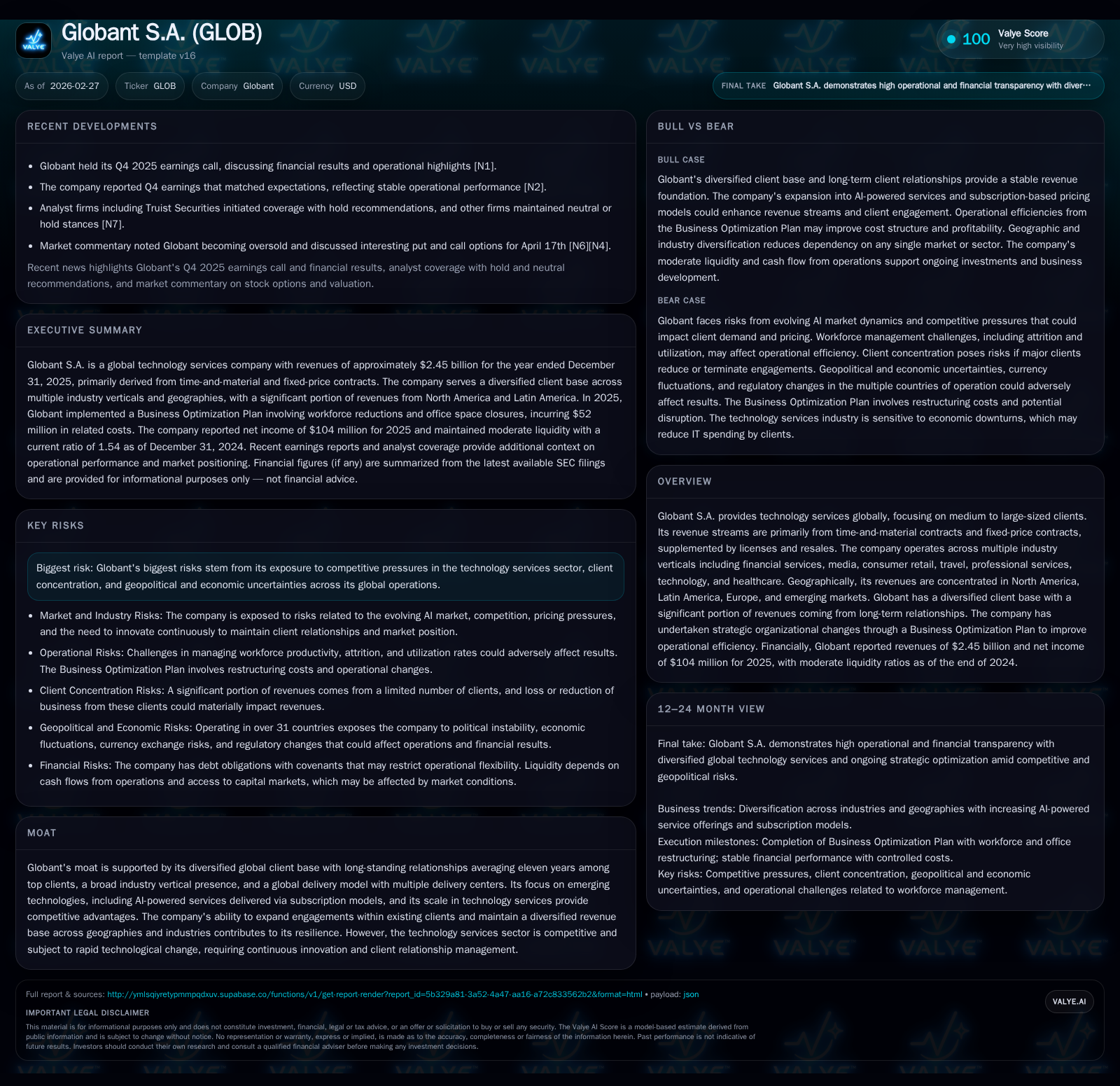
In 2025, Globant S.A. recorded a modest 1.6% revenue increase to $2.45 billion, signaling a plateau after prior sharper gains, while net income declined by 38.5% to $104 million due primarily to business optimization costs. The company shifted contract mix toward fixed-price engagements, expanded presence in financial services and travel sectors, and maintained longstanding client relationships averaging eleven years. Operational adjustments under the Business Optimization Plan weighed on margins but aim to sustain competitiveness amid intense sector rivalry and cyclical spending constraints.
Moderate Top-Line Growth and Shifting Revenue Mix in 2025
Globant’s top-line ascended only 1.6% year-over-year to $2.45 billion in fiscal 2025 [F1], a marked deceleration from the robust double-digit expansion seen between 2022 and 2023 that plateaued with a more moderate pace into 2024. This flattening trajectory highlights emerging macroeconomic pressures constraining client technology spend.
Historical performance (annual)
| FY | Rev ($bn) | Net ($mm) | Rev YoY | Net YoY |
|---|---|---|---|---|
| 2025 | 2.5 | 104 | +1.6% | -38.5% |
| 2024 | 2.4 | 169 | +15.3% | +6.6% |
| 2023 | 2.1 | 159 | +17.7% | +6.0% |
| 2022 | 1.8 | 149 |
Source: SEC companyfacts cache [F1].
Capital returns and efficiency (annual)
| FY | ROE% |
|---|---|
| 2025 | 4.8 |
| 2024 | 8.3 |
| 2023 | 8.9 |
| 2022 | 9.6 |
Source: SEC companyfacts cache [F1].
The company’s contract mix evolved noticeably: time-and-material contracts receded to approximately two-thirds (66.7%) of revenues from a peak near 79% in 2023 while fixed-price contracts rose to represent a significant 28% share in 2025 from just over 18% two years earlier [S3][S5]. This pivot aligns with a broader industry trend where clients seek greater budget predictability via fixed-price engagements despite their inherent margin risk for service providers. Licenses, resales, and ancillary offerings increased modestly to just over 5%, hinting at incremental diversification beyond core services.
The shift toward fixed-price contracts signals pricing discipline requires careful management of project scope and utilization metrics—common levers in professional services—to safeguard gross profitability amidst stiffening competitive pressures.
Industry Verticals and Geography: Evolving Demand Patterns
Globant’s revenue composition by vertical reveals pronounced shifts influenced by sectoral spending dynamics [S6]. The Banks, Financial Services and Insurance (BFSI) segment topped contributions at over $502 million (20.5%), buoyed by accelerated adoption of digital banking infrastructure initiatives across global financial institutions seeking agile technology partnerships.
Conversely, the Media and Entertainment vertical retreated by roughly 7% year-on-year due to recalibrations following intense prior expansion phases. Consumer, Retail & Manufacturing held steady near an $461 million contribution (18.8%), supplying stable demand grounded in incremental digital transformation projects.
Momentum accelerated significantly within Travel & Hospitality at $315 million (12.8%), reflecting recovery resurgence supported by normalization of corporate travel.
Geographically, North America accounted for majority revenues at approximately $1.33 billion or 54.3%, marginally down from prior years but still dominant [S6]. Latin America remains substantial (~20%), whereas Europe’s share rose notably to above 19%, fueled by expanding engagements within EU markets. Emerging 'New Markets' grew to represent about 6.5%, indicating strategic penetration beyond traditional geographies.
Business Optimization Plan: Operational Efficiency vs. Headwinds
In April 2025, Globant launched its Business Optimization Plan aiming for structural transformation focused on workforce resizing and office footprint consolidation [S1][S20]. These restructuring actions incurred one-time costs near $52 million during the year under review.
While these charges eroded reported operating profits—profit from operations declined from $225 million in 2024 to $172 million in 2025—the plan’s intent targets improved operational leverage going forward by rationalizing resource deployment amid slowing top-line dynamics.
Such "business optimization costs" reflect domain-standard tactical recalibrations designed to preserve unit economics under intensifying commercial constraints prevalent across global IT services players.
Client Concentration and Longevity: Resilience Amid Competition
Globant sustains a concentrated yet resilient client base with its largest customer consistently contributing about 8.7% of total revenues ($212 million in 2025) [S3][F1]. The top five clients account for just over one-fifth of sales (20.1%), while the top ten contribute nearly 30% — stable proportions indicating controlled client concentration risk.
Critically, average tenure of its top ten customers stands at eleven years signaling durable partnerships underpinned by frequent upsell opportunities within existing accounts [S3]. High client utilization rates coupled with expanded scope engagements confirm trusted advisory status though also underscore exposure if large clients alter discretionary IT budgets or strategic priorities.
Existing clients comprised an overwhelming majority (96%) of revenues in 2025, showcasing strong retention but necessitating vigilant diversification to mitigate client dependency vulnerabilities.
Profitability Compression: From IFRS to Adjusted Margins
The headline net income contracted sharply by -38.5% YoY to approximately $104 million on IFRS basis due largely to nonrecurring charges associated with the business optimization alongside share-based compensation and acquisition-related expenses [F1][S1]. Adjusted net income that excludes these items remained relatively stable near $276 million indicating underlying operational profitability resilience when isolating strategic investments.
Gross profit margins compressed slightly from around 35.7% in prior years down to roughly 35.0%, reflecting wage inflation from multi-currency salary adjustments offset partially by headcount reductions due to optimization efforts [S1][S21]. Notably, SG&A expenses are burdened by amortization of acquired intangibles and equity-settled incentive plans further pressuring reported operating margins currently around a diminished mid-single digit range.
Capital Expenditure and R&D Investment Trends
Total capital expenditures decreased substantially from $119 million in fiscal year 2024 down to about $83 million in 2025 [F1][S4]. This reduction reflects tempered acquisition activity as well as measured internal investments mostly dedicated toward expanding technology platforms and augmenting delivery center capabilities.
Approximately $65 million was devoted to internal developments including software licenses highlighting ongoing emphasis on organic innovation rather than inorganic growth through M&A amid cautious cash deployment strategy.
Capital Allocation Priorities: Dividends, Buybacks, and Cash Flow
Cash and equivalents totaled about $244 million at year-end with current assets exceeding current liabilities comfortably (current ratio ~1.64), underscoring solid liquidity buffers [F1][S7].
In September 2025 the board approved a share repurchase program targeting up to $125 million total spending through late 2026; around $100 million was utilized buying back approximately 1.56 million shares through Q4 last year [S10][S17].
The company has no present intention or history of dividend distributions citing Luxembourg regulatory constraints on payouts combined with preference for reinvestment into growth initiatives.
Return on equity contracted below five percent (4.8%) consistent with net income decline relative to expanding equity base [F1], highlighting pressure on capital returns amid strategic repositioning phase.
Risks From Market Pressures and Geopolitical Exposure
Globant faces multifaceted risks characteristic of technology services firms operating globally [S9][S11][S15]. Competitive intensity stems from large consulting firms, digital agencies, traditional outsourcers plus emergent AI-enabled startups placing continuous innovation demands.
Client attrition risk is exacerbated due to short-term nature of many service contracts without guaranteed renewals limiting revenue visibility despite long average relationships.
Geopolitical volatility—including tariffs, economic sanctions, currency fluctuations—and ever-evolving regulatory frameworks such as GDPR-compliant data protections impose cost burdens while complicating delivery models spanning over thirty countries worldwide.
Labor market challenges particularly around utilization rates, retention post-optimization plan execution plus union negotiations add another layer of operational uncertainty.
AI market evolution poses dual-edged uncertainty: rapidly changing customer preferences could render current AI offerings obsolete even as new products require timely development and deployment involving substantial upfront investment.
Compliance failures related to privacy breaches or ESG mandates carry material reputational damage risks alongside financial penalties potentially impacting investor confidence.
This analysis synthesizes publicly available information compiled primarily from Globant S.A.'s most recent SEC filings including the FY2025 Form 20-F as well as earnings releases [F1], [S#], supplemented by recent earnings call transcripts [N1], without making investment recommendations or forecasts beyond reported facts or explicit company guidance.
Disclaimer: This is research-only, informational analysis and not investment advice. It may include AI-generated interpretation and general industry context. Always verify important details using primary sources.

Comments