
Greenlane Holdings' Dual Strategy: Legacy Operations and Digital Asset Innovation
Greenlane Holdings balances its foundational token acquisition business with an advanced digital asset treasury strategy under stringent governance.
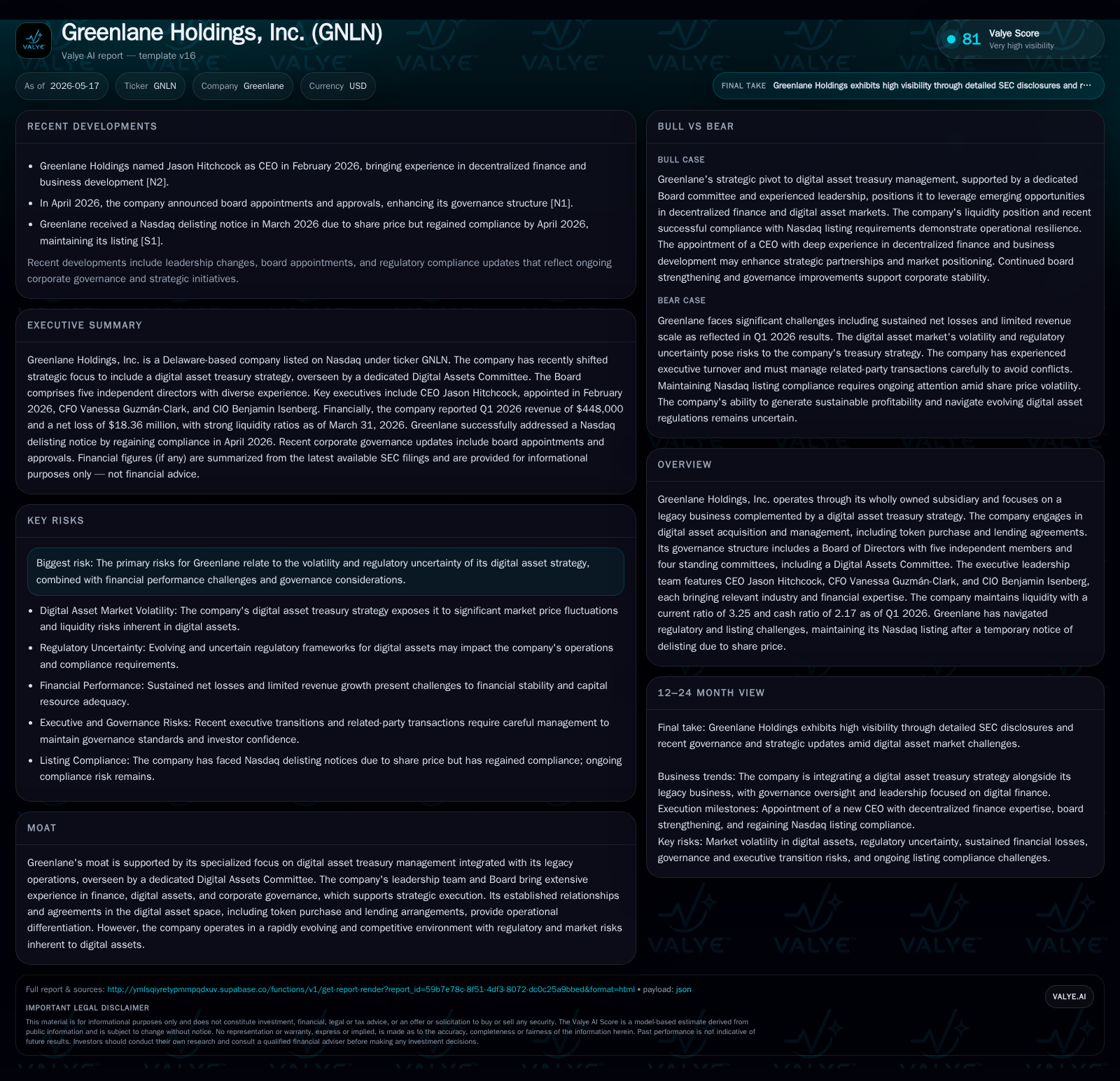
In Q1 2026, Greenlane Holdings maintained solid liquidity levels with a current ratio of 3.25 amid operational headwinds and regulatory scrutiny following a reverse stock split and Nasdaq compliance recovery. The company’s business model integrates legacy token purchase and lending agreements alongside an evolving digital treasury focused on Berachain’s BERA tokens, deploying substantial resources into staking and arbitrage activities. Specialized governance, including a Digital Assets Committee and an experienced leadership team, underpins the strategy execution inside a volatile digital asset market marked by regulatory uncertainty. Key near-term drivers include the expansion of lending volumes and digital asset deployment milestones, while risks stem from token price volatility, regulatory challenges, and legacy operational costs.
Q1 2026 Operating Highlights and Strategic Implications
Greenlane Holdings reported its financial results for Q1 2026 in its May 15 filing [S2], supplemented by the contemporaneous press release [S3]. Despite a challenging environment for legacy operations, the company preserved robust liquidity with a current ratio of 3.25 as of March 31, 2026 [F1]. This was supported by cash & equivalents totaling approximately $13.3 million against current liabilities of $6.1 million [F1], reflecting effective working capital management amid ongoing operating losses evidenced in prior annual data [F1]. The Q1 period followed a decisive corporate action—a 1-for-8 reverse stock split implemented to regain compliance with Nasdaq’s minimum bid price requirement after a notice of delisting and a subsequent hearing cancellation following compliance confirmation in late April [S11].
Significantly, Greenlane also entered into lock-up agreements on strategic warrants issued in October 2025 PIPE financing totaling about 162,760 common shares which remain restricted until April 2027 [S8]. These lock-ups underscore management’s commitment to long-term value creation during a sensitive phase marked by both regulatory scrutiny and market volatility.
The convergence of solid liquidity preservation post-reverse split alongside continued investment in digital asset strategies positions Greenlane at an inflection point—requiring measured execution to balance corporate governance expectations with operational scaling of novel treasury activities.
Business Model Overview: Legacy Core Combined with Digital Asset Management
Greenlane operates predominantly via its wholly owned subsidiary focusing on two intertwined but distinct revenue streams: legacy token purchase/lending agreements and a burgeoning digital asset treasury initiative centered on Berachain’s native token (BERA) [S1], [F1]. The legacy business involves acquiring tokens under contractual arrangements and extending loans secured by these assets or other digital collateral.
The shift towards digital asset treasury sophistication entails deploying the acquired BERA tokens into validator infrastructure (staking), participating in arbitrage trading activities, managing lending portfolios, and engaging protocol governance rights within the Berachain ecosystem [S25], [S29]. As of early April 2026, Greenlane had amassed approximately 77.9 million units of BERA tokens with around 50 million units deployed into staking via Berachain validator nodes [S25]. This indicates both scale and operational complexity beyond mere passive holding.
Revenue generation flows principally from lending fees on tokens loaned out to counterparties, staking yields derived from network participation rewards, arbitrage profits captured across decentralized exchanges or liquidity pools, and transactional gains or losses related to treasury management activities [S1]. Margins are influenced by token price volatility impacting valuation adjustments recorded at fair value as governed by mark-to-market accounting standards overseen by internal finance controls.
The business model necessitates disciplined management of counterparty credit risk since transactions include third-party executed purchases of BERA tokens through market participants unaffiliated with Greenlane [S25]. The firm’s exposure to these external execution dynamics introduces economic risk independent of internal treasury decisions.
Competitive Positioning within Digital Asset and Ancillary Markets
Greenlane holds a distinctive position blending traditional token acquisition mechanisms with innovative involvement in blockchain network infrastructure. Its competitive moat is partially carved out through strategic governance via a dedicated Digital Assets Committee established at board level to oversee all aspects of digital assets strategy—from yield-bearing activities to protocol participation rights [S29]. This committee’s role is critical given the fast-evolving regulatory backdrop globally concerning cryptocurrency custody laws, lending frameworks, and securities classification.
The senior executive team — including CEO Jason Hitchcock, CFO Vanessa Guzmán-Clark, and CIO Benjamin Isenberg — bring expertise spanning financial management alongside blockchain technical knowledge that support navigating this dynamic landscape effectively [N1], [S1]. Their stewardship helps differentiate Greenlane from pure-play crypto funds or custodians which may lack integrated legacy business operations or robust public reporting governance structures.
Pricing power in lending fees or staking returns tends to be competitive amid numerous market participants but is modestly buffered by specialized niche positioning within the Berachain ecosystem coupled with institutional-caliber governance procedures supporting regulatory compliance efforts.
However, this hybrid approach faces pressures typical of early-stage blockchain ventures including sudden market swings in token valuations (particularly BERA), emergent protocol changes influencing tokenomics, plus heightened scrutiny from U.S. regulators that shape clearance hurdles for certain treasury actions.
Growth Catalysts Centered on Digital Asset Activity and Governance Initiatives
Near-term growth prospects are tightly linked to successful expansion of Greenlane’s digital asset portfolio deployment — particularly increasing volumes loaned under token lending agreements and extended utilization of staked BERA tokens in validator infrastructure which earn network rewards [S5], [S25]. Incremental growth in token lending scales can boost recurring fee income while maximizing staked holdings leverages available assets toward yield enhancement.
Additional growth levers feature advance adoption of DeFi protocols related to Berachain that permit arbitrage trading gains or other liquidity provision incentives within decentralized exchanges accessible through the platform’s permissionless architecture. The company’s governance framework continuously evaluates partnerships or structural changes within Berachain that could affect strategic program viability or spur new revenue streams [S29].
Strategic consistency is further instilled by insider shareholder lock-ups expiring only after April 23, 2027 — implying sustained managerial alignment over at least the medium term to realize value creation from ongoing investments made during fiscal 2025–26 capital raises [S8].
Risks Associated with Market Volatility, Regulatory Dynamics, and Execution
Greenlane confronts multifaceted risks principally emerging from its digital asset exposure. The valuation of BERA tokens exhibits extreme price volatility due to relatively low market capitalization compared to major cryptocurrencies alongside novelty risks inherent in layer-1 blockchain adoption cycles [S4], [S5]. Such price swings directly impact mark-to-market accounting valuations affecting reported earnings volatility.
Regulatory uncertainties pose significant hazards as evolving legislative frameworks affect custody models for crypto assets especially those involving lending transactions where securities law interpretations remain unsettled in U.S. jurisdictions. Compliance burdens may increase costs or restrict certain treasury activities thus compressing margin potential.
Execution risk arises not only from volatile markets but also from managing legacy operating costs that currently contribute to net losses totaling -$85.58M for fiscal year ended December 31, 2025 (latest full year available) [F1]. Balancing new growth frontiers while controlling overhead requires astute cost management.
Additionally, concentrated insider ownership combined with lock-ups restricts near-term free float potentially reducing secondary market liquidity; this could cause share price sensitivity around warrant expiry seasons or news linked to digital asset performance metrics.
Key Upcoming Events and Milestones to Monitor
Critical forthcoming events include expiration of insider warrant lock-ups scheduled for April 23, 2027 — a timeline marker closely watched as it may signal shifts in insider share disposition patterns impacting market supply dynamics [S8].
Further milestones involve monitoring updates from Berachain network developments: protocol upgrades affecting validator returns or new staking programs issuing additional yield-bearing opportunities will be important demand markers for Greenlane’s deployed holdings volume expansion.
Quarterly financial results remain key execution indicators reflecting whether operational improvements materialize. Any adjustments in corporate capital allocation such as continuation or suspension of share repurchase programs authorized for up to $2 million further influence investor sentiment [S13].
Latest Financial Snapshot
Latest financial snapshot
| Metric | Value | Period |
|---|---|---|
| Cash & equivalents | $13mm | |
| 2026-03-31 | ||
| Current assets | $20mm | |
| 2026-03-31 | ||
| Current liabilities | $6mm | |
| 2026-03-31 | ||
| Current ratio | 3.25x | |
| 2026-03-31 |
Source: SEC companyfacts cache [F1].
Below is a compact snapshot summarizing Greenlane Holdings’ critical financial metrics as of the latest quarter ending March 31, 2026:
Debt date is older estimate; no newer confirmed figure in latest quarterly filings.
This snapshot underscores robust short-term liquidity juxtaposed against moderate total debt levels resulting in a negative net debt position (cash exceeds debt), providing flexibility to withstand interim operational deficits inherent during transition phases toward comprehensive digital asset platform growth.
Disclaimer: This analysis is for informational purposes only and does not constitute investment advice or recommendations.
Disclaimer: This is research-only, informational analysis and not investment advice. It may include AI-generated interpretation and general industry context. Always verify important details using primary sources.

Comments