
Green Brick Partners Executes Land-Focused Strategy with Mixed 2025 Financials
Green Brick maintains disciplined land acquisition in key Sunbelt markets while facing margin pressures reflected in its 2025 results.
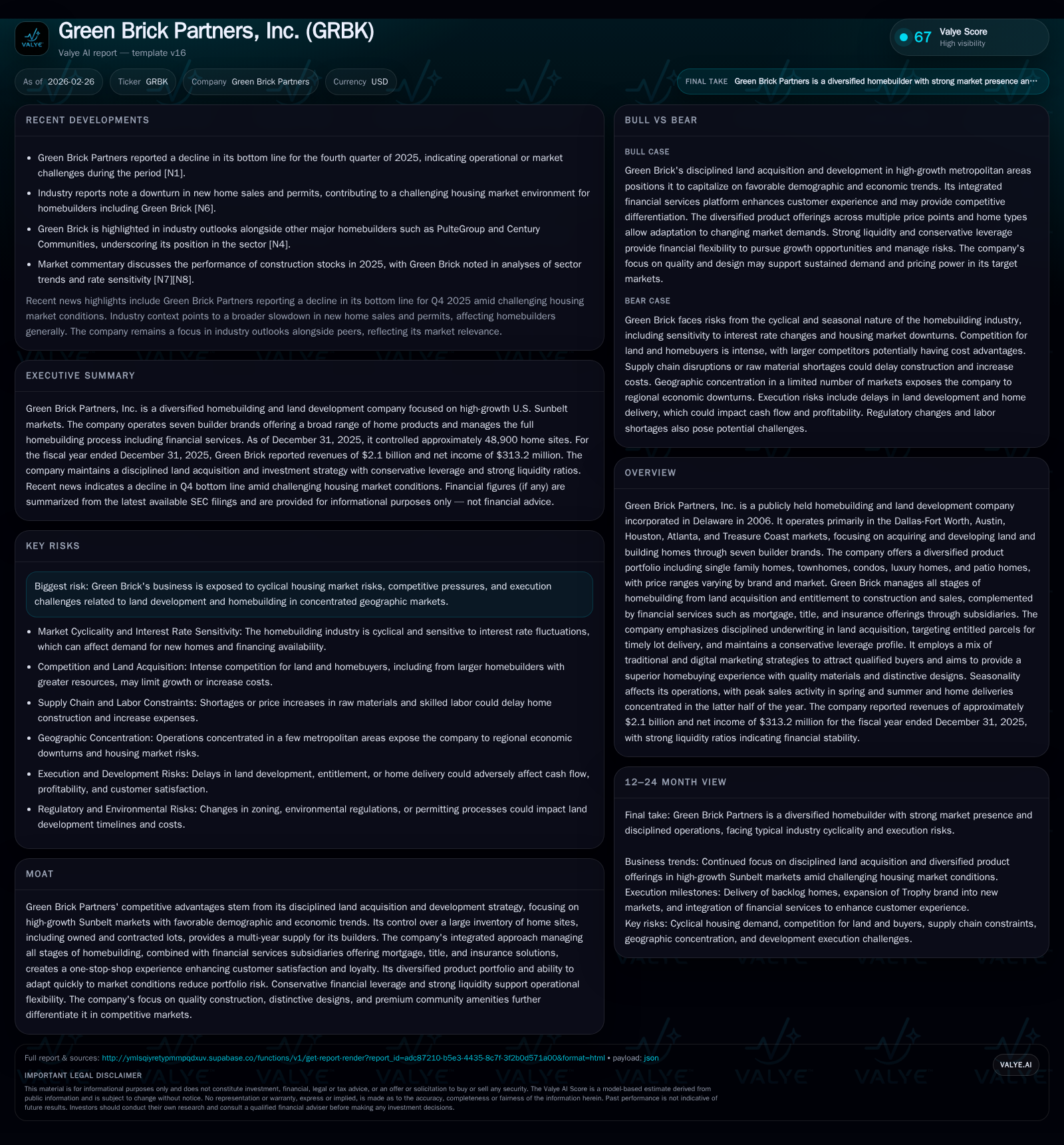
Green Brick Partners, Inc. leverages a strategic focus on acquiring and controlling a large lot inventory across fast-growing Sunbelt regions, underpinning its diversified homebuilding brands and integrated financial services. Despite stable revenue in 2025, the company experienced an 18% decline in net income amid softened margins and cancellation headwinds. Conservative capital structure management with active share repurchases and dividends reflects a careful allocation approach. Key metrics such as lot sales velocity and market absorption will be critical to monitor given sensitivity to economic cycles and localized market risks.
Strategic Foundations: Land Acquisition and Market Focus
Green Brick Partners has established a competitive moat rooted in its disciplined approach to land acquisition focused on high-growth Sunbelt metropolitan areas including Dallas-Fort Worth (DFW), Austin, Houston, Atlanta, and the Treasure Coast in Florida [S1][S8][S11][S14]. The company manages a substantial lot inventory—approximately 48,900 home sites owned or under contract—which is critical for maintaining a multi-year supply for its seven builder brands. Refining their disclosure metric from "lots controlled" to "lots under contract" aligns their reporting with industry peers, encompassing lots held through executed option contracts or purchase agreements subject to zoning or environmental contingencies [S1][S25][S27]. This nuanced control over entitled land projects allows Green Brick to calibrate risk effectively and optimize timing of lot deliveries to subsidiaries.
Product diversity spans single-family homes, townhomes, condos, luxury residences, and patio homes with pricing tailored by brand and regional demand [S14]. This breadth across product tiers provides flexibility against localized market volatility.
Review of 2025 Financial Performance and Historical Trends
In fiscal year 2025, Green Brick reported revenue essentially unchanged from 2024 at roughly $2.1 billion (YoY: ~0%) amidst a challenging macro backdrop [F1]. Net income declined about 17.9% to $313 million in 2025 from $382 million the prior year [F1]. Meanwhile, operating cash flow sharply increased by approximately 723% to $213 million driven by working capital management or operational efficiency improvements despite consistent capital expenditure levels ($4.8 million in 2025 vs. $4.4 million prior year) [F1].
The following table summarizes key annual financials with relevant YoY changes:
Historical performance (annual)
| FY | Rev ($bn) | Net ($mm) | CFO ($mm) | Capex ($mm) | Rev YoY | Net YoY |
|---|---|---|---|---|---|---|
| 2025 | 2.1 | 313 | 213 | 5 | -0.0% | -17.9% |
| 2024 | 2.1 | 382 | 26 | 4 | +18.1% | +34.1% |
| 2023 | 1.8 | 285 | 213 | 8 | +1.1% | -2.5% |
| 2022 | 1.8 | 292 | 91 | 2 |
Source: SEC companyfacts cache [F1].
Capital returns and efficiency (annual)
| FY | Div ($mm) | Buybacks ($mm) | FCF ($mm) |
|---|---|---|---|
| 2025 | 3 | 84 | 208 |
| 2024 | 3 | 48 | 22 |
| 2023 | 3 | 46 | 206 |
| 2022 | 3 | 101 | 89 |
Source: SEC companyfacts cache [F1].
The divergence between operating cash flow strength and net income contraction points toward margin pressures likely linked to cancellation rates and repricing challenges discussed below.
Land Inventory Expansion Fueling Builder Operations
Controlling nearly 49,000 residential lots positions Green Brick advantageously against supply-side volatility in homebuilding [S1][S8][S11][S25]. Approximately three-quarters of these lots are owned outright rather than optioned contracts [S25], underscoring significant capitalization deployed into lot inventory. Many parcels are fully entitled or undergoing entitlement—an administrative process granting zoning approval necessary before construction can commence—which expedites lot delivery once demand manifests [S20][S21].
This scale supports subsidiary builders' volume targets across product lines ranging from affordable Trophy Signature single-family homes to luxury offerings by Normandy Homes or Southgate brands [S14][S15]. The extended project durations—from initial development through final delivery—may span multiple years but allow for calibrated rollouts aligned with market conditions.
Integrated Financial Services as Differentiator
Green Brick’s vertical integration includes wholly-owned GRBK Mortgage alongside Green Brick Title and Insurance subsidiaries introduced recently [S6][S8]. This comprehensive one-stop shop arrangement streamlines buyer financing options, title processing, plus home/auto insurance offerings within its ecosystem—enhancing convenience and improving buyer satisfaction metrics.[S6] By capturing mortgage origination mix internally, Green Brick can partially insulate margins against housing sales volatility while fostering customer loyalty through coordinated service touchpoints.
Current Challenges: Margin Compression and Economic Headwinds
Despite operational strengths, Green Brick faces material headwinds from macroeconomic factors typical for the cyclical housing sector [S1][N2]. Elevated interest rates weigh on mortgage affordability directly reducing purchase demand; meanwhile local market saturation increases competition among new builds as well as resale homes diluting pricing power.
The company's own disclosures highlight risks from higher cancellation rates which compress margins as resources allocated toward unsold inventory or re-marketing incur costs without revenue realization [S1][N2]. The Q4 earnings report confirmed bottom-line deterioration notwithstanding stable top-line figures indicative of this dynamic [N2]. Delays in entitlement or labor/raw material shortages compound cost pressures within projects routinely requiring multi-phase development timelines.[S16]
Capital Structure Discipline and Allocation Decisions
Green Brick pursues conservative leverage management reflecting its philosophy to preserve flexibility amid cyclical uncertainty [F1][S4][S5][S22]. As of December 31, 2025, total debt represented approximately 14.7% of capitalization—a conservative footprint relative to sector norms given the capital-intensive nature of land development [S14][F1]. Loan covenants impose limitations on incremental debt incurrences plus restrictions on asset sales or cash distributions earmarked for dividends/share repurchases which must be navigated prudently [S4][S5].
Capital returns remain active albeit modest relative to net income size: dividends around $2.9 million annually maintain consistency without aggressive payout expansion; share repurchase activity accelerated with $83.77 million spent in FY2025 versus $48.4 million prior year reinforcing commitment to returning excess capital when feasible [F1][S22]. Return on equity stands near an attractive ~16.8%, driven partly by leverage discipline coupled with operational profitability metrics [F1].
Forecast Considerations and Monitoring Key Metrics
While explicit forward-looking guidance is absent from recent filings or press releases [N2], important indicators for forecasting will include lot sales absorption rates within core markets alongside shifts in mortgage rate environments that materially influence buyer demand sensitivity (i.e., cancellation trends). Further scrutiny should be given to construction cost inflation dynamics given their impact on margin preservation.
Liquidity positioning must be monitored due to bank credit facility maturities and covenant compliance constraints noted; any capital access disruptions could curtail growth initiatives particularly land acquisitions critical for sustaining pipeline capacity [S4][S5].
Risk Factors Centered on Market Cyclicality and Geographic Concentration
Green Brick explicitly enumerates multiple risk vectors primarily associated with the inherent cyclicality of the residential real estate sector including economic downturn effects leading to reduced employment levels or consumer confidence that depress purchases and escalate cancellations [S1][S10]. Geographic concentration risk is notable since operations overwhelmingly focus on five Sunbelt metro areas—their economic health disproportionally impacts financial results versus more geographically diverse peers [S11][S19][S29]. Regulatory shifts increasing compliance costs or environmental stipulations may add further complexity particularly around entitlement delays or bonding requirements essential for project completion.[S16][S17]
Competition from larger homebuilders with deeper resources remains an underlying challenge given supply chain leverage advantages they might exert impacting pricing of raw materials like lumber.
Conclusion
Green Brick Partners demonstrates strategic rigor via extensive lot inventory control combined with integrated homebuilding brands spanning broad price segments reflective of evolving buyer preferences across fast-growth Southern U.S regions. This land-focused model supports volume stability even amid turbulent macroeconomic conditions affecting demand elasticity evident in recent margin softness and net income declines.
Prudent capital allocation prioritizing manageable leverage levels together with meaningful share repurchases communicates confidence yet acknowledges operating headwinds remain material given cyclicality intrinsic to homebuilding markets concentrated regionally.
Tracking operational KPIs such as lot absorption velocity alongside mortgage rate trends will be essential for assessing trajectory while mindful of potential shocks from regulatory changes or input cost volatility uniquely impacting landed real estate development.
Disclaimer: This analysis is based solely on information publicly available through SEC filings and news sources cited herein as of February 26, 2026. It does not constitute investment advice but aims to provide an informed perspective on company fundamentals and industry context.
Disclaimer: This is research-only, informational analysis and not investment advice. It may include AI-generated interpretation and general industry context. Always verify important details using primary sources.

Comments